Why 316 / CF8M Eventually Reaches Its Limits
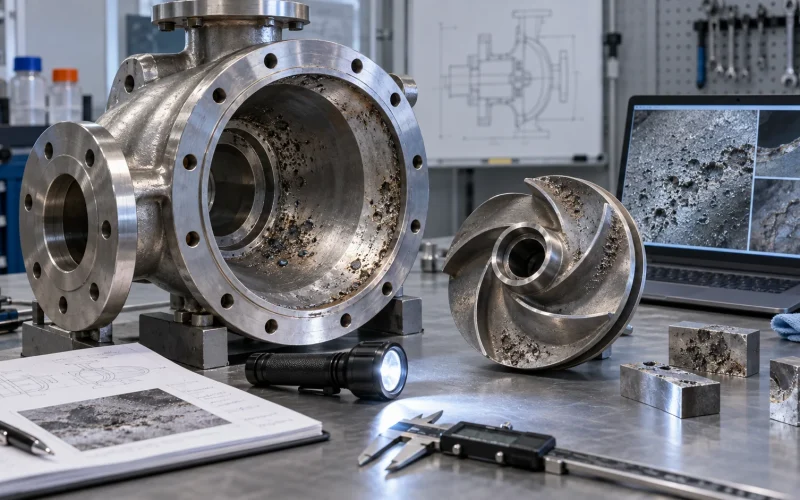
316 stainless steel and its common cast pump family are widely used because they combine corrosion resistance, availability and practical fabrication. But their performance is not a fixed property of the alloy name. Chlorides, temperature, reducing chemistry, deposits, crevices, solids, oxygen level and local pump hydraulics can all change the corrosion mechanism.
When a 316/CF8M wet end fails early, the first question should not be “Which exotic alloy is strongest?” The first question should be what failed, where it failed and which mechanism best explains the damage.
Engineering rule
Do not upgrade metallurgy until the failure mechanism is classified. A material change will not correct cavitation, an unstable operating point, a plugged suction condition or a piping problem.
Diagnose the Failure Mechanism Before Changing Alloy
316SS Pump Failure Diagnostic
Use visible damage and operating history to decide what evidence to collect before screening another material family.
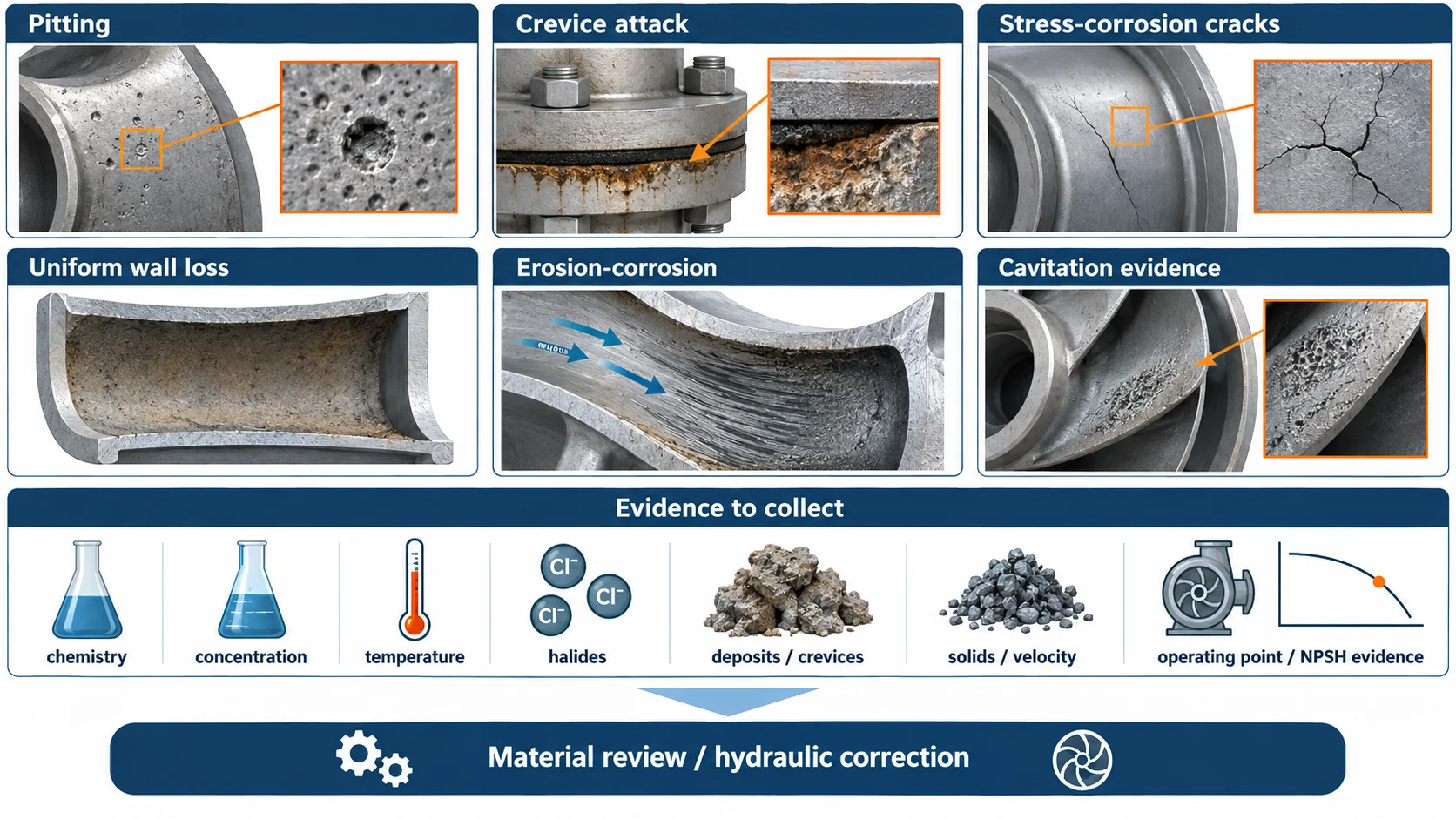
| Observed damage | Possible mechanism | First evidence to collect |
|---|---|---|
| Deep isolated pits | Pitting corrosion | Chlorides/halides, temperature, deposits, pH, oxidizing species |
| Attack under gasket, deposit or tight joint | Crevice corrosion | Crevice geometry, deposits, stagnant zones, local chemistry |
| Fine branching cracks | Stress-corrosion cracking | Temperature, halides, tensile/residual stress, service time |
| Broad, relatively even wall loss | General corrosion / depassivation | Exact chemistry, concentration, temperature, redox condition |
| Directional thinning in high-velocity zones | Erosion-corrosion | Velocity, solids, recirculation, local flow path |
| Honeycomb / impact-like attack near eye or vane region | Possible cavitation | NPSH, suction condition, operating point, noise/vibration history |
Chlorides: Why There Is No Single Safe ppm Limit for 316SS
Higher chloride concentration and higher temperature generally increase the risk of pitting, crevice corrosion and chloride stress-corrosion cracking in 316/CF8M. But one chloride-ppm number cannot qualify every pump service.
Use the chemical compatibility and resistance guide for exact-condition screening. Any final pump-material decision should remain tied to the actual chemistry, concentration and temperature.
PREN: Useful Screening Tool—Not a Pump-Life Predictor
Pitting Resistance Equivalent Number (PREN) is useful for rough comparison of stainless-steel families. It is not a corrosion-rate equation and it should not be used as a universal ranking system across stainless steel, nickel alloys and titanium.
Cr, Mo and N are the alloy’s chromium, molybdenum and nitrogen contents in weight percent.
Where chloride resistance is driving the review, a duplex material such as CD4MCuN may enter the shortlist. The separate CD4MCuN pump material guide covers the casting-family details and service variables that still need to be verified.
Which Material Family Should You Investigate Next?
The purpose of this matrix is not to rank materials from “good” to “best.” It identifies what kind of failure environment may justify investigating a different material family—and what evidence is still missing before selection.
| Material family | Why it may enter the shortlist | What still has to be verified |
|---|---|---|
| 316 / CF8M family | General corrosion-resistant baseline for many clean or moderately aggressive services | Actual chemistry, halides, temperature, crevices, deposits and SCC risk |
| CD4MCuN duplex | Selected chloride-bearing, abrasive or higher-strength duties | Exact cast grade, heat treatment, pH, solids, local velocity and process chemistry |
| Alloy 20 / CN7M family | Selected sulfuric-acid and acid-blend duties | Concentration, temperature, contaminants and exact wrought/cast product form |
| C-type nickel alloy | Severe mixed, reducing or chloride-bearing chemistry where lower-alloy materials are insufficient | Exact alloy/cast grade, process redox condition, contaminants and project specification |
| Titanium Grade 2 family | Many oxidizing chloride, seawater and wet-chlorine duties | Crevice conditions, pH/temperature, product form and dry-chlorine risk |
Wrought Alloy Names vs. Pump Casting Grades
One of the fastest ways to create a material dispute is to put a commercial or wrought alloy name on an RFQ and assume the pump casting is automatically the same grade. The purchasing specification should identify the exact component material and product form.
| Material family | Wrought reference | Pump-casting discussion |
|---|---|---|
| 316 family | UNS S31600 / S31603 | CF8M / CF3M family; exact ASTM purchase specification must be stated |
| CD4MCuN | Not a simple wrought trade-name substitute | ASTM A890 / A995 Grade 1B, UNS J93372, where applicable to the component/project specification |
| Alloy 20 | UNS N08020 | CN7M / UNS N08007 family; do not call wrought N08020 and cast CN7M identical specifications |
| C-276 | UNS N10276 | Specify the exact ASTM A494 C-type casting grade required; do not automatically convert C-276 to CW2M |
| Titanium Grade 2 | UNS R50400 | Confirm the exact casting/product specification separately for the actual component |
Do not treat wrought C-276 and cast CW2M as the same specification
Wrought C-276 is UNS N10276. Cast C-type alloy grades must be called out by their own ASTM/UNS designation. The cast grade should be selected from the actual project and component requirement—not inferred from the wrought trade name.
Why Acid Concentration and Temperature Must Stay Together
Acid-service material statements are meaningful only when concentration and temperature stay attached to the claim. Impurities, aeration, heat transfer, velocity and other process variables can further change the result.
For sulfuric-acid service, use the dedicated sulfuric acid pump material selection guide instead of applying one broad “safe concentration” range. For a direct comparison of higher-alloy candidates, see the Alloy 20 vs Hastelloy C-276 material selection guide.
Impeller-specific acid/caustic considerations are covered separately in the sulfuric acid and caustic impeller materials guide.
Corrosion, Erosion-Corrosion or Cavitation? The Alloy May Not Be the Root Cause
| Mechanism | Typical evidence | Wrong response |
|---|---|---|
| Chemical corrosion | Pits, crevice attack, general wall loss, chemistry-linked pattern | Changing impeller trim or speed without addressing material/environment compatibility |
| Erosion-corrosion | Directional attack, high-velocity zones, solids or recirculation | Assuming chemistry alone explains the loss |
| Cavitation | Eye/vane attack plus suction/operating symptoms, noise or vibration | Upgrading to a more expensive alloy without correcting the hydraulic cause |
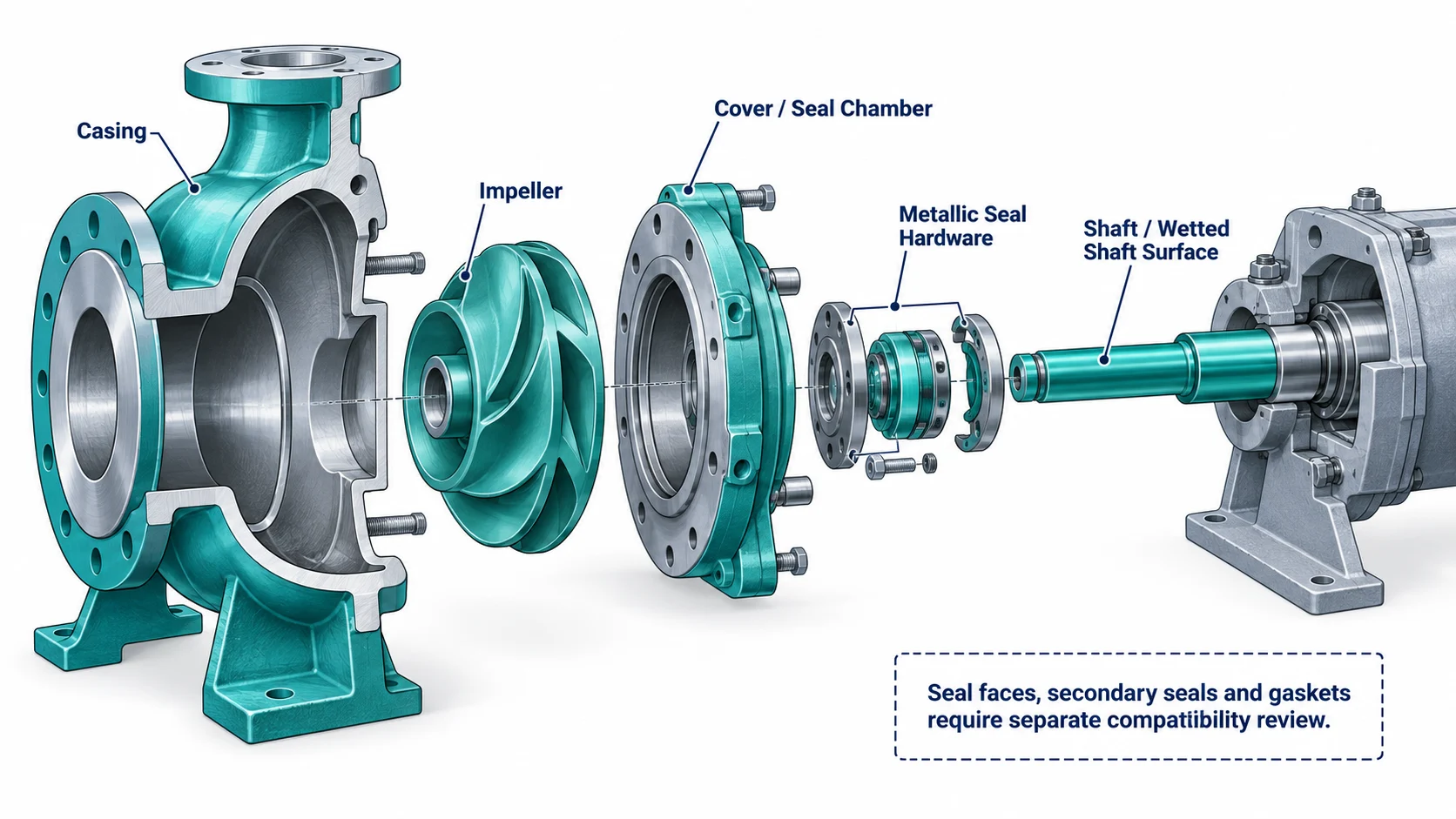
Review the Complete Wetted Assembly—Not Only the Casing
Complete Wetted Assembly Material Review
A high-alloy casing does not eliminate compatibility questions elsewhere in the wet end and sealing system.
Material Identity Is Not the Same as Material Suitability
Material certificates and PMI can support traceability and help confirm what material was supplied when the project requires them. They do not prove that the alloy is suitable for the actual chemistry, temperature, concentration, velocity or solids.
Procurement rule
Specify documentation because the RFQ / ITP / project requires it—not because every chemical pump order automatically needs the same document package.
A Seven-Step Material Upgrade Workflow
Failure-to-Material Review
Move from observed damage to an exact casting/material and pump-fit decision.
Where did it fail?
Photograph and locate the damage on casing, cover, impeller, shaft or seal area.
What mechanism?
Pitting, crevice, SCC, general corrosion, erosion-corrosion or cavitation.
Define process
Chemistry, concentration, temperature, contaminants, solids and cleaning/upset conditions.
Choose family
316, duplex, Alloy 20 family, C-type nickel alloy or titanium candidate.
Exact product form
Wrought vs cast, ASTM/UNS grade and component-specific requirement.
Verify pump interfaces
Casing, cover, impeller, shaft, seal and hydraulic geometry as applicable.
Lock evidence
Final material, drawings and required inspection/documentation scope.
What to Send for a Material & Failure Review
Material Upgrade Still Requires Model-Specific Pump Verification
ASME B73.1 helps standardize defined external installation interfaces, but it does not prove that one manufacturer’s complete wet end or internal parts automatically fit another manufacturer’s pump.
Material Upgrade FAQ for 316SS Pump Corrosion
Is there a universal chloride ppm limit for 316 stainless steel pumps?
No. Chloride concentration is only one variable. Temperature, pH, oxidizing species, crevices, deposits, fabrication condition, residual stress and local hydraulics can all change the risk of pitting, crevice corrosion and chloride SCC.
Does a higher PREN guarantee longer pump life?
No. PREN is mainly a stainless-steel screening/ranking tool for localized-corrosion resistance. It is not a corrosion-rate calculation and it does not predict service life in a real pump application.
Is Alloy 20 the same as CN7M?
No. Alloy 20 commonly refers to a wrought alloy family such as UNS N08020, while CN7M is a cast alloy designation/family used for pump and valve castings. The exact product specification matters.
Is Hastelloy C-276 the same as CW2M?
No. Wrought C-276 is UNS N10276. CW2M is a separate cast C-type alloy designation and should not automatically be labeled as C-276. Specify the exact ASTM A494 casting grade required for the component.
Does ASME B73.1 mean an exotic-alloy wet end automatically fits another OEM pump?
No. B73.1 standardizes defined external installation interfaces. Wet-end internal fitment, hydraulic geometry, seal-chamber geometry, shaft/impeller interfaces and other model-specific details still require verification.
Technical Sources
- Outokumpu — Stainless steel corrosion resistance and PRE/PREN guidance
- Nickel Institute — Practical guidance on duplex stainless steels and localized-corrosion resistance
- Carpenter Technology — Alloy 20 / 20Cb-3, UNS N08020
- Haynes International — Wrought and cast C-type alloy group designations
- TIMET — Titanium corrosion behavior and chlorine/chloride-service cautions
- ASME — B73.1-2026 dimensional-interchangeability scope