
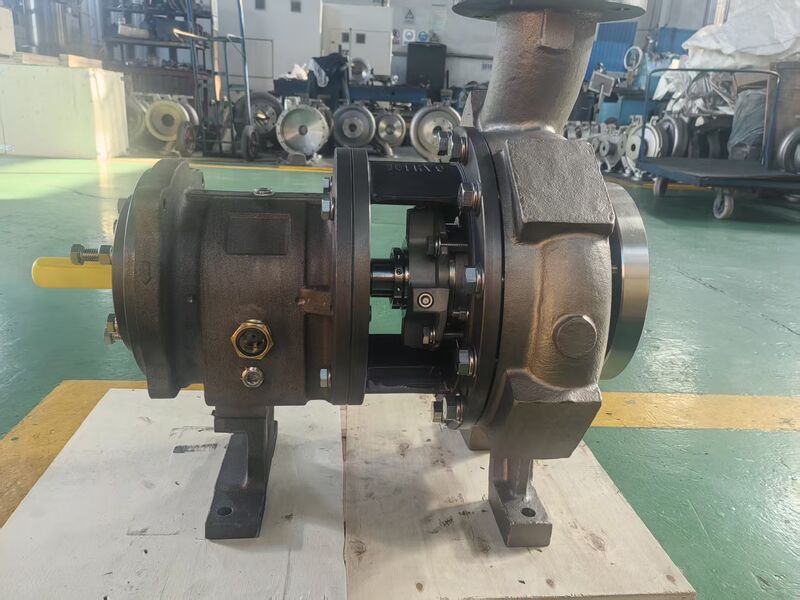
Why Impeller Adjustment Divides the ANSI Pump World
If you have ever maintained both Goulds 3196 and Durco Mark III pumps in the same plant, you know the moment of truth: the impeller adjustment mechanisms are fundamentally opposite. One adjusts against the front casing; the other adjusts against the rear cover. Getting this wrong during a rebuild does not just affect pump hydraulics – it can destroy a mechanical seal or cause catastrophic impeller rub in minutes.
This article provides a side-by-side technical breakdown of both ANSI pump impeller clearance setting methods. For a broader comparison of these two pump platforms, see our Goulds 3196 vs Durco Mark III complete comparison guide., their engineering rationale, and what maintenance teams need to know to get it right every time.
Goulds 3196: Front-Casing Adjustment (Standard Open Impeller)
The Goulds 3196 features a standard open impeller design, meaning the critical clearance is set between the front of the impeller vanes and the front pump casing (suction side).
⚠️ Quality & Compliance Assurance
All pumps and components from ANSI Pumps Pro are manufactured to ASME B73.1 dimensional specifications. Each shipment includes certified Material Test Reports (MTRs), CMM dimensional inspection reports, and hydrostatic test certificates (1.5× MAWP). 100% dimensional interchangeability guaranteed. Full material traceability from heat number to your receiving dock.
How to Adjust Clearance on Goulds 3196
- The adjustment is made via three jack bolts (push bolts) and three locking bolts located on the bearing housing adapter.
- A dial indicator is mounted magnetically on the shaft or bearing housing to measure axial movement precisely.
- The jack bolts are turned to move the entire rotating assembly forward until the impeller lightly touches the front casing face.
- Once contact is made, use the dial indicator to back the assembly rearward by the specified running clearance.
Key Technical Details
- Target clearance: Typically 0.015 inch for standard temperatures, increasing up to 0.030 inch for high-temperature service (STX, MTX, LTX frames). Always verify with your pump manual.
- Measurement tool: A dial indicator with 0.001 inch resolution is mandatory for an accurate setup.
- Seal chamber impact: Crucial Point! Because the shaft shifts axially relative to the stationary seal chamber during this adjustment, the mechanical seal setting must be re-verified and locked ONLY AFTER the impeller clearance is final. Forgetting this will alter the seal working length, leading to premature failure.
Durco Mark III: Rear-Cover Adjustment (Micrometer Thread)
The Durco Mark III utilizes a fundamentally different philosophy: a Durco Mark 3 reverse impeller adjustment guide centers around setting clearance against the rear cover (seal chamber face) rather than the front casing.
How It Works
- The Durco Mark III uses a unique micrometer thread bearing housing that threads directly into the bearing adapter.
- Rotating the entire bearing housing counter-clockwise moves the shaft and reverse impeller rearward until it makes light contact with the rear cover/seal chamber face.
- The housing is then rotated clockwise to advance the impeller forward by the required clearance, using the built-in micrometer markings.
- Locking bolts are then tightened to secure the bearing housing in place.
Key Technical Details
- Target clearance: 0.015 to 0.020 inch for Group 1 and 2; 0.018 to 0.025 inch for Group 3 frames.
- Measurement method: Inherent to the design. One full revolution of the micrometer housing equals a known axial displacement (typically 0.050 or 0.060 inch depending on the frame group). No external dial indicators are strictly required.
- Seal chamber advantage: Since the reverse impeller clearance is referenced directly from the rear cover, the relative position between the impeller and the seal chamber remains constant. You do not need to re-set or adjust the mechanical seal after adjusting the impeller clearance – a massive advantage for quick field maintenance.
Goulds 3196 vs Durco Mark III Impeller Adjustment Comparison
| Feature / Specification | Goulds 3196 | Durco Mark III |
|---|---|---|
| Clearance Reference Face | Front Casing (Suction Side) | Rear Cover (Seal Chamber Side) |
| Adjustment Mechanism | Jack bolts on adapter + dial indicator | Micrometer thread on bearing housing |
| Direction of Initial Movement | Forward (toward suction) | Rearward (toward seal chamber) |
| Dial Indicator Required? | Yes, required for precision | No, calibrated by housing thread pitch |
| Mechanical Seal Dependency | Dependent – must reset seal after adjustment | Independent – seal compression stays fixed |
| Field Adjustment Complexity | Moderate – requires instrument setup | Low – fast, repeatable mechanical adjustment |
Common Field Mistakes and How to Avoid Them
Goulds 3196 Pitfalls
- Locking down the seal too early: If maintenance crews lock the cartridge seal sleeve to the shaft before setting the impeller clearance, the subsequent shaft movement will compress or stretch the seal bellows, causing immediate leakage upon startup.
- Dial indicator sag: A loose magnetic base yields false clearance readings. Always verify your zero points.
Durco Mark III Pitfalls
- Thread Backlash: The micrometer housing threads can have slight play. To eliminate backlash error, always make your final adjustment setting by approaching it from the same rotational direction (clockwise/forward).
- Group Thread Confusion: Group 1, 2, and 3 Mark III frames have different thread pitches. A half turn does not equal the same axial move across different frame groups. Always calculate based on the specific frame manual.
Why This Matters for Your Spare Parts Strategy
The opposing engineering approaches mean that critical wet ends and power ends cannot be mixed between these two lines. Improper impeller adjustment is also one of the leading root causes of premature Durco Mark III bearing failures — incorrect clearance directly overloads the thrust bearings. Improper impeller adjustment is also one of the leading root causes of premature Durco Mark III bearing failures — incorrect clearance directly overloads the thrust bearings. The Goulds 3196 bearing housing adapter and the Durco Mark III micrometer housing are completely non-interchangeable.
Compared with major OEMs, as a source factory with over 10 years of experience in chemical pump manufacturing, we deeply understand these underlying fluid dynamics and mechanical design differences. Whether you need Goulds 3196 spare parts with precision seal face alignment, or Durco Mark III interchangeable bearing housings that strictly match the original micrometer thread pitch, we can provide 100% interchangeable seamless drop-in replacements. Same tolerances, same adjustment logic – your field maintenance team requires zero relearning.
Need 100% Interchangeable Impeller Components?
Whether you run Goulds 3196 or Durco Mark III — get precision-machined replacement wet ends with identical adjustment logic. Your maintenance team needs zero retraining.
Request a Technical Quote — Same Day Response →
WhatsApp: +86-186 5910 6155 | [email protected]
📋 Quick RFQ — No Registration Required