
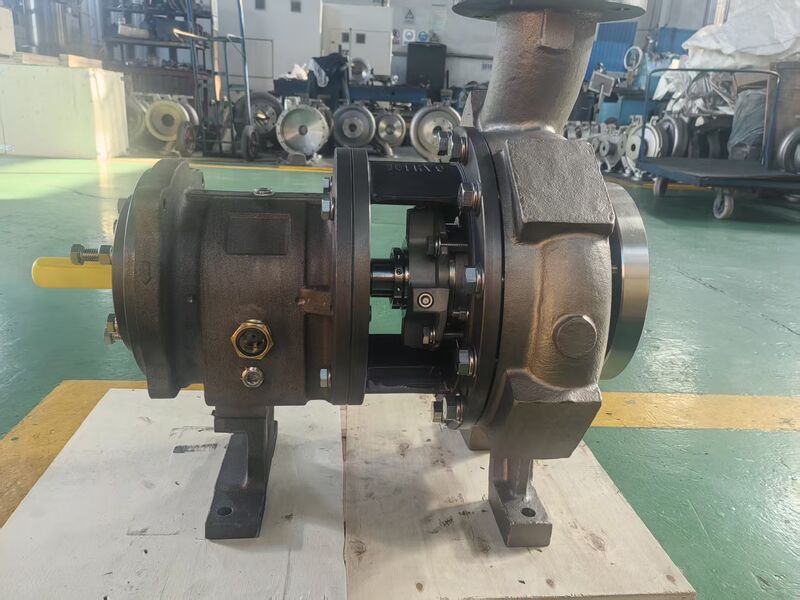
Process Pumps in the Food and Beverage Industry
Food and beverage plants are among the most demanding industrial environments for process pumps — not because every pump must meet 3-A sanitary standards, but because the combination of aggressive CIP chemicals, wide temperature swings, and corrosion challenges demands robust, reliable equipment. This is exactly where ANSI B73.1 process pumps excel.
ANSI B73.1 pumps are not designed for direct product-contact sanitary service (applications requiring 3-A or EHEDG certification). For those duties, dedicated hygienic centrifugal or positive displacement pumps from manufacturers like Fristam or Alfa Laval are the appropriate choice. However, food and beverage facilities have extensive non-product-contact pumping needs — CIP supply and return, water treatment, bulk ingredient transfer, and utility services — where the chemical resistance, dimensional interchangeability, and cost-effectiveness of ANSI B73.1 pumps make them the ideal solution.
This article focuses on how to select and configure ANSI B73.1 process pumps for food-grade utility, CIP, and non-contact processing applications — covering the material selection, seal configuration, and design features that matter in these demanding environments.
Key Standards for Food-Grade Pumps
⚠️ Quality & Compliance Assurance
All pumps and components from ANSI Pumps Pro are manufactured to ASME B73.1 dimensional specifications. Every shipment includes certified Material Test Reports (MTRs), CMM dimensional inspection reports, and hydrostatic test certificates (1.5× MAWP). We guarantee 100% dimensional interchangeability with Goulds 3196 and Durco Mark III. Full material traceability from heat number to your receiving dock.
| Standard | Scope | Applies to ANSI B73.1? |
|---|---|---|
| 3-A Sanitary Standards | Direct product-contact dairy/food pumps | Not inherently — requires specialized hygienic pump design |
| FDA 21 CFR | Food contact materials | Yes — wetted materials can be FDA-compliant (316SS, EPDM, PTFE) |
| EHEDG | Hygienic equipment design (Europe) | Not inherently — requires verified hygienic design |
| ASME B73.1 | Dimensional standard for chemical process pumps | Yes — the standard governing these pumps; interchangeability benefits apply |
Food and Beverage Pump Applications
Dairy Processing
| Application | Material | Special Considerations |
|---|---|---|
| Milk receiving/transfer | 316SS, polished ≤32 Ra | 3-A certification; CIP-compatible design |
| CIP supply | 316SS; Hastelloy C-276 for extended high-temperature caustic service >5% | Double mechanical seal with barrier fluid |
| Whey processing | 316SS | Low-NPSH design for vacuum evaporation processes |
Brewery and Beverage Production
| Application | Material | Special Considerations |
|---|---|---|
| Wort transfer | 316SS | Semi-open impeller for hop particles; NPSH margin for hot water |
| Yeast pitching | 316SS | Low-shear impeller (yeast cells are shear-sensitive) |
| Beer transfer/filtration | 316SS, polished | CO₂ environment — seal flush plans must accommodate dissolved gas |
| CIP supply | 316SS or Alloy 20 | Phosphoric acid cleaners aggressive to 316SS at elevated temp |
General Food Processing
| Application | Material | Key Considerations |
|---|---|---|
| Liquid sugar / corn syrup | 316SS | High viscosity at ambient; heating jackets sometimes required |
| Vegetable oil transfer | 316SS | Viscosity varies with temperature; free fatty acids corrosive |
| Tomato juice / thin puree transfer | 316SS | Low-to-medium viscosity only; acidic (pH 3.5-4.5). High-viscosity paste requires positive displacement pump — centrifugal pumps not suitable |
| Brine / salt solutions | CD4MCuN or Titanium | Hot brine attacks 316SS via Cl-SCC |
Food-Grade Design Features for Non-Contact Applications
- Surface finish: Wetted surfaces polished to ≤32 Ra μin where specified (not equivalent to 3-A certification)
- Drainability: Casing designed to be self-draining — no dead legs
- Crevice-free construction: Sanitary clamp (Tri-Clamp) or butt-weld connections preferred
- FDA-compliant elastomers: EPDM, FKM (Viton), or PTFE O-rings and gaskets
- CIP compatibility: Withstand 180-200°F cleaning solutions for 30-60 minute cycles
- SIP compatibility: Withstand saturated steam at 250-270°F for aseptic processes
Mechanical Seals for Food-Grade Service
- Sanitary seal design: Single cartridge with FDA-compliant elastomers
- Double seals for CIP: Back-to-back seal with barrier fluid for aggressive CIP chemicals
- SiC vs. SiC faces: Preferred for CIP resistance (carbon faces attacked by hot oxidizing CIP chemicals)
📋 Quick RFQ — No Registration Required