
The Real Cost of Corrosion in Chemical Transfer Pumps
Corrosion is not a single failure mechanism — it is a family of distinct degradation processes, each with its own root cause, progression rate, and material selection remedy. In chemical transfer pump service, where the pumped media may be a complex mixture of acids, chlorides, oxidizing agents, and abrasive particulates at elevated temperatures, material selection errors are the single most expensive mistake a process engineer or maintenance manager can make. A standard 316SS pump casing that costs $3,000 might fail in six months in the wrong service, while a properly specified Alloy 20 casing costing $8,000 might last 15 years. The initial price difference vanishes when weighed against the cost of even one unplanned process shutdown.
This article examines the four principal corrosion failure modes encountered in chemical pump service and explains how Alloy 20 (UNS N08020 / ASTM A744 Grade CN7M) — an alloy specifically developed to resist sulfuric acid attack — provides a robust and cost-effective solution for the most challenging services.
Four Corrosion Failure Modes in Chemical Pump Service
1. General (Uniform) Corrosion
General corrosion is the relatively uniform thinning of metal surfaces exposed to an aggressive chemical environment. In sulfuric acid service, for example, the corrosion rate of 316SS at concentrations below 10% or above 85% at ambient temperature is manageable (< 5 mils per year). However, in the 20-40% H₂SO₄ concentration range at temperatures above 40°C, the corrosion rate accelerates dramatically — often exceeding 50 mils per year — because the passive chromium oxide film becomes thermodynamically unstable in this regime.
⚠️ Quality & Compliance Assurance
All pumps and components from ANSI Pumps Pro are manufactured to ASME B73.1 dimensional specifications. Each shipment includes certified Material Test Reports (MTRs), CMM dimensional inspection reports, and hydrostatic test certificates (1.5× MAWP). 100% dimensional interchangeability guaranteed. Full material traceability from heat number to your receiving dock.
The practical consequence: pump casings that were originally 0.375 inches thick at the volute cutwater can thin to less than 0.125 inches in 18-24 months, creating a pressure boundary integrity risk. Wall thickness loss on this scale is detectable by ultrasonic thickness (UT) measurement, and any casing that has lost more than 25% of its original wall thickness should be removed from service immediately.
2. Stress Corrosion Cracking (SCC)
Stress corrosion cracking is a particularly dangerous failure mode because it occurs with little or no visible corrosion product and propagates rapidly once initiated. SCC requires three simultaneous conditions: (a) a susceptible material, (b) a specific corrosive environment, and (c) tensile stress above a threshold level. For austenitic stainless steels like 316SS, chloride-induced SCC is the most common variant. Even modest chloride concentrations (10-50 ppm) can trigger cracking at temperatures above 60°C (140°F), particularly in areas of stress concentration such as bolt holes, shaft keyways, and casting section transitions.
In chemical pump components, SCC typically manifests as brittle, branching cracks that initiate at the surface and propagate transgranularly through the wall. A shaft sleeve or casing that appears visually intact during a routine inspection can fracture catastrophically within hours of crack initiation under the combined influence of internal pressure and residual casting or machining stresses.
3. Pitting Corrosion
Pitting is a localized form of corrosion in which small areas of the passive oxide film are breached — typically at microstructural inhomogeneities such as sulfide inclusions or grain boundary precipitates — while the surrounding surface remains passive. The exposed anodic site corrodes rapidly, forming a pit that can penetrate several millimeters into the metal while the surrounding surface remains essentially unaffected.
The Pitting Resistance Equivalent Number (PREN) is a useful comparative metric for an alloy’s resistance to pitting in chloride environments:
PREN = %Cr + 3.3 × %Mo + 16 × %N
316SS has a PREN of approximately 24-26, making it suitable only for low-chloride environments. Alloy 20, with its higher molybdenum (2-3%) and nickel (32-38%) content, achieves a PREN of 28-32, providing improved — though not unlimited — resistance to chloride pitting.
4. Crevice Corrosion
Crevice corrosion occurs in stagnant, shielded areas where the local fluid chemistry can diverge significantly from the bulk process stream. In chemical pumps, common crevice sites include:
- Under gasket seating surfaces — particularly spiral-wound or PTFE envelope gaskets
- At O-ring grooves in seal chamber bores
- Between the shaft sleeve and the impeller hub
- Under deposits, scale, or polymer buildup on internal casing surfaces
Once a crevice is established, the restricted mass transport prevents the replenishment of dissolved oxygen within the crevice, while the hydrolysis of corrosion products acidifies the local environment. The resulting autocatalytic acidification can drive the crevice pH below 2, even when the bulk process fluid is only mildly acidic — creating a self-sustaining corrosion cell that 316SS cannot resist.
Alloy 20 (CN7M): Engineered for Sulfuric Acid Resistance
Alloy 20 — formally designated as UNS N08020 in wrought form and ASTM A744 Grade CN7M in cast form — was developed in the 1950s specifically to address the inadequacy of standard 300-series stainless steels in sulfuric acid service. Its nominal composition tells the story of this optimization:
| Element | Typical Weight % | Role in Corrosion Resistance |
|---|---|---|
| Nickel (Ni) | 32.0 – 38.0% | High nickel content provides the austenitic structure and imparts resistance to chloride SCC. Nickel also improves resistance to reducing acids (H₂SO₄, H₃PO₄). |
| Chromium (Cr) | 19.0 – 21.0% | Forms the passive Cr₂O₃ surface oxide film that provides general corrosion resistance in oxidizing environments. |
| Copper (Cu) | 3.0 – 4.0% | Copper is the distinguishing feature of Alloy 20. It provides outstanding resistance to sulfuric acid — particularly in the 20-40% concentration range — by modifying the electrochemical corrosion potential. |
| Molybdenum (Mo) | 2.0 – 3.0% | Enhances resistance to pitting and crevice corrosion in chloride-containing environments. Molybdenum also stabilizes the passive film in reducing acid conditions. |
| Carbon (C) | ≤ 0.07% | Low carbon content prevents chromium carbide precipitation during welding or casting, maintaining intergranular corrosion resistance (the cast CN7M grade allows slightly higher carbon due to the niobium stabilization). |
The synergistic effect of this composition is an alloy that delivers excellent resistance to sulfuric acid across the critical 20-40% concentration range — precisely the regime where 316SS fails rapidly. In laboratory corrosion tests conducted per ASTM G31, Alloy 20 typically exhibits corrosion rates below 5 mils per year (mpy) in 20-40% H₂SO₄ at temperatures up to 65°C (150°F), compared to 50+ mpy for 316SS under the same conditions.
Beyond sulfuric acid, Alloy 20 also provides strong resistance to:
- Phosphoric acid (H₃PO₄) — used in fertilizer manufacturing and food-grade acid production
- Nitric acid (HNO₃) — at moderate concentrations and temperatures
- Mixed acid environments containing sulfuric, nitric, and hydrofluoric acids — common in pickling and metal finishing operations
- Chloride-induced SCC and pitting — the high nickel content raises the threshold temperature and chloride concentration required to initiate SCC compared to 316SS
Real-World Service Life Comparison: 316SS vs. Alloy 20
The following comparison is based on aggregated field data from chemical plants operating ANSI B73.1 pumps in sulfuric acid transfer and circulation service (20-40% H₂SO₄, 40-60°C, continuous operation):
| Component | 316SS Typical Service Life | Alloy 20 Typical Service Life | Life Extension Factor |
|---|---|---|---|
| Pump Casing (Volute) | 2-3 years (wall thinning at cutwater) | 12-18 years | ~6x |
| Impeller | 1.5-2 years (vane tip erosion-corrosion) | 8-12 years | ~6x |
| Shaft Sleeve (under seal) | 6-12 months (pitting and crevice attack) | 5-8 years | ~8x |
| Seal Chamber / Stuffing Box Cover | 3-4 years | 15+ years | ~5x |
While Alloy 20 components typically carry a 2-3x price premium over 316SS equivalents, the 5-8x service life extension delivers a net present value (NPV) that is overwhelmingly positive when factoring in reduced replacement part costs, reduced maintenance labor, reduced production downtime, and eliminated environmental release risk from through-wall corrosion failures.
Alloy 20 ANSI Pump Components from ansipumpspro.com
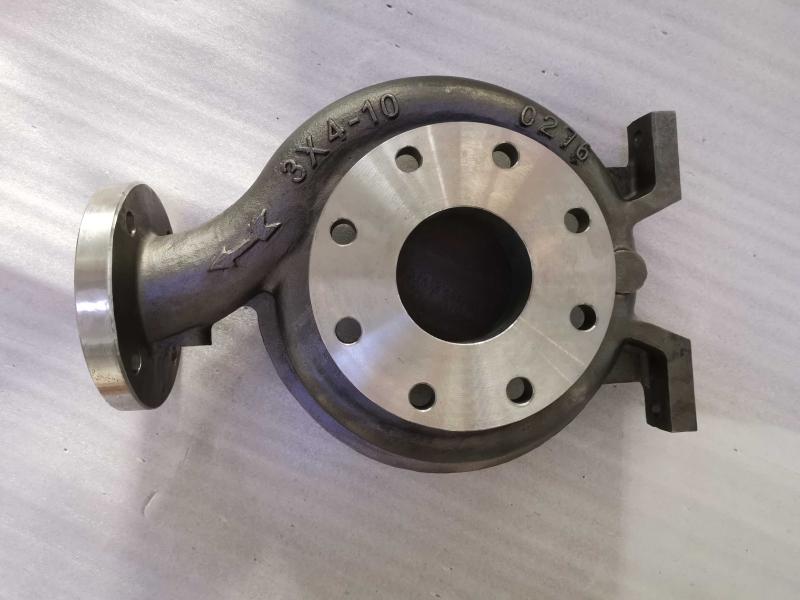
At ansipumpspro.com, we have invested in a dedicated Alloy 20 (CN7M) casting and machining supply chain specifically to serve chemical processors who have identified 316SS corrosion failures and are seeking a reliable, dimensionally interchangeable upgrade path. Our Alloy 20 ANSI pump components include:
- Complete casings (volutes) — investment cast in CN7M per ASTM A744, solution annealed and water-quenched, machined to ASME B73.1 envelope dimensions for direct interchange with Goulds 3196 and Durco Mark III OEM casings
- Impellers — both open (Goulds-type) and reverse vane (Mark III-type) designs, dynamically balanced to ISO 1940 Grade G6.3
- Seal chambers and rear covers — including Durco Mark III standard bore and taper bore configurations
- Shaft sleeves — with optional Stellite hard-facing in the seal running area for additional abrasion resistance
Every Alloy 20 casting is supplied with a certified Material Test Report (MTR) documenting the heat number, chemical analysis, mechanical properties (tensile strength, yield strength, elongation), and the results of intergranular corrosion testing per ASTM A262 Practice C (the nitric acid boil test for sensitization). This documentation is essential for plants operating under OSHA 1910.119 Process Safety Management (PSM) requirements or ISO 9001 quality systems.
To discuss upgrading your chemical transfer pumps to Alloy 20 construction, or to request a quotation for specific Alloy 20 ANSI pump components, contact our materials engineering team at ansipumpspro.com/contact.
📋 Quick RFQ — No Registration Required
🔗 Related Reading
Corrosion Failure Type Identification Guide
🔍 How to Identify What Killed Your Pump:
- Uniform wall thinning with smooth surface? → General corrosion. Check pH and temperature against material limits.
- Deep, isolated pits with otherwise clean surface? → Pitting corrosion. Chlorides exceeded the material PREN threshold.
- Branching cracks, often at welds or high-stress fillets? → Stress corrosion cracking. Check temperature + chloride combination.
- Honeycomb-like surface, selective metal loss? → Crevice corrosion. Inspect gasket seating surfaces, under-deposit areas.
- Grooves aligned with flow direction? → Erosion-corrosion. Flow velocity too high; check for entrained solids.
Diagnostic shortcut: Send a photo of the failed component to our engineering team with a brief note on the process fluid, temperature, and service life. We will provide a preliminary failure analysis within 24 hours — contact us →