When Standard Pump Materials Are No Longer Enough
An exotic-alloy review should begin when the existing material no longer provides a defensible service life, when corrosion repeats after replacement, or when the process environment has moved outside the conditions used for the original material decision. The objective is not to select the most expensive alloy. It is to identify the failure mechanism, define the real process envelope, and verify the exact material form required for each wetted component.
Use the broader ANSI Pump Material Selection Guide for first-pass screening across 316 stainless, duplex, Alloy 20, C-type nickel alloys and titanium. This article starts at the next decision point: when a severe-corrosion service requires a more focused exotic-alloy and metallurgy-verification review.
Start With the Process Envelope, Not the Alloy Name
A reliable material review starts with the condition that the pump actually sees. Record the complete fluid composition, concentration, normal and upset temperature, contaminants, oxidizing or reducing species, solids, entrained gas, operating cycle, startup and shutdown conditions, cleaning fluids, and the current failure history.
Keep concentration and temperature attached to every compatibility statement. Dilution, evaporation, aeration, contamination and batch transitions can create a different corrosion environment from the nominal process description.
| Decision input | Why it matters | What to document |
|---|---|---|
| Complete chemistry | The fluid name alone may hide oxidizers, reducers, chlorides, fluorides or another acid/base in the mixture. | Main chemical, concentration and known impurities or contaminants. |
| Temperature | Material behavior can change as temperature changes. | Normal, maximum, upset and cleaning temperatures where relevant. |
| Solids and deposits | Abrasion, erosion-corrosion and under-deposit conditions may change the failure mechanism. | Solids loading, particle description and where deposits form. |
| Hydraulic condition | Local velocity, turbulence, flashing, entrained gas and cavitation can create damage that is not purely chemical. | Flow, head, speed, suction condition and observed operating range. |
| Failure evidence | The location and morphology of damage help separate corrosion from hydraulic or mechanical causes. | Photos, component location, depth/distribution, operating history and prior material. |
For listed chemical, concentration and temperature combinations, use the Chemical Resistance Guide. Treat it as screening evidence rather than a substitute for the project specification or application-specific corrosion data.
Cast Grade vs Wrought Grade: Verify the Product Form Before You Specify the Alloy
Pump casings, covers and impellers are commonly cast, while shafts and other components may use wrought or machined product forms. A wrought alloy name and a corrosion-resistant pump casting can belong to the same material family without being the same purchase specification.
| Material family reference | Wrought reference commonly encountered | Casting reference to verify | Procurement meaning |
|---|---|---|---|
| Alloy 20 family | UNS N08020 | CN7M / cast UNS N08007 where specified | Do not place an order for a casting using only the wrought family name. State the required casting designation and applicable material specification. |
| C-type nickel / C-276 family | UNS N10276 | ASTM A494 CW12MW / cast UNS N30002 where specified | Treat the casting as a separate material specification. Confirm chemistry, heat treatment, repair requirements and traceability for the actual casting. |
| Titanium | Wrought grade stated by the project | ASTM B367 casting grade stated separately; B367 includes C-2 (UNS R52550) and C-3 (UNS R52551) | Do not convert a wrought titanium grade into a casting grade by name alone. Purchase the exact product form and grade required by the project. |
| Zirconium | UNS R60702 may be encountered for wrought Zirconium 702 product | ASTM B752/B752M covers corrosion-resistant zirconium-base castings; exact casting grade must be confirmed | Keep wrought and cast references separate and verify the project-specific casting requirement before release. |
For a focused comparison between Alloy 20 and C-type nickel materials, use the Alloy 20 vs Hastelloy C-276 guide. For C-276-specific verification questions, see the Hastelloy C-276 ANSI Pump Material Guide.
What Actually Changes an Exotic-Alloy Decision?
The alloy family is only one variable. The decision can change when the fluid becomes hotter, more concentrated, more reducing or oxidizing, more contaminated, more erosive, or more prone to deposits and crevices. Those variables should remain visible throughout the review instead of being collapsed into a single “recommended material” label.
If the current question is whether CD4MCuN should remain in the candidate set before escalating to a higher alloy, keep that first-pass duplex screening in the broader Material Selection Hub rather than duplicating it here.
Use Chemical Examples as Boundary Checks, Not Material Approvals
Chemical names are useful for organizing the review, but they should not be converted into universal alloy rules. Published corrosion data are normally tied to a defined composition, concentration, temperature, product form and test method.
Sulfuric acid
Do not convert “sulfuric acid” directly into “Alloy 20” or another fixed answer. Concentration, temperature, contaminants, aeration and transient dilution all belong in the decision. Use the sulfuric-acid and caustic impeller material guide when the rotating impeller is the component under review.
Hydrochloric and mixed reducing service
Reducing-acid behavior can change with concentration, temperature and oxidizing contaminants. C-type nickel alloys may enter the candidate set, but published laboratory corrosion data should be tied to the real process condition before a pump casting is approved.
Titanium service
Titanium depends on the environment supporting the required passive condition. Moisture, oxidizing state, contaminants, crevices and product form still require review. For a focused comparison, see Titanium vs C-Type Nickel Alloys for ANSI Pumps.
Zirconium service
Zirconium can enter severe-corrosion reviews, but a wrought Zirconium 702 data sheet does not by itself approve a zirconium pump casting. Confirm the casting specification, component design, fabrication requirements and project acceptance criteria separately.
Hydraulics Can Turn Corrosion Into Erosion-Corrosion
When a surface film is repeatedly damaged by solids, turbulence or local hydraulic effects, chemical attack and mechanical removal can interact. Cavitation can also produce pitting and material loss that resembles corrosion. Changing the alloy without checking the hydraulic cause can leave the original failure mechanism in place.
Locate pitting, grooves, polished tracks, deposits, cracks and unaffected comparison areas.
Check concentration, temperature, contaminants and the actual operating cycle.
Review solids, suction condition, operating point, turbulence, flashing and cavitation evidence.
Use qualified corrosion information only after the failure mechanism is reasonably defined.
Separate casting and wrought specifications and define the required evidence.
Use the Centrifugal Pump Sizing Calculator to organize flow, TDH, density, viscosity, temperature, vapor pressure, solids and available NPSH into a duty package. The calculator prepares hydraulic inputs; it does not automatically approve a material or pump model.
Review the Entire Wetted Assembly and Its Material Interfaces
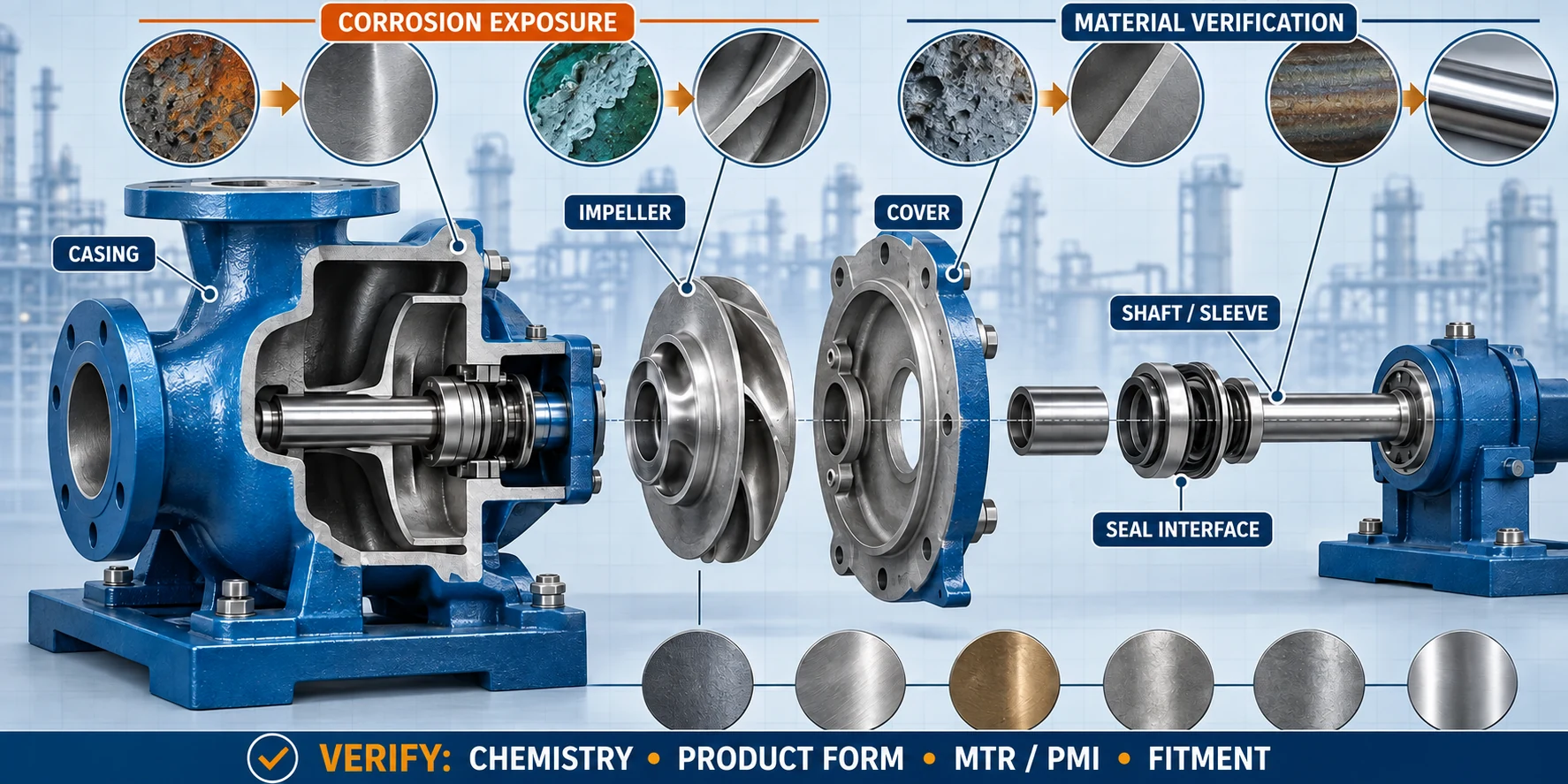
An exotic-alloy casing or impeller does not protect every adjacent component. Review the material, exposure and interface of each wetted part that can control service life. Different components can legitimately use different materials, but the combination must be intentional.
Build the Material Evidence Package Before the RFQ Is Released
A critical alloy order should define what evidence must connect the delivered part to the approved material requirement. The inspection package depends on the component, project specification and consequence of failure; it should not be assumed to be identical for every part.
| Evidence | What it helps verify | How to use it |
|---|---|---|
| Exact grade and material standard | The material actually specified for the component and product form. | State it on the RFQ, drawing or purchase specification. |
| Heat number and MTR | Chemistry and heat traceability when required. | Confirm the record is traceable to the supplied component rather than a generic certificate. |
| PMI | Material identity at the checked surface or component. | Define the scope, method and acceptance requirement when PMI is required. |
| Heat-treatment record | Required processing evidence for the specified material where applicable. | Request only when the material/project specification requires it. |
| NDE / repair documentation | Specified casting integrity or repair-weld evidence. | Define the required method and acceptance basis in the project specification. |
| Dimensional report | Replacement fitment at critical interfaces. | Match the inspection points to the approved drawing or retained installation. |
| Pressure-test record | Specified pressure-containing test evidence. | Use the applicable project or controlled standard requirement; do not apply an invented universal test pressure or hold time. |
| Balance record | Rotating-component verification where required. | Define the requirement for the specific impeller and project. |
Metallurgy Is Only One Gate in an ANSI Pump Replacement
A material can be correct and the replacement can still be wrong. Confirm the installed pump identity, size/frame/group, drawings, dimensions, hydraulic duty, impeller configuration, seal-chamber interface, shaft arrangement and quotation scope before release.
ASME B73.1-2026 defines dimensional interchangeability requirements for specified external interfaces of horizontal end-suction chemical process pumps. That dimensional standardization should not be treated as proof that every internal part, wet end or hydraulic component is universally interchangeable between manufacturers or configurations.
Chemistry, temperature, solids and operating cycle.
Exact cast/wrought grade and evidence package.
Size, frame/group, interfaces, dimensions and sealing arrangement.
Flow, head, speed, NPSH and verified performance data.
Approved scope, drawing and project documentation before quotation or production.
For wet-end replacement planning, review the ANSI Pump Wet-End Replacement Packages guide. When the service requires a severe-corrosion replacement configuration, continue to the Exotic-Alloy ANSI Replacement Pumps & Parts page only after the process and material evidence are defined.
What to Send for an Exotic-Alloy Pump or Wet-End Review
The fastest material review starts with evidence from the existing installation and the real service condition. Start with what is available; missing inputs can be identified before a material or replacement configuration is released.
Do not add a separate body RFQ block here. The existing Engineering Insights template should provide the single default Engineering Review CTA after the article body.
Frequently Asked Questions
Is Alloy 20 the same as CN7M?
No. Alloy 20 commonly refers to a wrought material family such as UNS N08020, while CN7M is a corrosion-resistant casting designation associated with cast UNS N08007. They may enter the same service discussion, but the purchase specification must state the correct product form and exact grade.
Is Hastelloy C-276 the same as a CW12MW pump casting?
No. C-276 / UNS N10276 is a wrought alloy designation. ASTM A494 CW12MW / cast UNS N30002 is a separate casting designation associated with the C-276 material family. Confirm the exact casting specification rather than treating the names as interchangeable.
Can a chemical-resistance chart approve an exotic-alloy pump material by itself?
No. A chart can support screening for a stated condition, but the final decision also requires the real process envelope, exact product form, pump component, hydraulic exposure, failure mechanism and project specification.
Should every wetted pump component use the same alloy?
Not automatically. Components can have different corrosion, mechanical, sealing and manufacturing requirements. Review the assembly and galvanic interfaces rather than applying a universal same-alloy rule.
What material documents should I request for an exotic-alloy replacement?
Define the exact grade and material standard first, then specify the traceability and inspection records required by the project. Depending on the component and risk, that may include heat-number/MTR traceability, PMI, heat-treatment records, NDE or repair documentation, dimensional inspection, pressure-test records, balance records and approved drawings.
Sources and Related Engineering References
The material references below support the product-form and standards boundaries used in this article. They should be read with the project specification and actual service data; no copyrighted standard tables are reproduced.
- ASME B73.1-2026 — Specification for Horizontal End Suction Centrifugal Pumps for Chemical Process.
- ASTM B367-22 — Titanium and Titanium Alloy Castings; includes separate titanium casting grades such as C-2 and C-3.
- ASTM B752/B752M-22 — Zirconium-Base Corrosion-Resistant Castings.
- Carpenter Technology — 20Cb-3 / Alloy 20, UNS N08020.
- Alloy Casting Industries — ASTM A743 CN7M / cast UNS N08007 reference.
- Haynes International — HASTELLOY C-276 alloy corrosion data and laboratory-test limitations.
- Fondinox — ASTM A494 CW12MW / cast UNS N30002 and wrought UNS N10276 reference mapping.