
Hastelloy C-276 can be a candidate for demanding chemical pump service, but the alloy name alone does not approve a component. Confirm the process conditions, the specified product form and material grade, and the replacement pump’s dimensional and hydraulic requirements before releasing an order.
This guide is for engineers, maintenance teams and buyers reviewing a C-276 pump component or replacement wet end. It separates corrosion suitability from fitment and explains which records to request from a supplier.
What does “Hastelloy C-276” mean for a pump part?
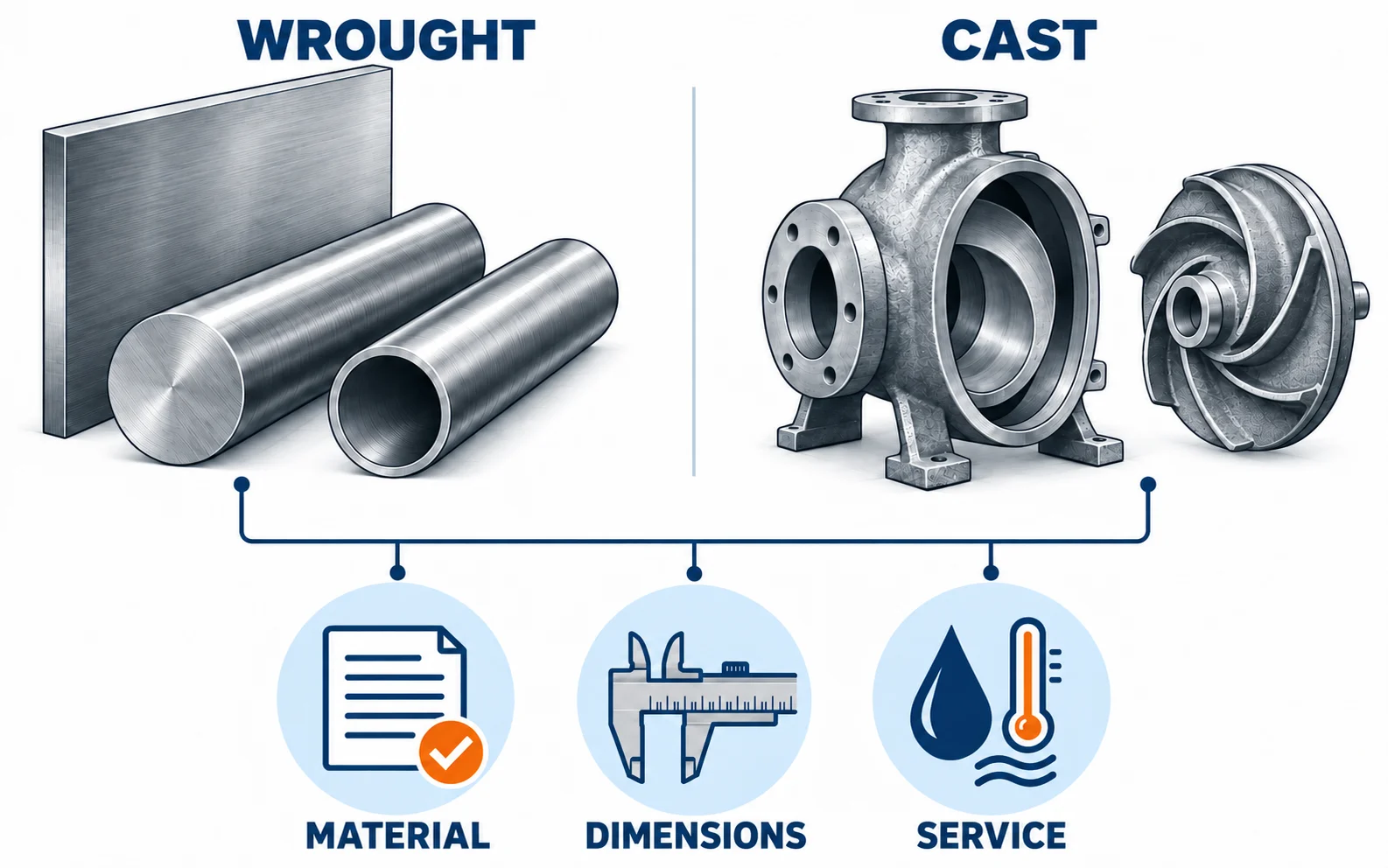
HASTELLOY C-276 (UNS N10276) is commonly specified in wrought product forms. Pump casings and impellers are cast components, so the purchase specification must identify the applicable casting grade rather than simply copy a wrought-alloy designation onto a casting purchase order. The Haynes technical data describes C-276 as available in forms including plate, sheet, bar, pipe and tube; the finished component’s form and governing material specification still need to be verified.
For cast nickel-alloy components, ASTM A494 CW12MW (UNS N30002) is commonly associated with the C-276 family. CW2M (UNS N26455) is a different casting grade and must not be used as a synonym for C-276. These designations do not make a casting identical to wrought UNS N10276. Confirm the project-required standard, grade, heat treatment and chemistry against the approved drawing and material test report (MTR). See the SFSA high-alloy casting reference and Haynes C-276 technical data.
| Designation | Product form / reference | What to verify before ordering |
|---|---|---|
| UNS N10276 | Wrought C-276 alloy reference | Applicable wrought product specification and component form |
| ASTM A494 CW12MW / UNS N30002 | Cast alloy commonly associated with the C-276 family | Required casting specification, grade, heat treatment and MTR |
| ASTM A494 CW2M / UNS N26455 | Different cast nickel-alloy grade | Do not substitute for CW12MW or describe it as a C-276 equivalent without an approved engineering basis |
Screen C-276 against the actual chemical service
C-276 has documented resistance in a range of aggressive environments, including chloride-related localized corrosion and selected inorganic acids. Those general properties are a starting point, not a service approval. Corrosion data must be read with its concentration, temperature, test medium and exposure conditions; Haynes notes that its selected data come from reagent-grade laboratory tests and encourages field testing before industrial use.
Before selecting a pump alloy, record the full liquid composition and operating envelope. Include normal and upset concentration and temperature, contaminants, chloride and fluoride levels where relevant, pH, oxidizing or reducing conditions, aeration, solids, velocity, crevices, cleaning cycles and periods of stagnant exposure. A change in any of these can change the corrosion mechanism.
For a mixed, variable or poorly characterized process stream, request a technical material review before approving the grade.
Use the site’s Chemical Resistance Guide to screen conditions that are explicitly listed. If the exact chemistry or temperature is absent, do not interpolate from a nearby row or treat a preliminary compatibility rating as a corrosion guarantee. Request a materials review for mixed, variable or poorly characterized process streams.
Keep material selection separate from replacement fitment
A material that suits the fluid may still be the wrong replacement part. Review the proposed assembly across five separate checks:
- Dimensional: compare pump size and frame, casing registers, nozzle locations, mounting, shaft extension and critical interfaces against the approved drawing and dimensional inspection report.
- Mechanical: check shaft, key, coupling, bearing arrangement, seal chamber, clearances and retained components using component drawings and interface measurements.
- Hydraulic: compare flow, head, speed, impeller trim, NPSH, power and operating range with the applicable pump curve and duty point.
- Material: match the wetted component, exact grade, product form, process chemistry and temperature to the approved specification, heat number and MTR; require PMI where specified.
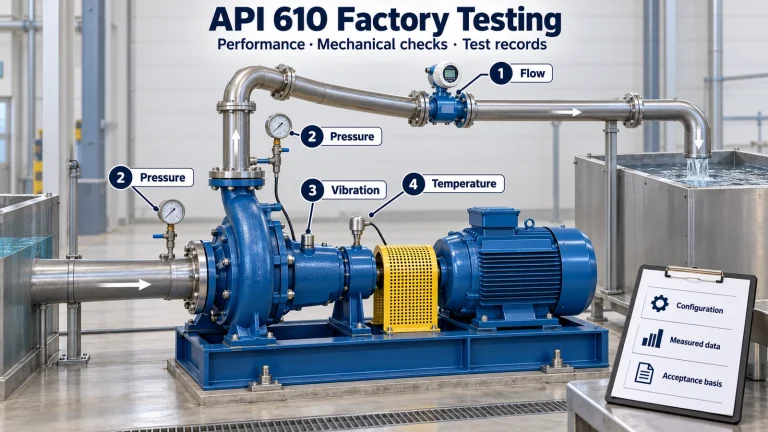
- Acceptance: agree the inspection and test plan, applicable test records and deviation list before order release.
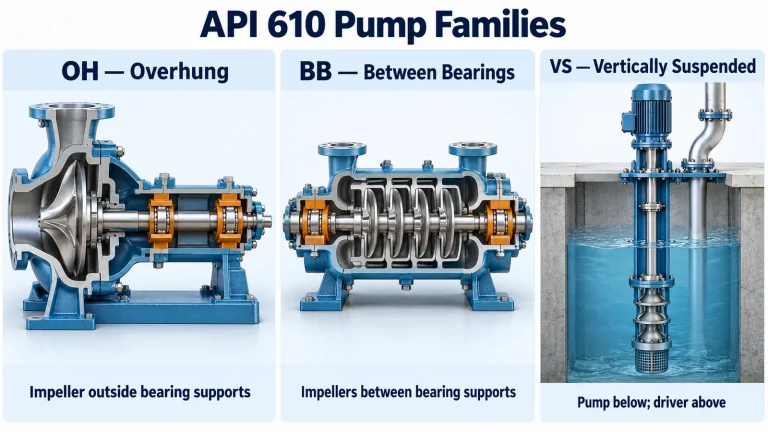
ASME B73.1 defines a dimensional framework for horizontal end-suction chemical-process pumps. Its interchangeability intent applies to pumps with the same standard dimension designation and specified installation interfaces; it does not prove that every internal component, seal chamber, material or hydraulic curve will interchange. See the ASME B73.1 guide and the explanation of dimensional interchangeability versus component compatibility.
For a Goulds 3196, Durco Mark III or another ANSI pump reference, verify the exact model, size, frame or group, seal arrangement, impeller configuration, power end and duty point. Do not approve a replacement from the brand name, nominal size or B73.1 reference alone.
Verify material and inspection records
Before order release, agree which records are required for each component. A buyer may specify an MTR with heat-number traceability, positive material identification (PMI), dimensional inspection, balance records for rotating parts, pressure testing for pressure-containing parts, non-destructive examination, and disclosure of weld repairs. Availability and acceptance criteria should be confirmed in the purchase documents rather than assumed.
PMI and laboratory chemical analysis answer different questions. Portable X-ray fluorescence (XRF) is useful for checking many alloying elements, but it does not provide a dependable carbon measurement. If carbon limits are part of the grade acceptance criteria, specify an appropriate laboratory method, such as optical emission spectroscopy or combustion analysis, in the inspection plan. Do not claim a test was performed unless the corresponding record is available for the supplied heat or component.
Escalate a quotation if the supplier names only a trade alloy, cannot identify the casting specification, cannot connect the supplied component to a heat number, omits the relevant drawing, or claims broad interchangeability without defining the verified model and component scope.
Prepare a complete C-276 pump-parts RFQ
- Installed pump manufacturer, model, size, frame or group, serial or asset number, and nameplate photograph.
- Required item: casing, impeller, cover, shaft sleeve, seal chamber, wet-end assembly or complete pump.
- OEM part number, drawing or section view, bill of materials and clear photographs of critical interfaces, when available.
- Liquid composition, concentration range, contaminants, solids, pH where relevant, normal and upset temperature, and operating or cleaning conditions.
- Required flow, head, speed, specific gravity, viscosity, vapor pressure, suction conditions and operating range.
- Exact material specification and product form for each wetted component; identify whether a casting or wrought part is required.
- Seal faces, elastomers, flush or barrier plan, gaskets, fasteners and components that will be retained.
- Required MTR, traceability, PMI, dimensional, balance, pressure-test, NDE and weld-repair records.
For a broader comparison of alloy families, see Alloy 20 vs. C-276 for chemical pumps.
Frequently asked questions
Is CW2M the cast equivalent of Hastelloy C-276?
No. CW2M (UNS N26455) is a different cast alloy grade and should not be used as a synonym for C-276. CW12MW (UNS N30002) is commonly associated with the C-276 casting family. Confirm the exact specification and product form in the purchase documents and MTR.
Is cast CW12MW identical to wrought UNS N10276?
No. They refer to different product forms and specifications. A buyer should identify the required casting or wrought grade explicitly and verify the supplied material records against that requirement.
Is C-276 suitable for every acid or chloride service?
No. Suitability depends on the complete chemistry, concentration, temperature, contaminants, velocity, oxidizing or reducing conditions, and component form. Review the exact operating envelope before approving the alloy.
Does ASME B73.1 guarantee that replacement pump parts will fit and perform the same?
No. B73.1 supports defined dimensional interchangeability for pumps with the same standard dimension designation. Internal component fit, mechanical interfaces, material suitability and hydraulic performance require separate verification.