When to Evaluate CD4MCuN for Seawater and Chloride Service
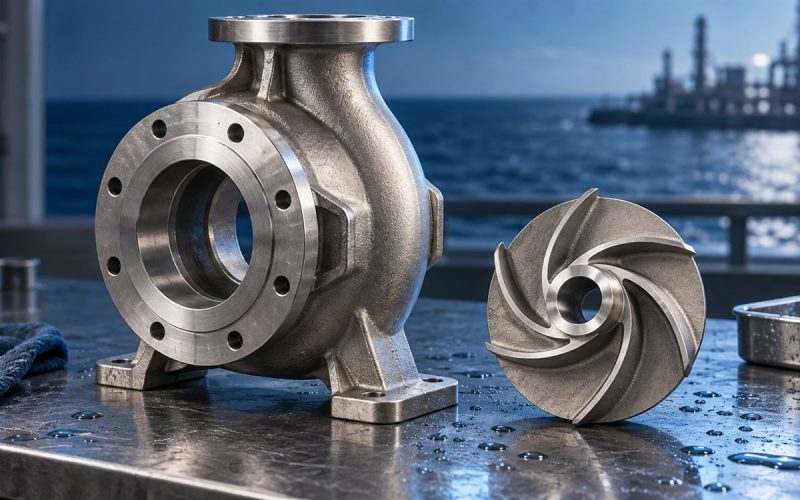
CD4MCuN is a cast duplex stainless steel that may be considered for pump parts exposed to some chloride-bearing process fluids. It is a candidate for engineering review, not a universal seawater approval. Chloride level alone cannot establish suitability: temperature, oxygen, deposits, crevices, velocity, solids, stress, component geometry and the condition of the casting all affect the decision.
Start by defining the actual service and the part being replaced. Then review material resistance, pump duty and fitment as separate questions. A material that is appropriate for the fluid can still be wrong for the hydraulic duty or the installed pump configuration.
Do not use a single chloride or temperature cutoff
There is no universal ppm or temperature value in this guide that approves CD4MCuN—or rejects another alloy—for every seawater installation. Obtain a condition-specific materials review when the service is critical or the exposure is uncertain.
Specify the Casting Grade, Not Just “Duplex Stainless”
For a pump casting, identify CD4MCuN by its applicable material specification and grade. ASTM A890/A890M identifies CD4MCuN as Grade 1B and UNS J93372; ASTM A995/A995M may apply where specified for pressure-containing castings. The governing edition and purchase specification should be stated on the order.
CD4MCuN and CD4MCu are distinct casting designations. Do not accept a generic “duplex” description or infer equivalence from a supplier’s family-level material list. For the designation and purchasing detail, see the CD4MCuN pump material guide.
| Specification item | CD4MCuN reference | What the buyer should verify |
|---|---|---|
| Casting designation | CD4MCuN, Grade 1B, UNS J93372 | The purchase order, material certificate and part marking identify the same grade and heat. |
| Chemistry ranges in the cited ASTM A890/A890M-13 Grade 1B table | Cr 24.5–26.5%; Ni 4.7–6.0%; Mo 1.7–2.3%; Cu 2.7–3.3%; N 0.10–0.25% | Use the chemistry requirements in the applicable standard edition and the heat-specific material report. |
| Minimum mechanical properties in the cited ASTM A890/A890M-13 Grade 1B table | Tensile 690 MPa; yield 485 MPa; elongation 16% | Confirm the applicable specification, heat treatment, test results and purchaser requirements for the casting. |
| Duplex microstructure | Austenitic-ferritic casting alloy | Request metallurgical examination or ferrite acceptance data only when required by the purchase specification or service review. |
Reference basis: SFSA Supplement 2 (2017), ASTM A890/A890M-13 Grade 1B table. Confirm the governing edition and purchase requirements for the supplied casting; these reference figures do not replace heat-specific test results.
Specification values are not seawater service limits
Chemistry and tensile properties help identify and qualify a material. They do not establish corrosion life, a maximum chloride concentration, a universal operating temperature or fitment to a particular pump.
Diagnose Corrosion, Erosion and Hydraulic Damage Separately
Similar-looking damage can have different causes. A metallurgy change may help with one mechanism while leaving another untouched. Review the damage pattern and the operating history before specifying a replacement material.
From service problem to engineering check
Use the observed failure to choose the next check; more than one mechanism can be active at once.
Locate the damage
Record whether attack is broad, localized, near a gap, at a vane, or at a flow turn.
Check the mechanism
Consider pitting, crevice corrosion, erosion-corrosion, cavitation, impact or a combination.
Check the service
Compare chemistry and temperature with deposits, solids, velocity and actual operation.
Set acceptance evidence
Name the grade, interfaces, inspection records and any project-specific tests.
What this means for a replacement part
Evaluate corrosion resistance for the wetted environment, then separately confirm pressure boundary, impeller geometry, wear clearances, balance, shaft interfaces, seal arrangement and duty point. Do not claim that higher strength alone prevents erosion or blade deflection without component design and service evidence.
If damage suggests a suction or operating problem, use the site’s centrifugal-pump cavitation checklist to review the hydraulic cause before ordering a material upgrade.
A CD4MCuN Part Is Not Automatically a Drop-In Replacement
ANSI dimensional conventions do not make every internal component or performance curve interchangeable. Verify the installed pump configuration and the exact component position. A replacement impeller can fit mechanically yet have a different trim, hydraulic curve, power demand, clearances or NPSH requirement.
| Verification layer | Evidence to compare | Decision closed |
|---|---|---|
| Dimensional | Approved drawing, critical dimensions, shaft/key fit, interfaces and clearances | Will the part fit the identified pump configuration? |
| Mechanical | Balance requirement, rotating assembly, seal chamber, wear parts and pressure boundary | Will the assembly operate within the project and manufacturer requirements? |
| Hydraulic | Required flow/head, speed, impeller trim, power and applicable pump curve | Will the proposed configuration meet the duty? |
| Material | Exact casting grade, heat traceability, chemistry, condition and service review | Is the material supported for the actual fluid and component? |
For Goulds 3196 or Durco Mark III wet-end scope, see the CD4MCuN wet-end kit fitment guide. For a shaft sleeve, use the separate shaft sleeve verification guide. Final compatibility must be confirmed against the actual size, frame, configuration and part reference.
Define the Material and Inspection Records in the Purchase Scope
Ask for records that connect the specified material to the casting being supplied. The acceptance plan should match the governing material standard, purchase order, component criticality and site requirements.
Agree acceptance criteria before manufacture
Do not assume a universal PMI percentage, ferrite range, penetrant-test code, balance grade or hydrostatic-test requirement. Put the applicable method and acceptance criteria in the order or approved inspection plan.
For material screening, the chemical resistance guide can help identify listed conditions. Its ratings are screening references for stated conditions; they do not approve an unlisted chemistry or replace review of the complete wetted system.
When to Escalate Before Selecting the Alloy
Request a condition-specific review when chloride concentration or temperature is unknown or varies, the service is continuously immersed or chlorinated, deposits or tight crevices are present, localized corrosion has recurred, solids or high velocity are significant, or a supplier proposes a substitute grade without traceable records.
Provide the fluid analysis, normal and upset temperatures, pH, dissolved oxygen or treatment details, solids, flow and speed, pump model and size, part number or drawing, photos of the damage, prior material and required inspection records. This lets the review distinguish material suitability from a hydraulic correction or a complete replacement scope.
For material designation, continue to the CD4MCuN material guide. For broader engineering references, see ANSI Pumps Pro Technical Resources.
CD4MCuN Seawater and Chloride FAQ
Is CD4MCuN suitable for every seawater pump?
No. Suitability depends on temperature, oxygen, deposits, crevices, velocity, solids, component design, casting condition and the rest of the wetted system. Review the actual service instead of relying on the alloy name alone.
What do Grade 1B and UNS J93372 identify?
They identify the CD4MCuN casting grade and UNS designation used with the applicable material specification. The purchase documents should state the exact grade and standard edition required.
Does a CD4MCuN impeller automatically fit a Goulds 3196 or Durco Mark III?
No. Verify the pump size and configuration, dimensions, shaft interface, impeller geometry and trim, clearances, balance, seal arrangement and duty curve for the specific installation.
Does a material certificate prove the part will resist my process fluid?
A certificate helps verify the supplied heat against specified material requirements. It does not by itself prove corrosion performance in an unreviewed process condition or confirm mechanical and hydraulic fit.
What should I send for a CD4MCuN material review?
Send the fluid composition and chloride information, normal and maximum temperature, pH, solids, operating conditions, pump model and size, component or drawing, damage history and required inspection criteria.
Standards and Engineering References
- ASTM International — ASTM A890/A890M-26, Duplex Stainless Steel Castings. Confirm the edition and purchase requirements that govern the supplied component.
- Steel Founders’ Society of America — Steel Castings Handbook Supplement 2 (2017), High Alloy Specifications; A890/A890M-13 Grade 1B table. Grade and property reference; verify against the applicable current standard and order.
- Nickel Institute — A Practical Guide to Using Duplex Stainless Steels.
- ASTM International — Seawater Corrosivity Around the World: Results From Five Years of Testing.
- TWI — Operating temperature limits of austenite-ferrite stainless steel grades.
Use the governing standard, supplier documentation and project-specific corrosion review for final material selection and acceptance.