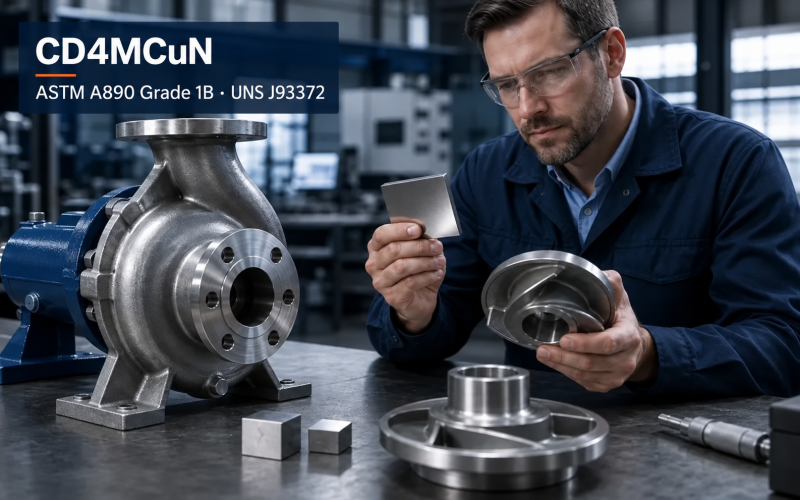
CD4MCuN is a duplex stainless steel casting alloy identified as ASTM A890 Grade 1B and UNS J93372. Its specified strength and corrosion resistance make it a candidate for selected pump duties, including some abrasive and chloride-containing services. The grade name alone does not establish compatibility: review the complete fluid chemistry, temperature, solids, velocity, component design and applicable purchase specification.
This guide summarizes the designation, published specification values and checks that matter when reviewing CD4MCuN pump castings. It is a screening reference, not a corrosion guarantee or a substitute for the project material specification.
01 · Designation
What do CD4MCuN, Grade 1B and J93372 mean?
CD4MCuN is a duplex stainless steel casting grade. ASTM A890 covers duplex stainless steel castings for general application; ASTM A995 covers duplex stainless steel castings for pressure-containing parts. The purchase order should identify the standard and edition, grade, product form and any supplementary requirements. A wrought bar or forging needs the specification for that product form, not an automatic casting-grade equivalence.
| Item | Reference | What to confirm |
|---|---|---|
| Common casting designation | CD4MCuN | Confirm the supplied product is a casting and the exact grade is on the order and material record. |
| ASTM grade / UNS | Grade 1B / J93372 | Confirm the specified standard and edition; do not accept “duplex stainless” alone. |
| General-application castings | ASTM A890 | Use the project requirements for inspection, testing and acceptance. |
| Pressure-containing castings | ASTM A995 | Use where the design and purchase specification call for the pressure-containing casting standard. |
ASTM describes A890 as a general-application casting specification and A995 as a specification for pressure-containing duplex castings. Both emphasize that properties depend on balanced chemistry and proper heat treatment. See the current ASTM A890 scope and active ASTM A995/A995M-20.
02 · Chemistry
CD4MCuN chemical composition
The table below reproduces the Grade 1B chemistry limits shown in the Steel Founders’ Society of America handbook’s ASTM A890/A890M-13 summary. Use the exact edition named in the contract for acceptance; the heat analysis on the material test report is the supplied heat’s measured chemistry.
| Element | Grade 1B range or maximum, wt.% | Selection context |
|---|---|---|
| Carbon (C) | 0.04 max. | Low maximum carbon is part of the specified alloy chemistry. |
| Manganese (Mn) | 1.00 max. | Confirm against the applicable heat analysis. |
| Silicon (Si) | 1.00 max. | Confirm against the applicable heat analysis. |
| Phosphorus (P) | 0.04 max. | Maximum specified value. |
| Sulfur (S) | 0.04 max. | Maximum specified value. |
| Chromium (Cr) | 24.5–26.5 | Major alloying element; contributes to passivation and localized-corrosion resistance. |
| Nickel (Ni) | 4.7–6.0 | Part of the duplex alloy balance. |
| Molybdenum (Mo) | 1.7–2.3 | Contributes to resistance to pitting and crevice corrosion. |
| Copper (Cu) | 2.7–3.3 | Part of the specified CD4MCuN chemistry; acid performance remains service-specific. |
| Nitrogen (N) | 0.10–0.25 | Controlled alloy addition; do not infer a weld procedure or corrosion rating from nitrogen alone. |
| Iron (Fe) | Balance | Base metal; confirm chemistry against the heat-specific report. |
Composition limits are not a substitute for a heat-specific MTR. The published SFSA handbook table is a secondary reproduction of an older ASTM edition; verify current contract requirements before using any value for acceptance.
03 · Mechanical properties
Specified strength and how to compare it fairly
The Grade 1B values in the cited ASTM A890/A890M-13 table are minimum tensile properties for the specified casting grade and heat-treatment condition:
These are casting-specification minima, not guaranteed values for every component location or a direct prediction of wear life. If comparing against CF8M, CN7M/Alloy 20 or a wrought 316 grade, state the product form, governing specification, edition and whether each value is a minimum or typical result. Do not compare a cast Grade 1B minimum with a typical wrought value as if the test basis were identical. See the SFSA handbook summary and verify the contract edition.
A Flowserve bulletin for its Durcomet 100 CD4MCuN product reports a typical Brinell hardness of 224. That is a manufacturer-specific typical value, not a universal ASTM A890 acceptance requirement. Hardness alone does not establish slurry erosion performance.
04 · Duplex structure
PREN, ferrite and the role of nitrogen
Duplex stainless steels contain ferrite and austenite. ASTM A890 states that ferrite levels are not specified by the standard and that these alloys typically develop approximately 30–60% ferrite, with the balance austenite. Do not publish a 40–60% acceptance requirement unless the purchaser’s specification explicitly adds it.
A commonly used estimate is PREN = %Cr + 3.3 × %Mo + 16 × %N. The Nickel Institute’s practical guide lists CD4MCuN at about PREN 34. Actual composition changes the calculated result, and PREN does not predict corrosion rate or replace application-specific corrosion data.
Grade 1B specifies nitrogen content, unlike the older CD4MCu/Grade 1A designation. Nitrogen affects alloy balance and is relevant to duplex metallurgy and welding behavior. Describe this as a grade difference, not as proof that every Grade 1B casting is a drop-in replacement for every Grade 1A component. Confirm the drawing, specification, service and customer approval before substitution.
05 · Application review
Where CD4MCuN may be considered—and what must be checked
Use the following as a screening framework, not a universal chemical-resistance chart. Published manufacturer experience includes wet-process phosphoric-acid duties involving solids and mixed acids. That evidence supports evaluating CD4MCuN for a defined application; it does not mean every phosphoric-acid, sulfuric-acid or fluoride mixture is suitable.
| Service factor | Information to provide | Why it matters |
|---|---|---|
| Fluid chemistry | All chemicals, concentration ranges, contaminants and cleaning chemicals | Mixed and changing chemistries can behave differently from a single pure chemical. |
| Operating conditions | Normal, maximum and upset temperature; pressure; starts and shutdowns | Temperature and transients affect corrosion and material limits. |
| Chlorides and pH | Chloride level, pH, dissolved oxygen and oxidizing/reducing conditions | These influence localized corrosion and stress-corrosion risks. |
| Solids and hydraulics | Solids type, concentration, particle size, velocity and expected impingement | Erosion-corrosion depends on both alloy and flow/particle conditions. |
| Component details | Casing, impeller or other wetted part; crevices, deposits, weld repairs | Local geometry and manufacturing history can change the failure mechanism. |
For sulfuric acid specifically, the Flowserve bulletin notes that its CD4MCuN product behaves differently in aerated and deaerated acid, and that oxidizing contaminants can change the applicable range. Do not state a universal concentration/temperature limit without an isocorrosion chart for the exact alloy and conditions.
ASTM A890 states that its duplex grades are not recommended above 315°C because embrittling phases may precipitate. This is the standard’s general service note; the project specification and current standard edition govern. Do not substitute a simplified “475°C is the maximum” claim. For low-temperature service, request the applicable impact-test and design qualification rather than applying a generic −50°C cutoff.
Strong acids, seawater and chloride brines should be reviewed with full chemistry and supplier data. If no relevant corrosion data exists, escalate to a qualified materials engineer or corrosion specialist before specifying the alloy.
06 · Manufacturing and records
What to verify for a CD4MCuN pump casting
ASTM A890/A995 require heat treatment appropriate to the grade, and ASTM describes rapid cooling as important for the duplex castings. Do not copy a single temperature/time recipe from a product bulletin into a universal procedure. Confirm the governing standard edition, foundry procedure and heat-treatment record for the supplied casting.
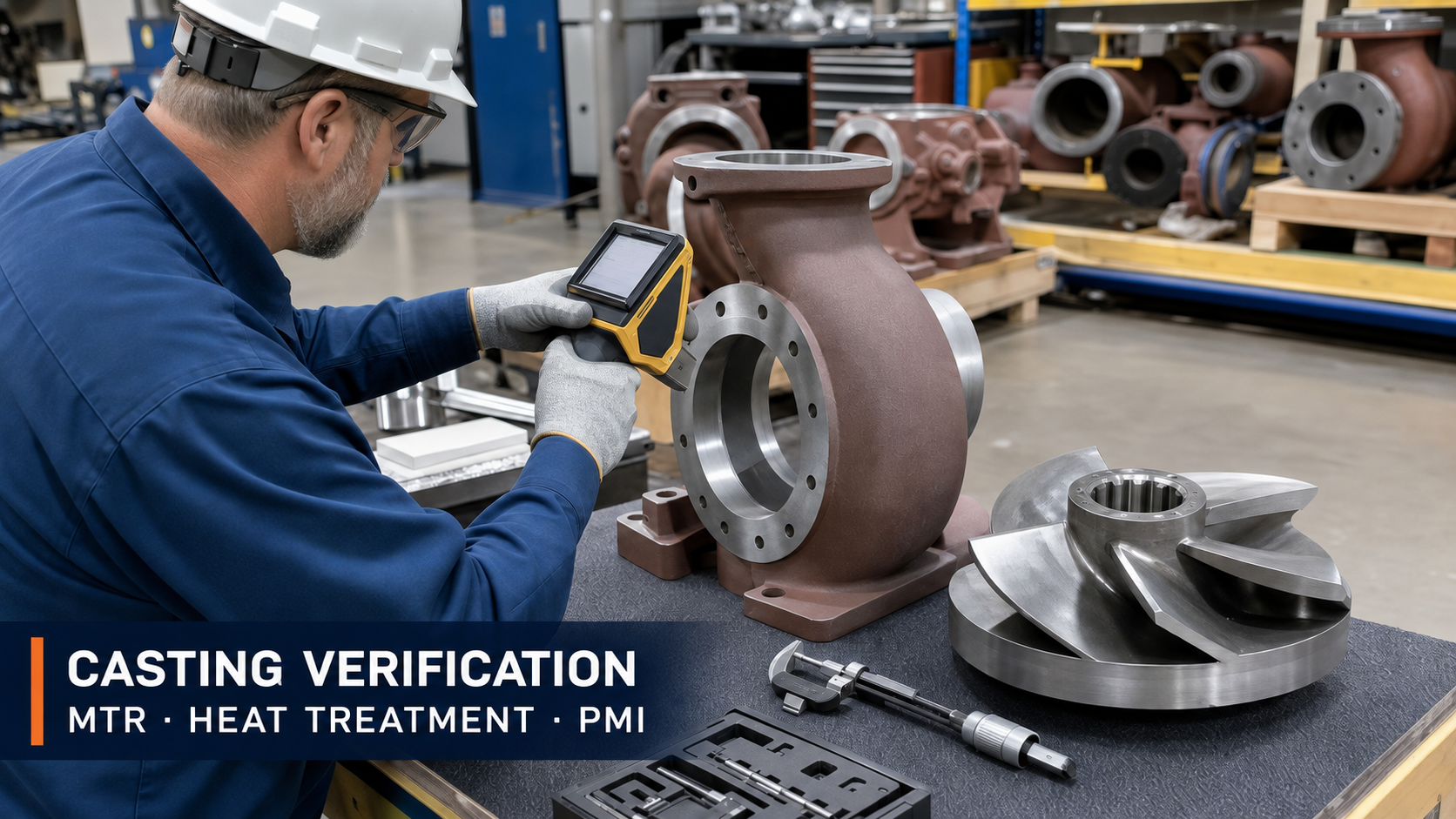
PMI can help verify alloy identity but does not replace heat-specific chemical analysis, heat-treatment records or required mechanical testing. If ferrite measurement, impact testing or a particular certificate format is needed, state it in the purchase order and agree the method and acceptance criteria in advance.
07 · Pump parts
Ordering CD4MCuN replacement pump components
Material selection and replacement fitment are separate approvals. For an impeller, casing, cover or wet-end kit, provide the exact pump model and size, part number or drawing, material callout, operating duty and service chemistry. Then verify dimensional interfaces, shaft/seal arrangement, clearances and hydraulic performance against the installed configuration.
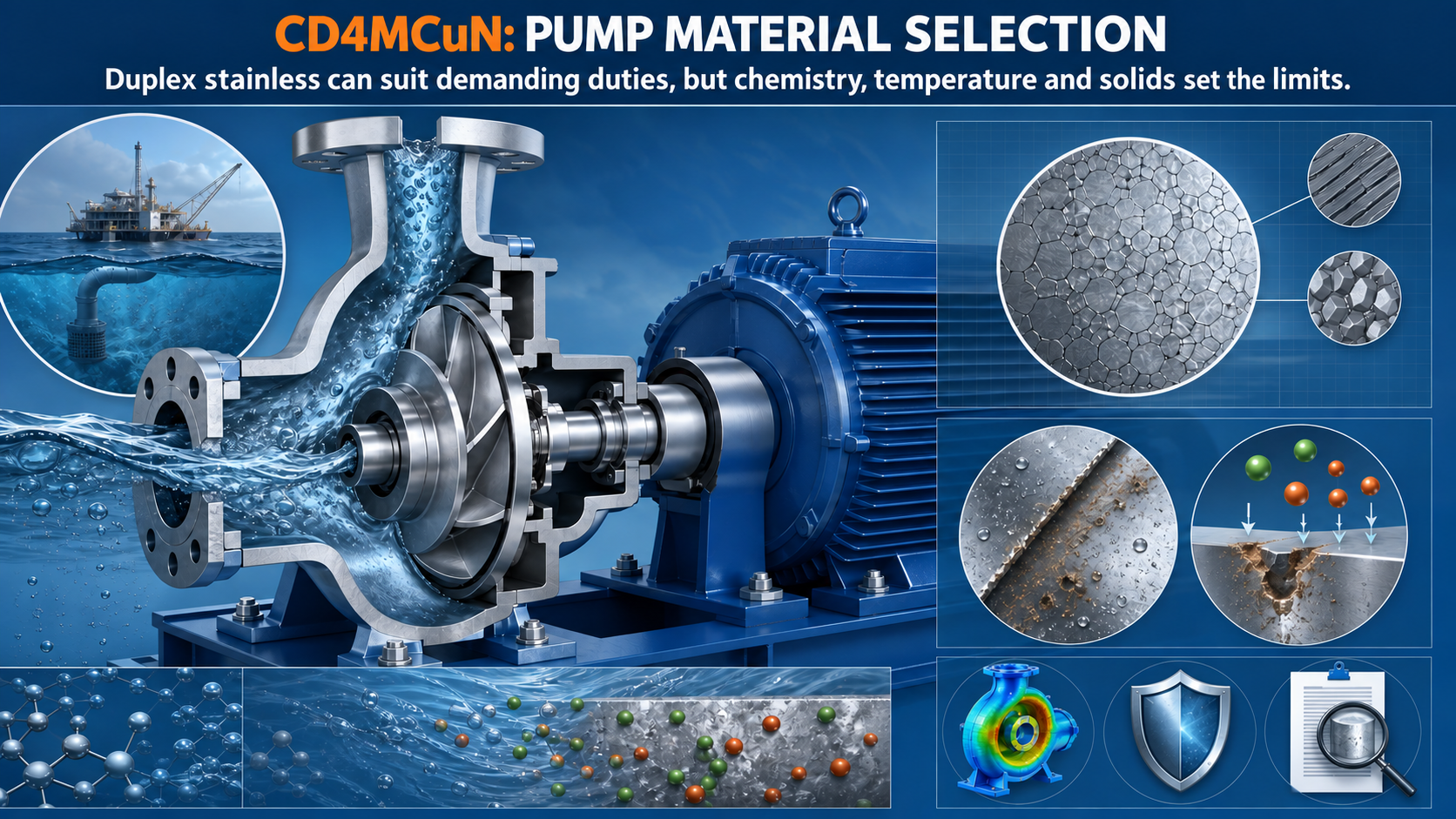
For Goulds 3196 or Durco Mark III replacement scopes, see the CD4MCuN wet-end kit fitment guide. Browse the ANSI process pump range for pump and replacement options. Brand names identify reference equipment only; confirm the exact supplied scope and compatibility evidence.
Request a CD4MCuN material review
Send the pump model, component drawing or part number, fluid composition, concentration, temperature, chloride level, pH, solids and operating duty. We can review the material question separately from fitment and hydraulic requirements.
Sources
Standards and technical references
- ASTM A890/A890M-26 — scope and general requirements for duplex stainless steel castings.
- ASTM A995/A995M-20 — active edition identified in ASTM’s version history for pressure-containing duplex castings; confirm the purchase-order edition.
- SFSA Steel Castings Handbook Supplement 2 (2017) — reproduced ASTM A890/A890M-13 chemistry and minimum mechanical-property table.
- Nickel Institute, A Practical Guide to Using Duplex Stainless Steels — duplex casting designations and typical PREN reference.
- Flowserve Durcomet 100 CD4MCuN bulletin — manufacturer-specific properties, heat-treatment description and corrosion discussion.
Sources are provided for technical context. The applicable purchase specification, current standard edition and project-specific engineering review take precedence.
Frequently asked questions
CD4MCuN FAQs
Is CD4MCuN the same as ASTM A890 Grade 1B?
CD4MCuN is the common alloy designation for ASTM A890 Grade 1B, UNS J93372, in cast form. Confirm the standard and edition specified for the supplied component.
What is the difference between CD4MCu and CD4MCuN?
CD4MCu is commonly associated with Grade 1A, while CD4MCuN is Grade 1B with a specified nitrogen range. The grades are not automatically interchangeable in every drawing or service; obtain project approval before substitution.
What are the specified minimum mechanical properties for Grade 1B?
The cited ASTM A890/A890M-13 table lists minimum tensile strength of 690 MPa, minimum 0.2% yield strength of 485 MPa and minimum elongation of 16%. Verify the contract edition and test basis.
Can CD4MCuN handle sulfuric or phosphoric acid?
It may be a candidate in selected services, but no universal concentration or temperature limit applies. Acid concentration, temperature, aeration, contaminants, solids and velocity can change corrosion and erosion-corrosion behavior. Review data for the exact conditions.
What should I request with a CD4MCuN casting?
Specify the casting standard and grade, heat-number traceability, material test report, heat-treatment evidence and any required PMI, NDE, dimensional, pressure-test or balance records in the purchase order.