
Engineering review: September 25, 2026. This guide focuses on ANSI/ASME B73.1 pump MRO procurement. It does not promise fixed savings, delivery times or compliance outcomes. Confirm each replacement against the installed pump, service, purchase specification and destination-country requirements.
Where ANSI B73.1 Pumps Fit in Oil and Gas Facilities
ANSI/ASME B73.1 covers a defined family of horizontal, end-suction, single-stage chemical-process pumps. Depending on project specification and service, these pumps may be used in utility, water-treatment, chemical-transfer and other process duties. The applicable standard is set by the project and owner requirements; do not select or replace a pump by industry label alone.
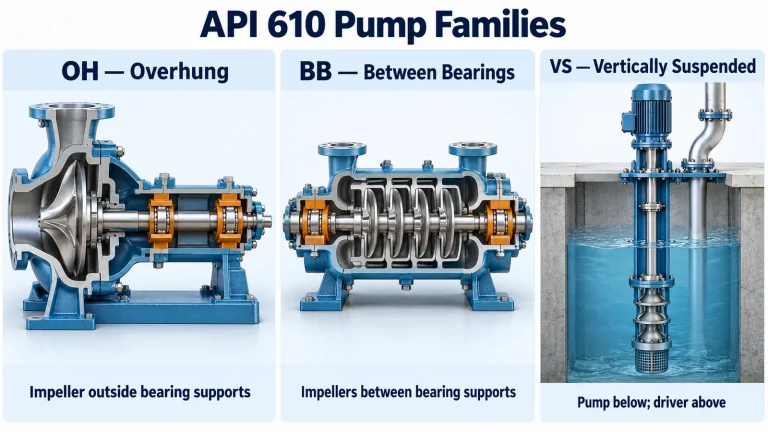
API 610 is commonly specified for many petroleum, petrochemical and natural-gas process services. B73.1 and API 610 have different scopes. Before proposing an ANSI pump or aftermarket part for an oil-and-gas asset, confirm the equipment datasheet, purchase specification, service and criticality. A B73.1 pump is not an automatic substitute for an API 610 pump.
ASME describes B73.1 dimensional interchangeability in relation to specified installation interfaces such as mounting dimensions, nozzle size and location, input shafts, baseplates and foundation bolt holes. This does not establish universal interchangeability of internal parts, materials or hydraulic performance. See the ASME B73.1 scope and verify the installed configuration.
Establish the Installed-Pump and Cost Baseline
Create a controlled register for the pumps in the MRO review. Capture enough information to distinguish similar-looking equipment and make quotations comparable:
- OEM, model, size, frame or group, serial number, speed and nameplate photo.
- Impeller diameter, shaft arrangement, power end, seal chamber, coupling and retained components.
- Service liquid, concentration where relevant, temperature, density, viscosity, solids and operating duty.
- Approved drawings, revisions, installation dimensions, material requirements and seal arrangement.
- Failure mode, maintenance history, vibration or leakage observations, operating hours and redundancy.
- Part numbers, quoted scope, freight and inspection costs, documented lead time and stock location.
Separate verified information from assumptions and measurements still required. Compare equivalent scope on each quotation: part or assembly, material, inspection package, packing, freight, import responsibility and installation work. Build the business case from the site’s purchase and maintenance records rather than a generic saving percentage.
Use the site’s OEM part-number cross-reference or aftermarket pump-parts overview as identification starting points. A cross-reference locates a candidate; it does not by itself approve fit, material or duty.
Set Spare Strategy by Asset Criticality
Classify assets using the site’s safety, environmental, production and redundancy criteria. These A/B/C labels are a planning aid, not a prescribed standard or universal stocking formula.
| Planning class | Consequence to assess | Planning response |
|---|---|---|
| A — high | High failure consequence or limited redundancy | Approve critical spare scope, drawings, acceptance evidence and delivery route before the planned outage. |
| B — medium | Some redundancy, bypass or time to plan | Use planned replenishment, condition history and configuration-specific reorder rules. |
| C — lower | Lower consequence or readily available workaround | Consider order-to-plan or repair assessment; share stock only when fitment and storage controls are clear. |
Inventory should reflect failure consequence, observed consumption, repair options, supplier evidence, storage conditions, transport route and time available before intervention. Do not assign a fixed stock quantity to every site or pump model without reviewing those factors.
Choose the Right Spare Scope
Modular spares can simplify a planned intervention when the assembly and interfaces have been approved in advance. A pre-assembled power end or complete wet end may reduce field work in a specific maintenance plan, but does not guarantee a particular change-out duration. Check lifting, access, coupling, alignment, seal, piping and acceptance requirements at the installation.
| Spare scope | Engineering checks | Records to agree |
|---|---|---|
| Wet end | Casing, cover, impeller, wear clearances, gaskets, material and duty. | Approved drawing, material specification, dimensions and agreed pressure test. |
| Rotating assembly | Shaft, sleeve, impeller, key, bearings, fits, balance and speed as one system. | Assembly drawing, fit-up dimensions, balance and inspection records as specified. |
| Seal or wear parts | Seal chamber, sleeve, faces, elastomers, flush arrangement and liquid compatibility. | Seal data, material review, clearances and inspection evidence as specified. |
| Complete pump | Nozzles, base, coupling, motor, curve, driver load and installation interfaces. | Datasheet, GA drawing, performance data, agreed tests and deviation list. |
Separate dimensional, mechanical, hydraulic, material and operating compatibility. Cross-brand power-end questions need model, frame or group and interface checks; see the ANSI power-end compatibility review. Also see B73.1 dimensional interchangeability versus component compatibility.
Agree QA/QC Evidence Before Ordering
Define inspection and documentation in the purchase specification before production. The right package depends on component, service risk, material, contract and customer requirements; one certificate or test plan does not automatically apply to every pump and part.
- Material: specified grade, heat or batch traceability, and certificate type required by the order.
- PMI: apply when required by material, service or project specification; agree parts and acceptance method.
- Dimensions: approved drawing revision, critical interfaces, tolerances and inspection method.
- Rotating parts: balance requirement and acceptance criteria for the component and applicable specification.
- Pressure boundary: test scope, pressure, duration and acceptance criteria defined by governing specification or contract.
- Performance: test scope and acceptance grade only where required and applicable.
- Nonconformances: written deviation list, concession approval and release records.
For rigid-rotor balancing, ISO lists ISO 21940-11:2016 as the current standard replacing ISO 1940-1:2003. The required balance grade still comes from the pump design, component and agreed specification; do not apply one grade universally. Likewise, agree pressure and performance tests with the governing specification and contract instead of using a blanket multiplier or grade.
State which documents are included with a quotation and which require a project-specific request. Promise only records and response times that the supplier can provide for the quoted scope.
Plan Regional Logistics and Local Support by Country
West Africa is not one customs or local-content jurisdiction. For each shipment, record destination country, delivery point, importer of record, shipping terms, required permits, document owner, packaging, storage conditions and actual stock location. Use shipment and broker records for route estimates; port names alone do not establish a reliable transit time.
Nigeria: verify current import and local-content requirements
For Nigeria, confirm whether the product and transaction fall within SONCAP or import-permit requirements. SON says SONCAP and import-permit processes for Form M, PAAR and cargo clearance moved to the National Single Window from March 2026. Product scope and importer requirements vary; consult SON service information and the current SON National Single Window notice before shipment. This is Nigeria-specific guidance, not a rule for every West African country.
NOGICD Act and NCDMB requirements apply in the Nigerian oil and gas context. Local-content obligations, registrations, certificates and contracting roles depend on work scope and tender. Confirm project requirements with the operator or a qualified Nigerian adviser; do not assume every aftermarket part needs the same certificate or that a nominal local partner satisfies the contract. See NCDMB ministerial regulations.
For a local service partner, define responsibility for field measurement, technical approval, installation, alignment, testing, traceability, customs documents and escalation. Verify actual capability and contractual roles.
A 12-Month MRO Improvement Plan
- Q1 — Baseline: asset register, configuration data, criticality ranking, spend categories, failure history and missing-data list.
- Q2 — Qualify: select a limited trial scope, close drawing and material questions, agree inspection records and log baseline condition.
- Q3 — Review: document received dimensions, fit-up, commissioning observations, delivery performance and deviations.
- Q4 — Decide: compare actual total cost, documentation, reliability observations and replenishment performance; expand or revise based on evidence.
Track equivalent-scope delivered cost, planned and actual delivery dates, receiving-document completeness, fit-up deviations, maintenance labor, repeat failures and inventory value. This is a review cadence, not a guaranteed savings schedule.
West Africa Pump MRO RFQ Checklist
- Country, site, destination, importer and required delivery date.
- Pump OEM, model, size, frame/group, serial number and nameplate photos.
- Part and position numbers, drawing revisions, and any provisional field measurements.
- Requested scope: individual part, rotating assembly, power end, wet end or complete pump.
- Liquid, temperature, concentration, density/SG, viscosity, solids and duty data as applicable.
- Materials, seal arrangement, inspection/testing requirements and requested documents.
- Quantity, planned maintenance window, packaging, shipping terms, customs and installation responsibilities.
- Known deviations, assumptions and information still needed for approval.
Send the pump model, part list or photos, drawings, service conditions, required records and delivery destination. An engineering review can identify the interfaces and specifications to confirm before quotation.
Request a West Africa Pump MRO Review
Share the installed pump details, requested part scope, operating conditions and delivery destination for an engineering review.
Frequently Asked Questions
How can operators reduce pump MRO cost without increasing risk?
Standardize asset records, verify each replacement against the installed configuration, agree quality evidence before ordering and align inventory with site failure consequences and logistics. Compare equivalent delivered scope using actual procurement and maintenance records.
Does ANSI/ASME B73.1 make internal pump parts interchangeable?
No. B73.1 includes specified installation-dimension requirements, but does not establish universal interchangeability of internal parts or hydraulic performance. Verify pump model, frame/group, materials, interfaces and duty.
Does every pump-spare shipment to Nigeria require SONCAP?
Not necessarily. Applicability depends on product scope and the import transaction. Check current SON/NSW guidance with the importer or customs adviser for the specific item and shipment.
What belongs in a pump MRO RFQ?
Include destination, pump identification, part or assembly scope, drawings or measurements, fluid and duty data, materials, seal details, required records, quantity, critical date and customs or installation responsibilities.
References and Scope Notes
Standards and import procedures change. This page was reviewed on September 25, 2026. For a specific project, use the current purchase specification and verify requirements with the responsible operator, importer and competent authority.