
ANSI B73.1 / PERFORMANCE SELECTION
Select an ANSI process pump for the duty you actually run.
Compare G196 and Mark III–interchangeable pump ranges by flow, head, temperature, pressure and wetted material—then have an engineer review the operating point.
Start pump selection →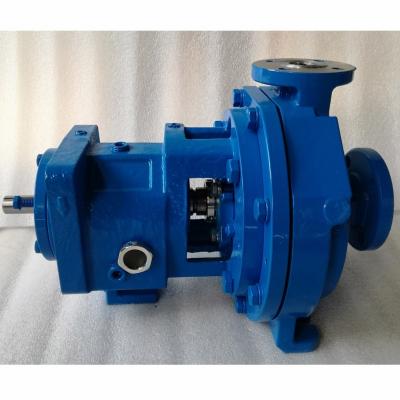
START WITH THE DUTY
Find the right performance envelope first.
Use known operating conditions to narrow the likely series. Final hydraulic and material selection is confirmed by engineering.
Add known duty data to see a likely series.
This is an orientation step, not a final pump selection.
View matching curves ↓Send selected data for review →SERIES COMPARISON
Two engineered routes to the same decision.
G196 maps to a 3196-style installed base; Mark III equivalent covers Mark III configurations and the higher duty envelope.
3196-interchangeable ANSI process pump
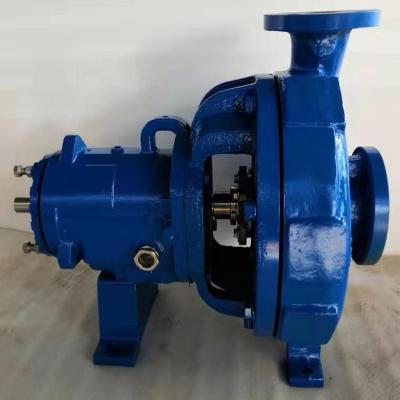
Mark III–interchangeable ANSI process pump
CURVE CENTRE
G196 performance envelope
The G196 range covers STX through XLTX frames with flow to 1,364 m³/h and heads to 223 m.
1×1.5-6 to 2×3-8
Illustrative envelope only. Final curve must state speed, impeller diameter, liquid SG and NPSHa.
MATERIAL SCREENING
Match metallurgy to the process, not just the pump model.
Begin with fluid, concentration and temperature. Engineering confirms the final wet-end alloy and seal arrangement.
CF8M / 316SS
Broad process-chemical coverage.
CD4MCu
Duplex stainless option.
CN7M / Alloy 20
Common sulfuric-service route.
Hastelloy B & C
High-alloy wet-end options.
Nickel
Available wetted-part material.
Titanium / Zirconium
Specialist selection; review required.
Preliminary material screening only. Do not select a material from this page without fluid concentration, temperature, pressure and solids data being reviewed.
ENGINEERING FAQ
Answer the curve questions before the pump is specified.
These answers are a practical starting point. Final hydraulic selection is confirmed against the application duty and system conditions.
How do I select an ANSI pump performance curve?
Start with flow, head, fluid, concentration, temperature and available NPSH. Engineering then confirms speed, impeller diameter, material and seal arrangement against the final curve.
What is the best efficiency point (BEP) on a pump curve?
BEP is the capacity range where hydraulic efficiency is highest. Operating near it generally supports stable hydraulic performance and lower operating stress.
Can a G196 replace a 3196 or a Mark III equivalent replace a Durco Mark III?
Compatibility is checked against the exact model, frame, interfaces, duty point and material requirement. Engineering confirms final interchangeability before quotation.
What information is needed for an engineering curve review?
Provide flow, head, fluid, concentration, temperature, solids, pressure, existing pump model and available NPSH. A datasheet, nameplate photo or existing curve helps but is not required to begin.

ENGINEERING EVIDENCE
Performance data needs a build and inspection trail behind it.
Manufacturing capability covers casting, machining, inspection and export packing for ANSI B73.1 pumps and parts.
- Hydraulic and interchangeability review — confirm family, frame, curve and critical interfaces.
- Material and manufacturing route — align construction with service conditions and documentation.
- Inspection evidence before shipment — dynamic balance, pressure test and fit test as applicable.
ENGINEER REVIEW
Send the duty point. We’ll return the curve context.
Share flow, head, fluid and any existing pump reference. A complete datasheet is welcome, but not necessary.