What Information Is Needed for a Goulds 3171 Replacement?
A reliable Goulds 3171 replacement review starts with the installed pump identity, required duty, drawing-defined setting, shaft and column arrangement, steady-bearing details, installation interfaces, and process conditions. Flow and head are necessary for hydraulic review, but they do not establish dimensional fit or component interchangeability.
This checklist is for plant engineers, maintenance teams, and buyers preparing an inquiry for a complete pump or a specific component. If the installed equipment is another vertical sump configuration, begin with the broader vertical process pump range and identify the exact model before using 3171-specific references.
Send what you have; identify what is missing
A nameplate, GA drawing, sectional drawing, BOM, repair record, and clear installation photographs each answer different questions. Mark estimated or inaccessible measurements as unverified rather than treating them as controlled dimensions.
Identify the Pump Before Comparing Replacement Parts
The Goulds 3171 IOM describes the 3171 as a vertical submerged-bearing sump and process pump and identifies S/ST, M/MT, and L drive-unit groups with multiple hydraulic sizes. The model name alone does not identify the complete shaft, column, bearing, hydraulic-end, or discharge configuration. Record the nameplate exactly and use the installed pump documents to resolve the configuration.
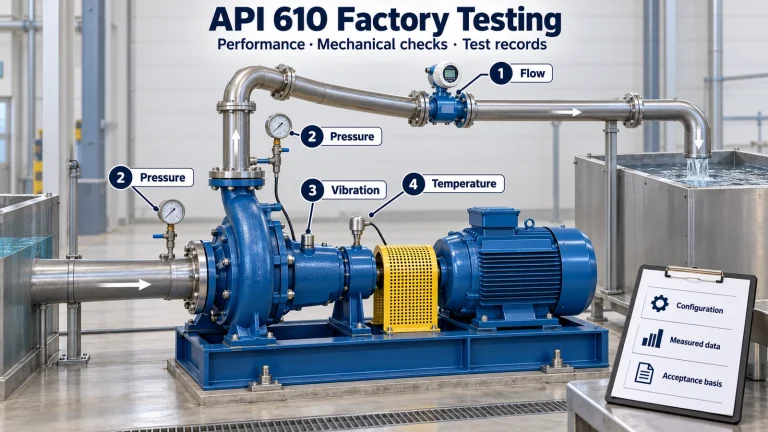
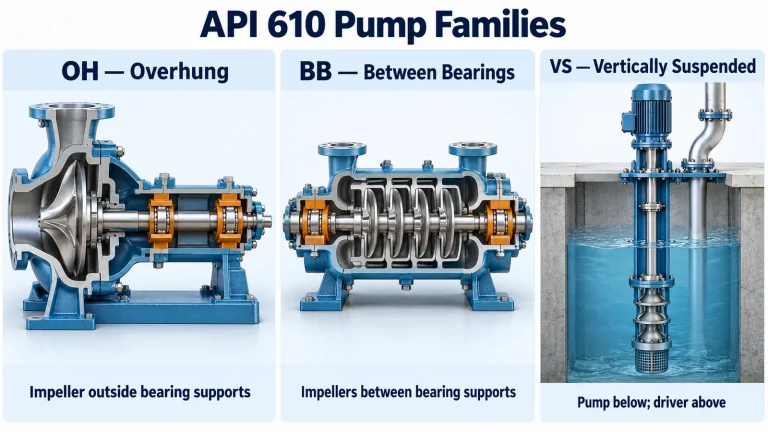
Do not infer that a standard Goulds 3171 is an ASME B73.1, ISO 2858, or API 610 pump. Goulds documents a separate API 3171 product; confirm the applicable design basis from the nameplate and project documents before specifying a replacement.
| Data group | What to provide | Why it matters |
|---|---|---|
| Identification | Manufacturer, model designation, pump size, serial number, nameplate photograph, and drive-unit group if documented | Establishes the starting configuration for document and part identification |
| Hydraulic duty | Required and observed flow, total head, operating speed, duty range, and suction conditions | Supports hydraulic review; the replacement curve must be checked for the specified duty |
| Setting and installation | Drawing-defined setting with both datums, pit depth, support-plate interface, discharge arrangement, liquid levels, and removal clearance | Defines the installed envelope and the axial arrangement to be reviewed |
| Shaft and column | Section lengths, joint types, coupling or thread details, shaft journals, column connections, and orientation features | Identifies mating interfaces and how the assembly is built and removed |
| Steady bearings | Count, locations from a stated datum, type, material if known, housing/register details, and lubrication passages where present | Supports review of the installed lineshaft arrangement and replacement component |
| Process conditions | Fluid composition, concentration, normal and maximum temperature, solids, operating history, and known corrosion or abrasion | Informs the project-specific review of wetted materials, bearings, and sealing arrangement |
| Driver | Motor or driver data, power, speed, frame, coupling, rotation, and available electrical details | Allows the power-end and operating requirements to be checked |
| Supporting records | GA and sectional drawings, BOM, datasheet, repair data sheet, prior inspection findings, and marked-up field sketches | Provides controlled references for confirming the interfaces and scope |
Photographs to collect before dismantling
Record Pit Depth and Pump Setting Separately
Pit depth describes the civil installation. Pump setting is a pump dimension defined between reference points on the applicable drawing. Do not substitute one for the other or convert either directly into shaft or column length without the controlled dimensional chain.
Every measurement needs a reference
For each vertical measurement, identify the start datum and end datum. Record liquid levels from a stated reference, and note whether a support plate, mounting stand, gasket, or other interface is included only when the drawing defines it. Mark field estimates as estimates.
For the field measurement sequence and the relationship among setting, shaft length, column sections, and bearing locations, follow the vertical sump pump setting and shaft measurement guide. Use the installed pump drawing to determine the actual datums.
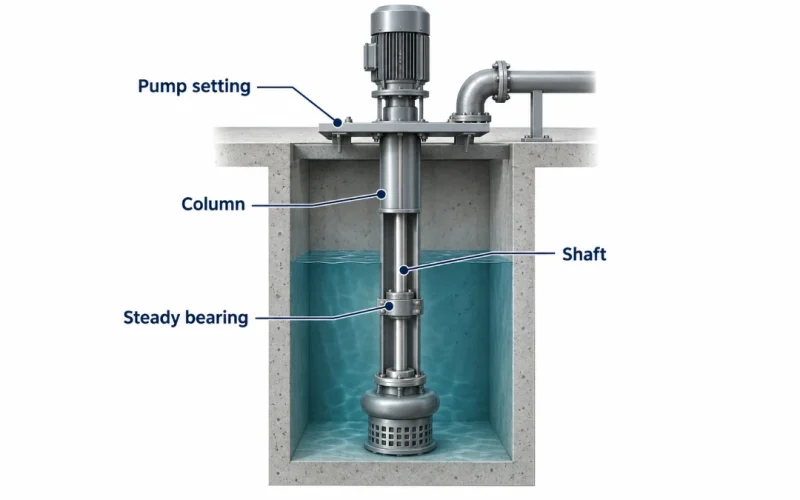
Setting, Column, Shaft, and Steady-Bearing References
Use the illustration to identify the information to document, not as a dimensional drawing for manufacture.
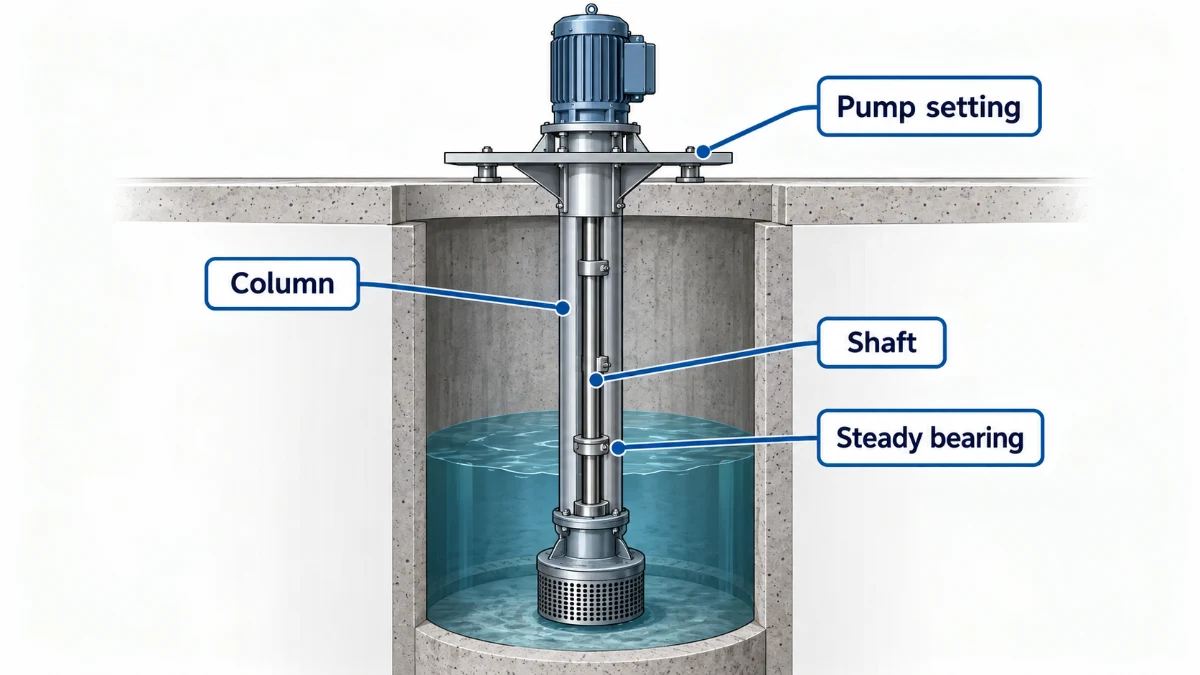
Document the Shaft, Column, and Steady-Bearing Arrangement
For a shaft or column inquiry, record each section and connection rather than providing only an overall length. Include coupling or thread features, keyways where applicable, bearing journals, shoulders, impeller attachment, and any runout or inspection findings required by the project drawing.
For a steady-bearing inquiry, provide the bearing or housing identification, register dimensions, shaft diameter at the bearing, bearing length, material if known, and lubrication passages or connections where present. If bearings remain installed, identify their positions from one datum and distinguish measured positions from estimates.
Bearing spacing is configuration-specific
Do not copy bearing quantity or spacing from another pump solely because its total setting appears similar. Arrangement depends on the documented pump configuration and service. The OEM IOM and installed drawings are the references for a model-specific review; this checklist does not prescribe universal shaft dimensions, bearing spacing, speed limits, or setting limits.
Provide the Duty and Process Conditions for Engineering Review
State the required operating point and any observed operating conditions, including flow, head, speed, liquid levels, and suction conditions. A pump curve or performance claim must match the specific size, configuration, speed, and impeller condition; the model family name alone is not performance evidence.
If you need to calculate or check a hydraulic input, use the relevant pump calculator for that calculation, then submit the resulting duty for model-specific review. The replacement data checklist does not replace a curve review or system analysis.
For material and bearing review, provide the actual fluid composition, concentration, temperature range, solids, and operating history. Do not select an alloy or bearing material from the chemical name alone. Final suitability depends on the complete service and configuration.
Choose the Review Scope: Complete Pump or Individual Component
| Request scope | Include with the inquiry | Review objective |
|---|---|---|
| Complete pump | Nameplate, duty, drawing-defined setting, installation interfaces, liquid levels, process data, and driver information | Review dimensional fit, hydraulic duty, materials, and the proposed assembly scope |
| Shaft or column | Section drawings or measured interfaces, each section length, joints, shaft features, bearing positions, and installation/removal constraints | Confirm mating interfaces and assembly arrangement before manufacture or quotation |
| Steady bearing or housing | Part markings, housing/register dimensions, shaft diameter at the bearing, bearing length, material, and lubrication details where applicable | Identify the component and the interfaces that must be verified |
| Hydraulic-end component | Pump size, serial or part number, BOM or sectional drawing, material, and observed wear or damage | Confirm part identity and compatibility with the retained pump configuration |
For complete-pump and parts information, review the 3171 vertical sump and process pump page. Replacement fit must be confirmed against the installed size, group, drawing, interfaces, materials, and duty; the model name alone does not establish interchangeability.
3171 Replacement RFQ Checklist
Send the information available and identify anything that still needs to be measured or confirmed. Attach the applicable drawings, BOM, datasheet, repair records, and photographs.
When the package is ready, request an engineering review and identify whether the inquiry is for a complete pump, shaft, column, bearing, or another component.
Goulds 3171 Replacement Questions
Can a Goulds 3171 replacement be selected from flow and head alone?
No. Flow and head support hydraulic review, but dimensional fit also depends on the installed size and group, drawing-defined setting, shaft and column arrangement, support plate, discharge interfaces, and other configuration details.
Is pit depth the same as the pump setting?
No. Pit depth is an installation dimension. Pump setting is defined between drawing-specific reference points. Record both separately and identify the datum for each.
Can a replacement shaft be quoted from a photograph?
A photograph can help identify the arrangement, but it does not establish controlled dimensions, material, mating interfaces, or required tolerances. Provide drawings or measured details where available.
Does the 3171 model name identify the shaft and steady-bearing arrangement?
No. The IOM describes multiple drive-unit groups and hydraulic sizes. Confirm the installed configuration from the nameplate, drawings, BOM, and component details.
Is every Goulds 3171 an API 610 pump?
No. The standard 3171 and Goulds API 3171 are separate product references. Verify the installed pump’s design basis from its nameplate and project documents.
Sources and Review Method
The model-family description and configuration terminology were checked against Goulds OEM literature. These references help identify what information to collect; they do not establish replacement fit, performance, or material suitability for every installed unit.
- Goulds Model 3171 Installation, Operation, and Maintenance Manual.
- Goulds 3171 / CV 3171 Vertical Sump and Process Pumps brochure. The brochure’s dimensional information is model-specific and is labeled not for construction use.
Prepared by the ANSI Pumps Pro editorial team from OEM literature and the replacement-review workflow. Last source review: September 26, 2026. Final setting, fit, material, and hydraulic selection require configuration-specific engineering verification.
ITT Goulds and referenced model designations are trademarks or product identifiers of their respective owners and are used only for identification and replacement-reference purposes. ANSI Pumps Pro / Yingsiman is independent and is not affiliated with, sponsored by, or endorsed by ITT Goulds.
For related vertical-pump engineering articles, browse Engineering Insights. General product context is available from the Vertical Process Pumps category.