
Start with the contract and the applicable NOGICD requirements
Do not assign a Nigerian-content percentage to a pump package by assumption. Identify the operating company, project, contracting strategy, procurement route, scope split and applicable tender clauses first. Then confirm which statutory provisions, Nigerian Content Plan commitments, NCDMB approvals and tender-specific requirements apply to the package.
Section 7 requires an operator to submit a Nigerian Content Plan before carrying out a project. Section 10(1)(a) requires the plan to provide for first consideration for services provided from within Nigeria and goods manufactured in Nigeria; Section 10(1)(b) addresses first consideration for Nigerians in training and employment. Section 11 addresses the minimum Nigerian content levels in the Act’s Schedule and provides for Board-set levels when a project item is not listed. Section 12 requires the plan to explain how the operator and contractors will give first consideration to Nigerian goods and services, including how bids are assessed. These provisions do not create one universal percentage for every pump purchase. Confirm the applicable requirements against the project documents and current NCDMB guidance. Ask the project’s Nigerian Content team or qualified Nigerian counsel to confirm the current requirements for the specific procurement.
For workforce and training, check the provisions in Sections 28–31 and the relevant project commitments. Technology-transfer provisions are addressed separately in Sections 43–46. Keep these obligations distinct in the compliance matrix instead of treating them as interchangeable.
Understand the roles of NCDMB, NOGIC JQS and NipeX
The Nigerian Content Development and Monitoring Board (NCDMB) administers the Act and publishes guidance and procedures. NOGIC JQS is the Nigerian Oil and Gas Industry Content Joint Qualification System used to register and classify service companies and suppliers. NipeX is an industry procurement and tendering platform with its own vendor-registration and tender processes. These systems are related, but they are not the same approval or a substitute for reviewing an actual tender.
Confirm the registration category and evidence requested in the live tender documents. Requirements can vary by contracting party, procurement route, service category and contract. Do not assume every pump purchase above a single threshold follows one universal NipeX process. Verify the current tender instructions and NCDMB procedure with the buyer.
Check NCEC status against the actual scope
Where a tender requires a Nigerian Content Equipment Certificate (NCEC), verify the certificate against the exact equipment category, certificate holder, stated capability, validity and contract scope. Use the current NCDMB guidance and approved list, and confirm directly with the contracting entity if the category or applicability is unclear.
An NCEC is not an ANSI/ASME pump design approval, a hydraulic-performance guarantee or a general certificate for every locally registered company. Do not present another company’s certificate as transferable or “borrow” it to qualify an unrelated supplier. NCDMB guidance requires the applicant and its capabilities to meet the applicable criteria. A local manufacturing or service partner should perform the real, documented work described in the tender and should be assessed for the actual scope.
Build a scope-specific evidence matrix
Assign an owner and source to each requirement before the RFQ is issued. The matrix below is a planning aid; the tender, approved Nigerian Content Plan and current NCDMB requirements control what evidence is actually needed.
| Workstream | Confirm | Evidence owner or source |
|---|---|---|
| Procurement basis | Applicable NOGICD provisions, tender route, Nigerian Content Plan commitments and approval steps | Buyer’s Nigerian Content team; tender documents; current NCDMB guidance |
| Supplier qualification | Required NOGIC JQS category, registration status and tender-specific eligibility | Supplier; NOGIC JQS; contracting entity |
| Equipment certification | Whether an NCEC is required and whether its holder, category, scope and validity match | Certificate holder; current NCDMB records; tender issuer |
| Local execution | Which Nigerian personnel, facilities, services, training or other deliverables are genuinely in scope | Named subcontractor or partner; project team; contract records |
| Technical acceptance | Duty, materials, interfaces, inspection and test requirements, documentation and witness points | Purchaser’s engineering specification; approved vendor documents; purchase order |
Define the pump duty and technical acceptance criteria
State the required flow, total head, fluid properties, operating range, temperature, suction conditions, driver, materials, applicable design standard and site conditions. Identify normal, minimum and maximum operating points and any standby or parallel-pump arrangement. The pump selection and acceptance criteria should be based on the approved data sheet and project specification, not on a model name alone.
ASME B73.1 defines dimensional and interface requirements for specified horizontal end-suction chemical-process pumps. Matching the standard designation and interfaces can support dimensional interchangeability; it does not by itself establish identical hydraulic performance, materials, impeller details or suitability for the service. Review the certified curve, nozzle loads, baseplate and coupling arrangement, seal plan and materials against the actual duty.
For sour service, apply NACE MR0175/ISO 15156 only when the fluid environment and project specification call for it. Material selection and acceptance depend on the relevant environment, material form and service conditions. There is no single hardness limit that should be applied indiscriminately to every pump component.
Request only the documentation specified for the package
Include a document register with the RFQ and agree required submittals, review codes and hold points in the purchase order. Depending on the specification, the package may call for:
- Pump data sheet, duty point and approved selection documentation.
- General arrangement, sectional drawing, nozzle dimensions and interface details.
- Material certificates and heat traceability; EN 10204 Type 3.1 only where specified.
- PMI records for the components and extent defined by the project specification.
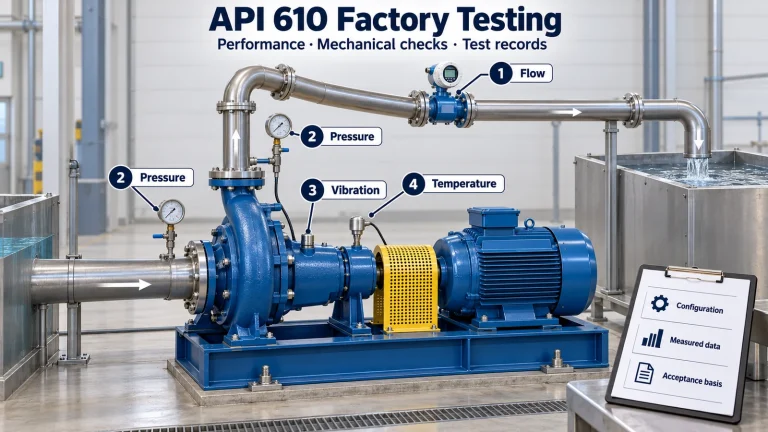
- Hydrostatic and performance test procedures and reports to the agreed code, acceptance criteria and witness requirements.
- Inspection and test plan, nonconformance records and final manufacturing record book where required.
- Installation, operation and maintenance instructions, recommended spares and training records when included in scope.
These technical records support engineering and quality acceptance. They do not, on their own, prove Nigerian-content compliance or replace NCEC, NOGIC JQS or project approval evidence.
Use a practical procurement workflow
- Before the RFQ: map the contract scope and confirm tender-specific Nigerian Content Plan, registration, certificate and approval requirements with the buyer.
- At supplier prequalification: validate the supplier’s required NOGIC JQS status and, if applicable, check NCEC holder, category, validity and capability against the exact scope.
- At bid evaluation: evaluate technical compliance, commercial terms and Nigerian-content evidence in separate but coordinated reviews. Record exceptions and obtain written clarification where requirements conflict or remain unclear.
- Before award: align the contract scope, local deliverables, subcontractors, reporting duties, document register and inspection points. Do not count proposed local work until the responsible party and deliverables are defined.
- During execution and closeout: retain approved submittals, inspection and test records, training evidence, delivery records and contract reports required by the buyer or regulator.
Common procurement mistakes to avoid
- Using an unsourced “typical Nigerian-content percentage” for all pump packages.
- Treating a database search as conclusive proof that no Nigerian supplier or capability exists.
- Assuming registration on NOGIC JQS, listing on NipeX or holding an NCEC automatically satisfies every tender requirement.
- Using a partner’s certificate without verifying the certificate holder’s actual capability and contractual role.
- Claiming a pump is fully interchangeable based only on frame dimensions or a model cross-reference.
- Promising a fixed savings, lead time or compliance outcome without a project-specific quotation and evidence.
- Confusing technical quality documents with Nigerian-content approvals.
Frequently asked questions
Does the NOGICD Act set one Nigerian-content percentage for every pump purchase?
No. Section 11 refers to the Act’s Schedule and Board-determined targets where applicable. The project, contract scope, Nigerian Content Plan and current tender or NCDMB requirements must be reviewed before setting a target.
Does every pump supplier need an NCEC?
Not necessarily. Check the tender and current NCDMB procedure to determine whether an NCEC applies to the equipment category and scope. Where required, verify the certificate holder, category, validity and capability.
Are NOGIC JQS and NipeX the same system?
No. NOGIC JQS is a supplier qualification and registration system. NipeX is a procurement and tendering platform with separate vendor and tender processes. Follow the contracting entity’s current instructions for both.
Does an EN 10204 Type 3.1 certificate prove Nigerian-content compliance?
No. It is a metallic product inspection document type. It may form part of the technical quality record when specified, but it is not an NCDMB approval or Nigerian-content certificate.
Plan the compliance review before committing to the pump package
For a pump selection or replacement review, send the RFQ or tender clause, pump nameplate, duty conditions and required interfaces. ANSI Pumps Pro can review the technical fitment and documentation scope requested for the quotation. Any Nigerian-content eligibility, NCEC applicability or statutory compliance determination should be confirmed with the buyer, NCDMB and qualified Nigerian counsel.
Request a pump documentation and fitment review or review the OEM part-number cross-reference. For model-specific replacement considerations, see our Goulds 3196 replacement pump and fitment review.
Official references and technical standards
- NCDMB: Overview of the NOGICD Act and Board mandate
- NCDMB: Guidelines for approvals of oil and gas contracting processes
- NCDMB: Strategic Business Development Unit and NCEC information
- NCDMB: NCEC guidance notes and certificate transfer clarification
- NCDMB: Approved NCEC list
- NCDMB: NOGIC JQS guidelines
- NipeX: About the procurement platform
- ASME B73.1: Horizontal end-suction centrifugal pumps
- ISO 15156: Materials for use in H₂S-containing oil and gas production environments
- EN 10204: Metallic products—types of inspection documents