
Short answer: An Aurora 3550 replacement should be selected from the installed pump’s documented interfaces and duty, not from the model name alone. Pentair has listed the Aurora 3550 as discontinued, so buyers may need to choose between replacement parts, a complete pump or a qualified alternative after fitment verification.

Why Aurora 3550 Replacement Searches Are Different
A discontinued pump can remain in service for years, while its maintenance requirement continues. The buyer may need a casing, impeller, shaft, sleeve, seal-related scope, rotating assembly or complete replacement. Each path has a different fitment risk. A similar flange size or ANSI B73.1 family does not by itself prove that the proposed pump will match the existing installation, hydraulics or materials.
What Must Match Before Calling It a Drop-In Replacement?
Use a controlled drawing and the installed pump data to check each interface. “Drop-in” should be treated as a project-specific fitment conclusion, not a universal product description.
| Check | What to verify |
|---|---|
| Suction and discharge | Nozzle location, orientation, flange size and class, and centerline height. |
| Base and footprint | Baseplate or foot dimensions, bolt pattern, anchor locations and maintenance clearance. |
| Shaft and coupling | Shaft diameter and extension, key, coupling, rotation, motor frame and alignment. |
| Seal system | Seal chamber, sleeve, gland, flush or quench connections and the applicable seal plan. |
| Wet-end interfaces | Casing, impeller, cover, gasket and wear interfaces when only parts are being replaced. |
| Hydraulic duty | Flow, head, speed, impeller trim, NPSH, power and the normal-to-maximum operating range. |
| Materials | Liquid concentration, temperature, pH, chlorides, solids, velocity and wetted material requirements. |
Pump Replacement vs Replacement Parts
- Complete pump: Confirm the installation, driver, coupling, hydraulics, materials and commissioning requirements.
- Wet end: Confirm casing, impeller, cover or seal-chamber interfaces, shaft arrangement, materials and the hydraulic effect of any trim change.
- Rotating assembly: Confirm shaft, impeller, sleeve, bearings, balance, clearances and power-end arrangement as a complete system.
- Individual component: Confirm the exact retained interfaces, drawing revision, material and inspection records before release.
Do not assume that a part advertised for an Aurora 3550 fits every size, frame or modified installation. Record what is being retained and what is being replaced.
Hydraulic and Material Verification
Provide actual or design flow, head, speed, density, viscosity, temperature, solids and suction conditions. Review the proposed curve at the required duty point and across startup, turndown and upset conditions. A pump that fits physically but operates far from its preferred region can introduce vibration, radial loading, seal problems or unnecessary energy use.
Review casing, impeller, cover, wear parts, sleeve and seal-wetted materials together. Concentration, temperature, pH, chlorides, solids, velocity and oxidizing or reducing conditions can change material suitability. ANSI B73.1 dimensional context does not replace a project-specific hydraulic or materials assessment.
What to Send for an Aurora 3550 RFQ
- Pump nameplate, serial or asset number and photographs of the installation.
- Overall and component drawings, part numbers and any known field modifications.
- Suction and discharge dimensions, baseplate or footprint measurements and coupling details.
- Required flow, head, speed, liquid properties, temperature, solids and suction conditions.
- Seal arrangement, motor data, materials of construction and the part or pump scope.
- Required inspection records, material certificates, PMI, balance, hydrostatic or performance tests.
- Delivery location, shutdown constraints and any limits on piping or baseplate changes.
When the original drawing is unavailable or the pump has been modified, request controlled field measurements before ordering. A documented measurement review is usually less disruptive than correcting nozzle, coupling or baseplate differences during installation.
Need an Aurora 3550 fitment review? Start an OEM part-number cross-reference with the nameplate, duty data, drawing and material requirements.
Inspection and Commissioning Checks
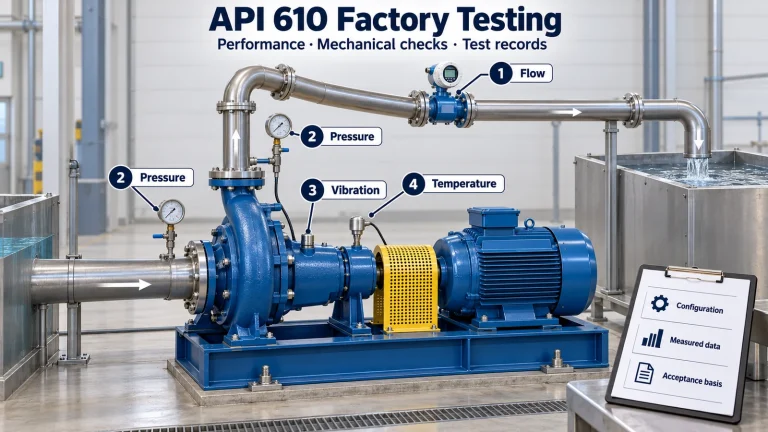
Agree the acceptance basis before production. Depending on the scope, request approved drawings, material test reports, PMI where appropriate, key-dimensional records, hydrostatic-test evidence, impeller-balance documentation and a deviation list. After installation, verify rotation, lubrication, alignment, seal support connections and valve position. Record suction and discharge conditions, flow, motor current, temperature and vibration at startup.
When an Alternative Is Not Yet Qualified
Pause the order when the supplier cannot identify the reference configuration, the drawing is uncontrolled, the curve is missing, critical dimensions are assumed, repair history is undisclosed or the proposed scope relies on a model name alone. The correct solution may be a part, a wet end, a complete pump, a piping change or a different material after engineering review.
Request Aurora 3550 Fitment Review
Send the installed pump data, photos, drawings and operating conditions. ANSI Pumps Pro can separate dimensional, mechanical, hydraulic, material and documentation checks before quotation approval.
Frequently Asked Questions
Is the Aurora 3550 discontinued?
Pentair has listed the Aurora 3550 as discontinued. The installed pump may still be serviceable, but parts and complete-pump replacement decisions should be based on the exact configuration and available documentation.
Can an ANSI process pump replace an Aurora 3550 directly?
Only after the specific nozzle, base, shaft, seal, hydraulic, material and operating requirements are checked against the proposed pump. ANSI B73.1 context alone does not prove universal drop-in fit.
Should I order a complete pump or replacement parts?
Choose the scope that solves the verified problem. A wet end or rotating assembly may be appropriate when retained interfaces and condition are known; a complete pump may be more defensible when the configuration, hydraulics or power end is uncertain.