
Short answer: The lowest quotation is rarely the full sourcing decision. Industrial buyers need to confirm what is actually included, how fitment will be proven, what records will ship with the pump and who owns the risk if the first installation does not meet duty.

The purchasing problem behind Asia pump sourcing due diligence
The lowest quotation is rarely the full sourcing decision. Industrial buyers need to confirm what is actually included, how fitment will be proven, what records will ship with the pump and who owns the risk if the first installation does not meet duty. The practical risk is a part or pump that appears compatible during quotation but fails at installation, misses the duty point, corrodes early or arrives without evidence that can be traced to the supplied item.
Separate the decision into five gates: dimensional fit, mechanical fit, hydraulic performance, material suitability and operating acceptance. A model family, flange pattern or standard designation may help narrow the search, but it cannot replace these gates.
What evidence should exist before purchase
| Gate | Evidence | Question to close |
|---|---|---|
| Dimensional | Approved drawing, CMM or dimensional report | Will it install without forced fit or unplanned machining? |
| Mechanical | Shaft, key, bearing, seal chamber, coupling and clearance data | Will the rotating and stationary parts work together? |
| Hydraulic | Corrected pump curve, duty point, NPSH and power data | Will it meet process duty at the actual liquid condition? |
| Material | Specification, heat number, MTR and PMI plan | Is the wetted material suitable and traceable? |
| Acceptance | Inspection, test and deviation records | How will the buyer prove conformity after delivery? |
Step-by-step buyer verification
1. Freeze the reference configuration
Record the original manufacturer, model, size, frame, impeller diameter, speed, seal chamber, power end, wet-end materials, shaft arrangement and part numbers. Photograph the nameplate and critical interfaces. If the existing pump has been modified, record those changes rather than assuming the catalogue configuration is still present.
2. Compare the drawing, not only the catalogue
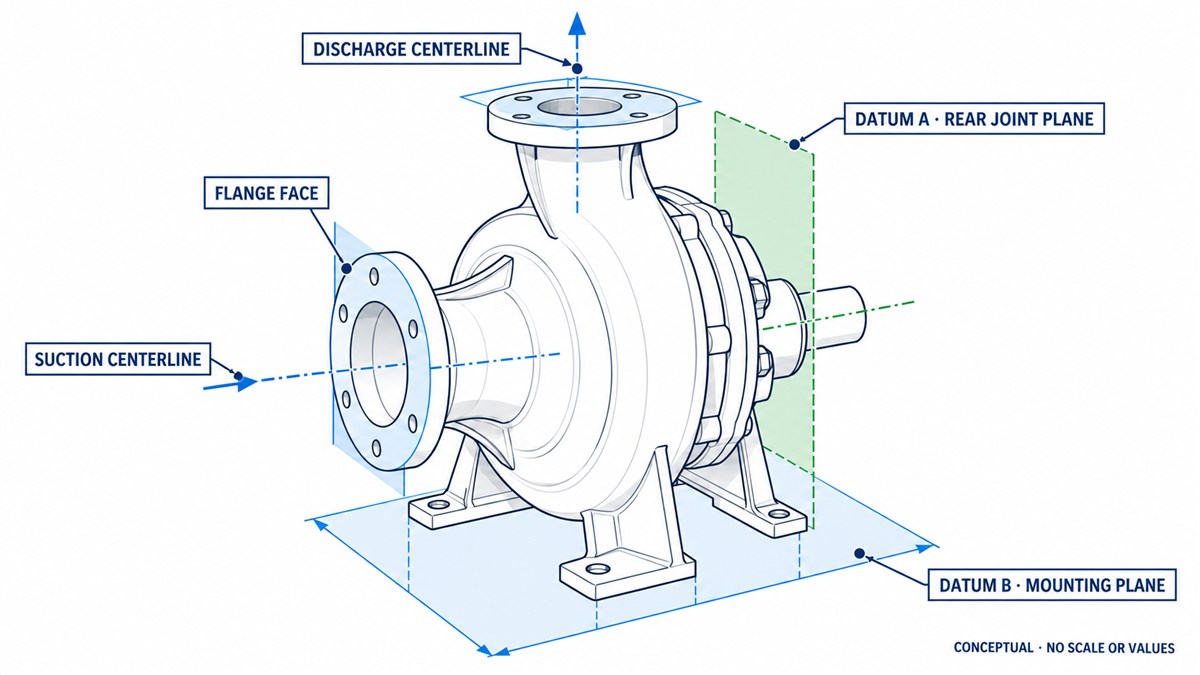
Check suction and discharge location, baseplate and bolt holes, shaft extension, coupling, bearing housing, casing dimensions, impeller clearances, seal chamber, gasket interfaces and rotation. If a supplier says “interchangeable,” ask which dimensions are guaranteed and which remain conditional.
3. Verify the duty point and fluid
Compare required flow, head, temperature, specific gravity, viscosity, vapor pressure, solids and operating range with the offered curve. Do not assume that a dimensionally compatible impeller produces the same head, efficiency, NPSH or motor load. Recheck the curve when the material, trim or speed changes.
4. Verify the material and manufacturing route
Ask whether the component is cast or wrought, what specification applies, how heat treatment is controlled, how repair welds are disclosed and how the heat number follows the item. For corrosion service, consider concentration, temperature, chlorides, pH, solids, velocity, oxidation and reducing conditions. For duplex and nickel alloys, chemistry alone is not enough; metallurgical condition and inspection evidence matter.
n
Where the purchase specification requires European-style material certification, state whether an EN 10204 3.1 inspection certificate is required; otherwise define the project’s required material-certificate format and traceability scope explicitly.
nn
Asia sourcing due diligence that protects the first installation
Screen the supplier’s technical response before comparing price. Ask for a marked-up datasheet, drawing revision, bill of materials, inspection and test plan, material route, performance test method, packing list, warranty exclusions, Incoterms and spare-parts support. Clarify whether the quotation is for a complete pump, wet end, power end or bare part.
Use a staged release: technical clarification, drawing approval, material release, in-process inspection, final inspection, performance evidence and shipment document review. This reduces the chance that a low price hides missing records or an ambiguous scope.
Inspection, traceability and acceptance checklist
- Approved GA and component drawings with revision control.
- Part-number and configuration cross-reference that states its limits.
- Dimensional report for critical interfaces and fit-up surfaces.
- Material certificates, heat numbers and PMI or other required verification.
- Balance, hydrostatic, performance, coating, weld-repair or casting records as applicable.
- Deviation list showing what differs from the original or purchase specification.
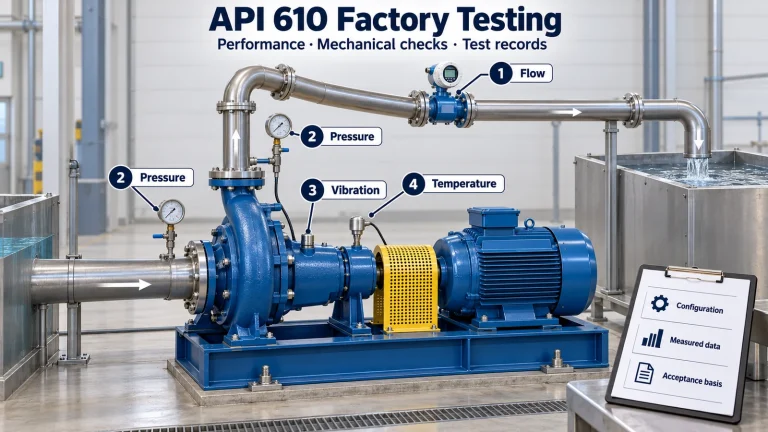
- Installation and commissioning readings for flow, head, vibration, temperature and leakage.

When a replacement should be rejected or escalated
Escalate when the supplier cannot identify the reference configuration, when a drawing is not controlled, when the material is described only by a trade name, when the curve is missing, when critical dimensions are assumed, when repair welds are undisclosed or when the part is claimed to fit multiple models without a stated scope. A lower quotation is not a saving if the first installation causes rework or production loss.
Send the drawing or part number for a technical fitment review.
What to send with an inquiry
Include the original pump model and size, serial or asset information, part number, drawing, duty point, liquid chemistry and temperature, material requirement, seal and coupling details, installation photos, inspection standard, delivery location and required records. State which items are mandatory and which can be proposed as alternatives.
Need help with Asia pump sourcing due diligence?
Send the pump nameplate, drawing, part number and operating conditions. ANSI Pumps Pro can help separate fitment, hydraulic, material and documentation risks before quotation approval.
Sources and related guides
- ASME B73.1 official standard page for chemical-process pump scope and dimensional interchangeability intent
- ANSI process pumps and replacement parts
- ANSI pump technical review
Frequently Asked Questions
What should be checked before ordering an ANSI pump from Asia?
Verify pump model and size, duty, materials, drawings, inspection scope, test standards, documentation, Incoterms, packaging, lead time and warranty exclusions.
How can I verify that a replacement part will fit?
Use approved drawings and a dimensional inspection report for casing, impeller, shaft, seal chamber, base and critical interfaces; do not rely on photos alone.
What is the most important supplier document?
There is no single document. A controlled drawing, material traceability, inspection record and performance evidence should agree with the purchase specification.
{“@context”:”https://schema.org”,”@type”:”FAQPage”,”mainEntity”:[{“@type”:”Question”,”name”:”What should be checked before ordering an ANSI pump from Asia?”,”acceptedAnswer”:{“@type”:”Answer”,”text”:”Verify pump model and size, duty, materials, drawings, inspection scope, test standards, documentation, Incoterms, packaging, lead time and warranty exclusions.”}},{“@type”:”Question”,”name”:”How can I verify that a replacement part will fit?”,”acceptedAnswer”:{“@type”:”Answer”,”text”:”Use approved drawings and a dimensional inspection report for casing, impeller, shaft, seal chamber, base and critical interfaces; do not rely on photos alone.”}},{“@type”:”Question”,”name”:”What is the most important supplier document?”,”acceptedAnswer”:{“@type”:”Answer”,”text”:”There is no single document. A controlled drawing, material traceability, inspection record and performance evidence should agree with the purchase specification.”}}]}