
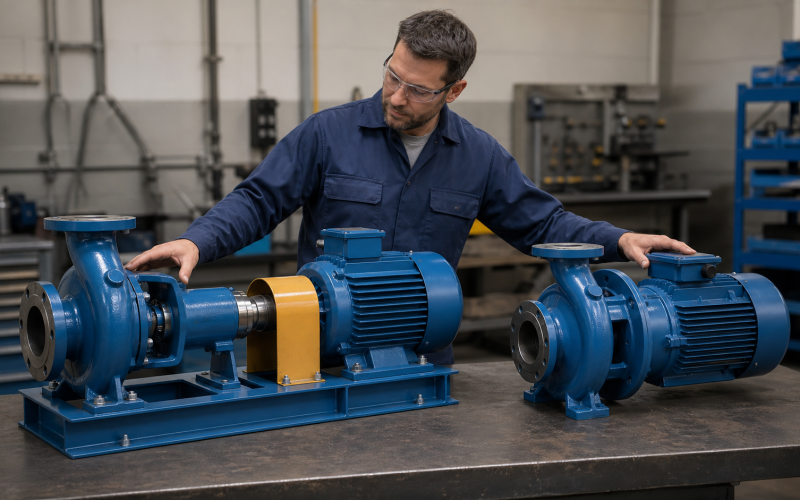
Frame-mounted and close-coupled centrifugal pumps can both be correct choices, but they solve different installation and maintenance problems. The choice affects alignment, bearing support, footprint, motor substitution, seal access, serviceability and total cost. This buyer guide explains what to compare before selecting an ANSI process pump configuration.
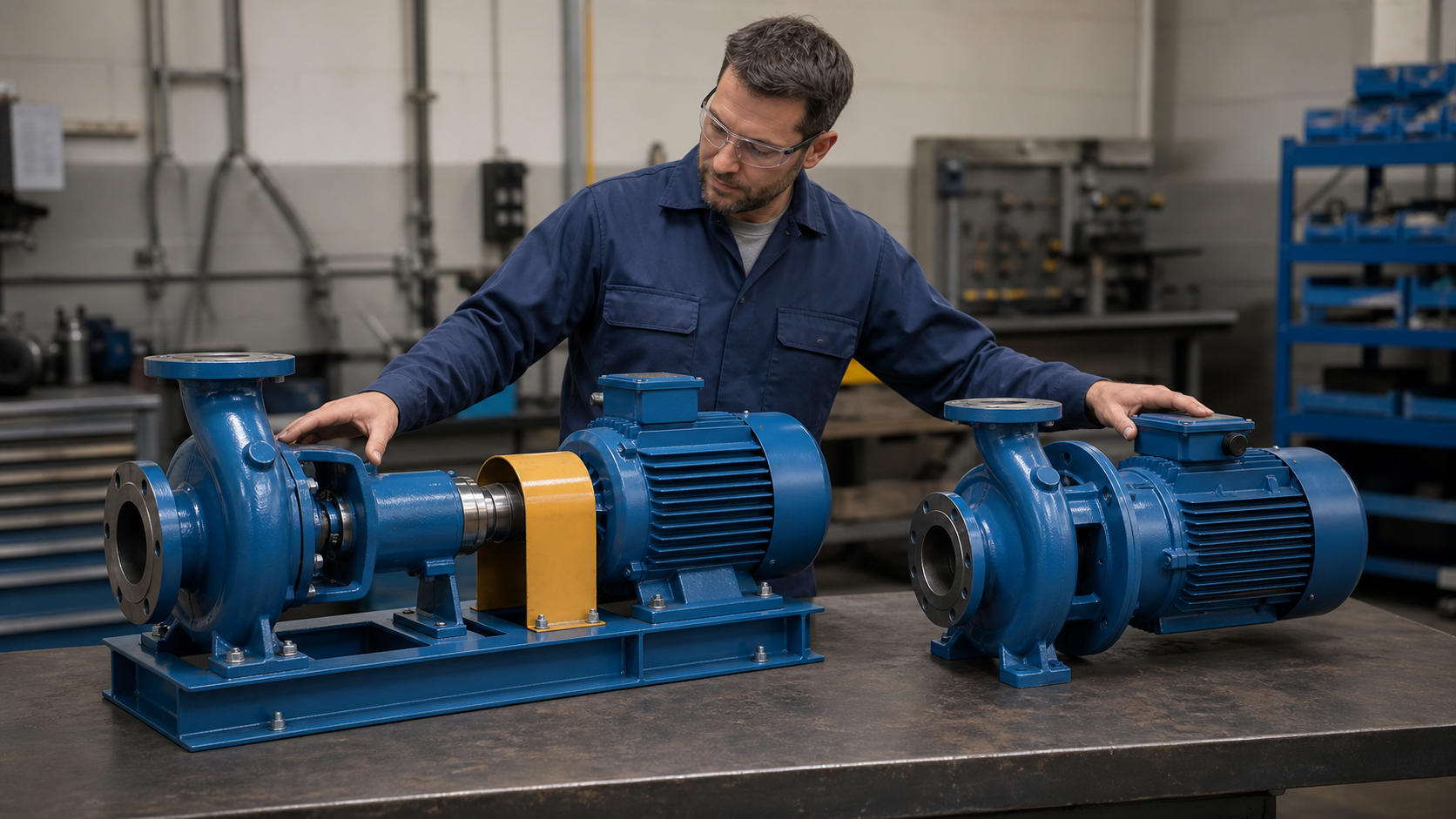
When does the configuration decision matter?
It matters when a pump is being replaced in an existing footprint, when the motor must be changed independently, when the service is continuous or critical, when maintenance access is restricted, or when a compact package is being considered for chemical process duty.
Do not choose only by purchase price or apparent simplicity. The right configuration is the one that supports the duty, maintenance plan and installation constraints.
How frame-mounted pumps work
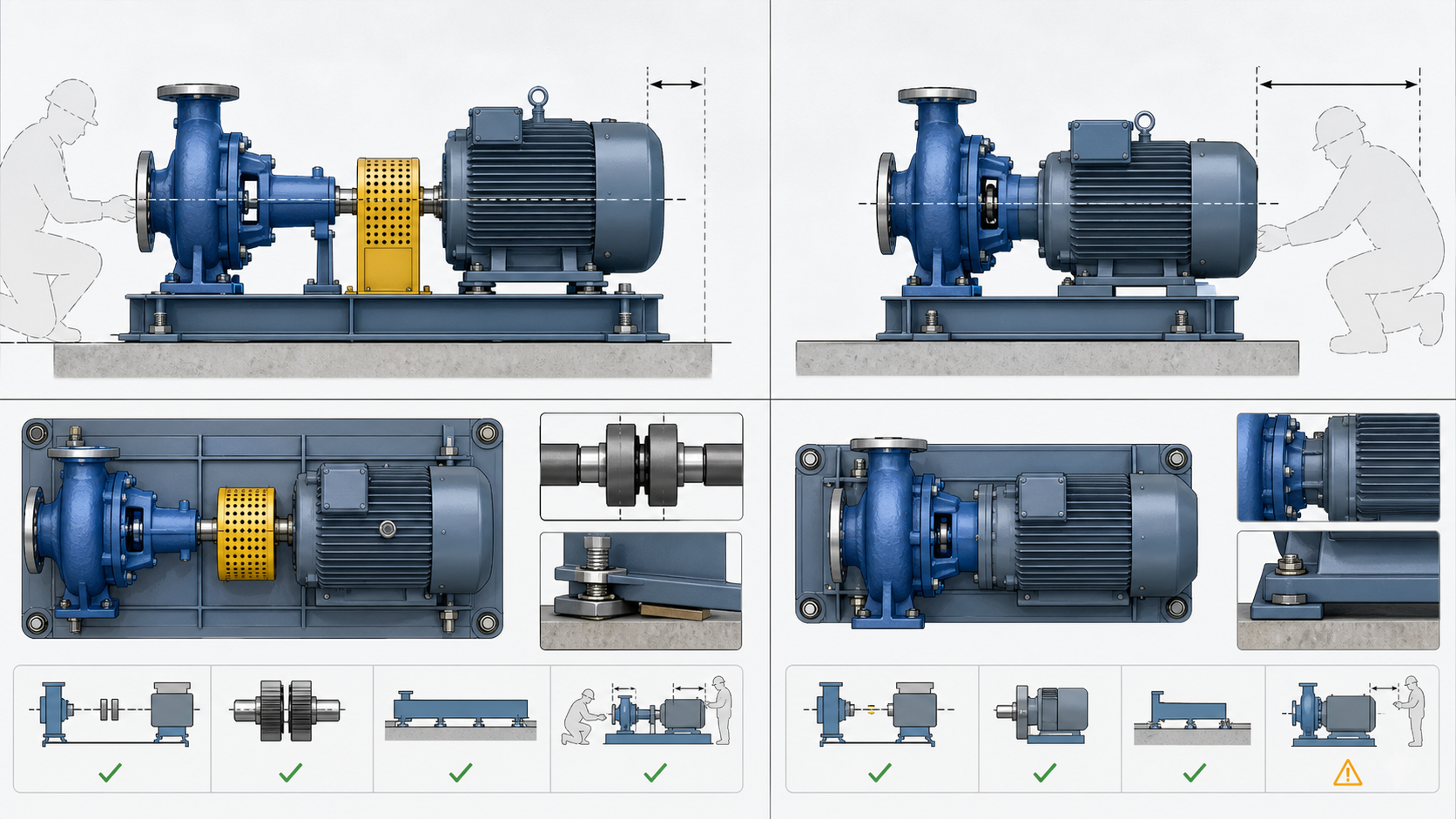
A frame-mounted arrangement uses a separate bearing frame or power end between the pump and motor, normally with a flexible coupling and baseplate. It can provide serviceable bearing support, allow motor replacement without changing the hydraulic end and suit demanding continuous-duty applications when correctly aligned and lubricated.
It also requires a sound base, coupling guard, alignment procedure, soft-foot control and more installation space. Pipe strain and foundation condition remain important.
How close-coupled pumps work
A close-coupled arrangement mounts the motor directly to the pump or adapter, eliminating a conventional long coupling and often reducing footprint and alignment work. It can be attractive for compact packages and applications where the standard motor-pump interface is well defined.
Constraints include motor compatibility, seal and bearing access, heat transfer, replacement options, shaft interface and the possibility that a motor change affects the complete assembly.
Compare the lifecycle trade-offs
| Factor | Frame-mounted | Close-coupled |
|---|---|---|
| Footprint | Larger base and coupling envelope | Compact package in many layouts |
| Alignment | Requires coupling alignment and soft-foot checks | Fewer external alignment steps, but interface must be correct |
| Maintenance | Separate power-end and motor service may be practical | Compact but motor/seal access can be more configuration-specific |
| Motor replacement | Often more independent, subject to shaft and coupling fit | Must match mounting, shaft, frame and adapter requirements |
| Critical service | Can support robust bearing and monitoring arrangements | May suit simpler duty when limits and service access are acceptable |
Duty and shaft loading still control the choice
Check flow, head, speed, liquid properties, temperature, solids, pressure, NPSH, operating hours and preferred operating region. Then review radial and axial loads, bearing arrangement, seal chamber, shaft diameter, impeller overhang and motor power.
A close-coupled package is not automatically less reliable, and a frame-mounted package is not automatically overbuilt. The design must be matched to the actual duty and failure consequences.
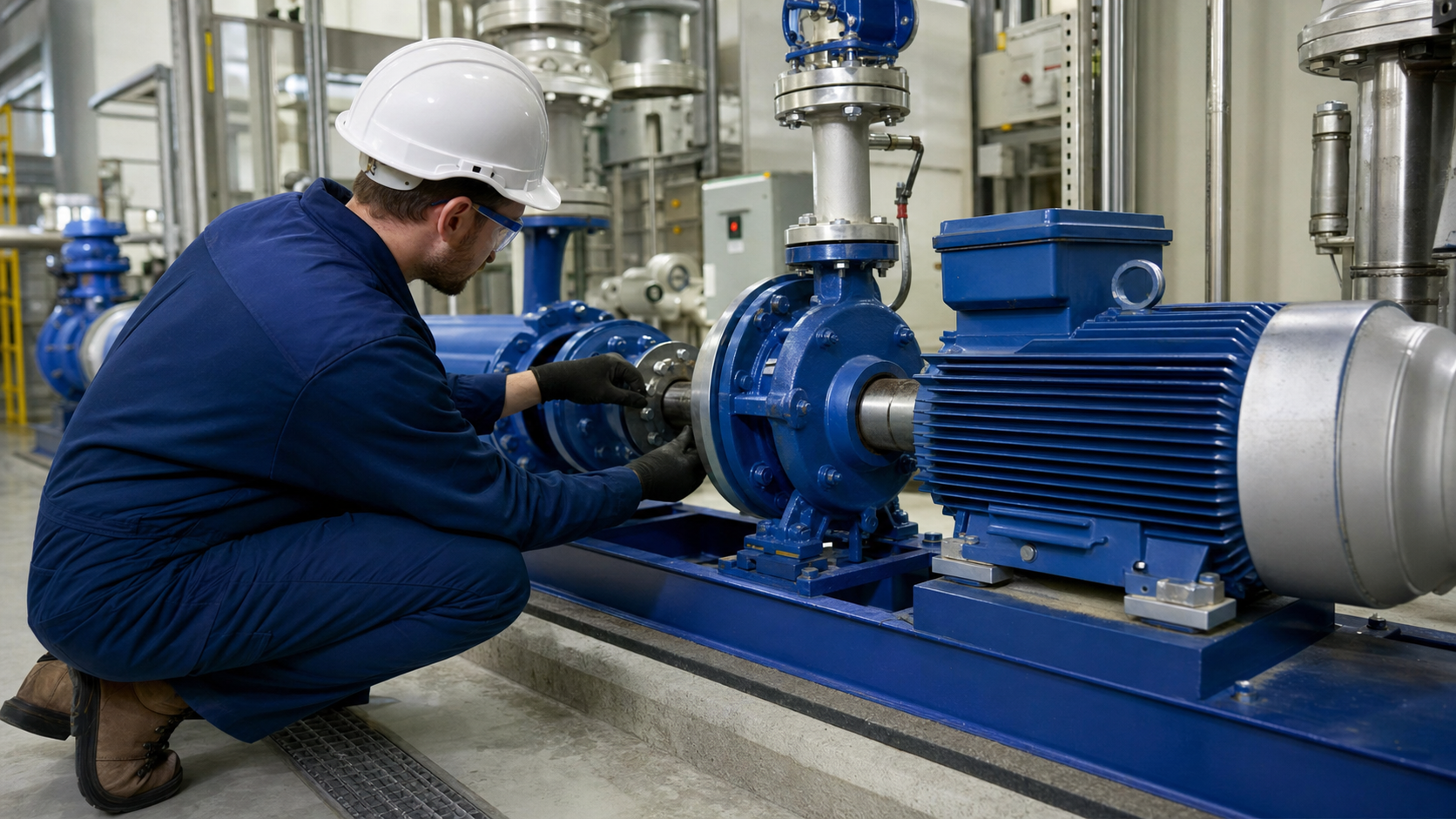
Installation and maintenance checklist
- Confirm the outline drawing, flange locations, centerline and base or support.
- Check motor frame, shaft extension, rotation, power and service factor requirements.
- Review coupling, guard, alignment, soft foot and pipe-strain controls.
- Plan seal replacement, bearing or motor access and lifting path.
- Confirm lubrication, cooling, monitoring and spare-parts strategy.
- Define acceptance tests for pressure boundary, performance and vibration where required.
Replacement compatibility is configuration-specific
For an ANSI replacement, compare the casing, impeller, shaft, power end, bearings, seal chamber, coupling or adapter, motor interface, materials and actual curve. A frame-mounted unit cannot be treated as a direct close-coupled replacement without reviewing the base, shaft and service envelope.
Similarly, a close-coupled pump may match the flange location but still have a different motor interface, seal arrangement or allowable duty.
How to choose for an export project
Ask the supplier to identify the exact pump configuration, motor interface, materials, seal, bearings, dimensional drawing, test scope and spare-parts scope. Request packaging and preservation details for the complete rotating assembly. Clear configuration documentation is particularly important when the pump will be installed by a third party.
When to request a technical review
Request a review when replacing one configuration with the other, when the pump is critical, when motor standardization is important, when the pump handles corrosive or hazardous liquid, or when the existing failure involves alignment, bearings, seals or shaft damage.
What to send for a configuration quotation
Send the current pump nameplate, outline and foundation drawing, duty point, liquid properties, motor data, seal requirements, operating hours, maintenance history, site lifting and access limits and any required interchangeability scope. This supports a model-specific recommendation.
What to send for a useful quotation or review
Include the pump model or dimensional drawing, actual duty range, liquid properties, motor data, installation constraints, operating history, photos and required documentation. Model-specific inputs make the selection more defensible and reduce commissioning surprises.
Need help choosing a pump mounting configuration?
ANSI Pumps Pro helps buyers compare ANSI process pump duty, materials, fitment, testing and lifecycle support.
Sources and related reading
Use the applicable manufacturer documentation, project specification and site procedures. For system-level pumping guidance, see the U.S. Department of Energy pumping systems resources and the Hydraulic Institute. These links provide general engineering context; final limits are project-specific.
Frequently asked questions
Which is more reliable, frame-mounted or close-coupled?
Neither is universally more reliable. Reliability depends on duty, installation, alignment or interface quality, maintenance access, materials and the consequences of failure.
What is the main advantage of a frame-mounted pump?
It can provide a serviceable power end and allow more independent motor and pump maintenance, but it requires proper base, coupling and alignment control.
What is the main advantage of a close-coupled pump?
It can reduce footprint and external coupling work, but motor, shaft, adapter, seal access and replacement compatibility must be checked as one package.
Can a close-coupled pump replace a frame-mounted ANSI pump directly?
Not without review. Check hydraulic duty, dimensions, shaft and motor interface, seal chamber, base, piping, maintenance access and acceptance requirements.