
Chemical Feed Is an Application—Not One Pump Type
The phrase chemical feed pump describes what the system is doing: moving a chemical into a treatment process, pipeline, vessel or production step. It does not by itself define one pump construction. In many dosing systems, the appropriate technology is a controlled-volume metering pump. In other services, the chemical is moved as a continuous or batch process flow and a centrifugal chemical-process pump may enter the selection.
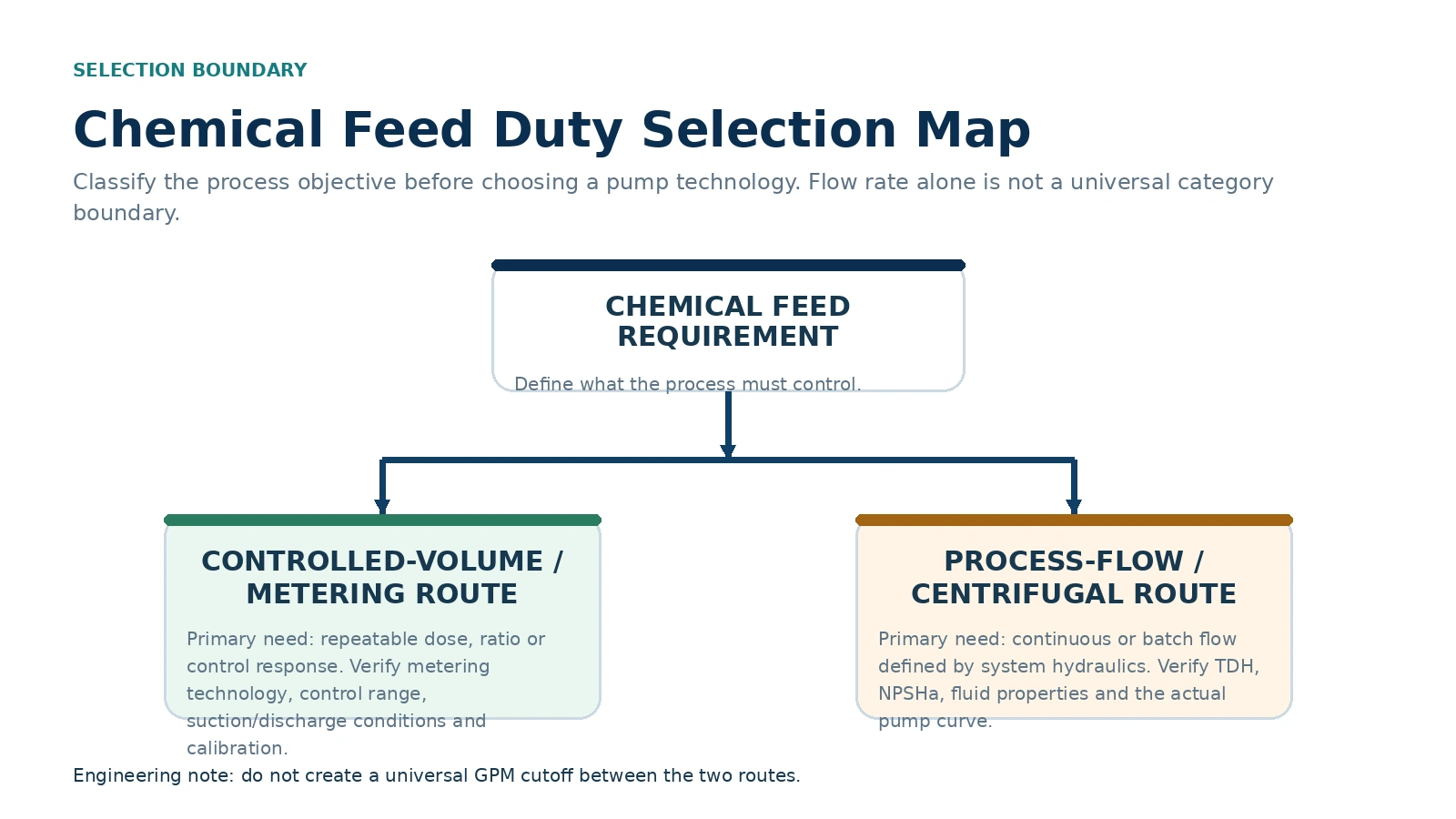
The first engineering decision is therefore not a universal flow-rate cutoff. Define what the process must control. If the requirement is a repeatable delivered dose, ratio or control response, start with the metering route. If the requirement is principally a continuous or batch flow against a hydraulic system, start with the process-pump route.
Do not select the pump category from GPM alone
There is no universal GPM boundary at which a chemical-feed duty automatically changes from a metering pump to a centrifugal process pump. Pump technology should follow the process objective, control requirement, pressure/hydraulic conditions, liquid behavior and the verified operating envelope of the selected equipment.
Chemical Feed Duty Selection Map
Use the process objective to choose the engineering route before comparing pump models.
Metering Duty or Process-Flow Duty?
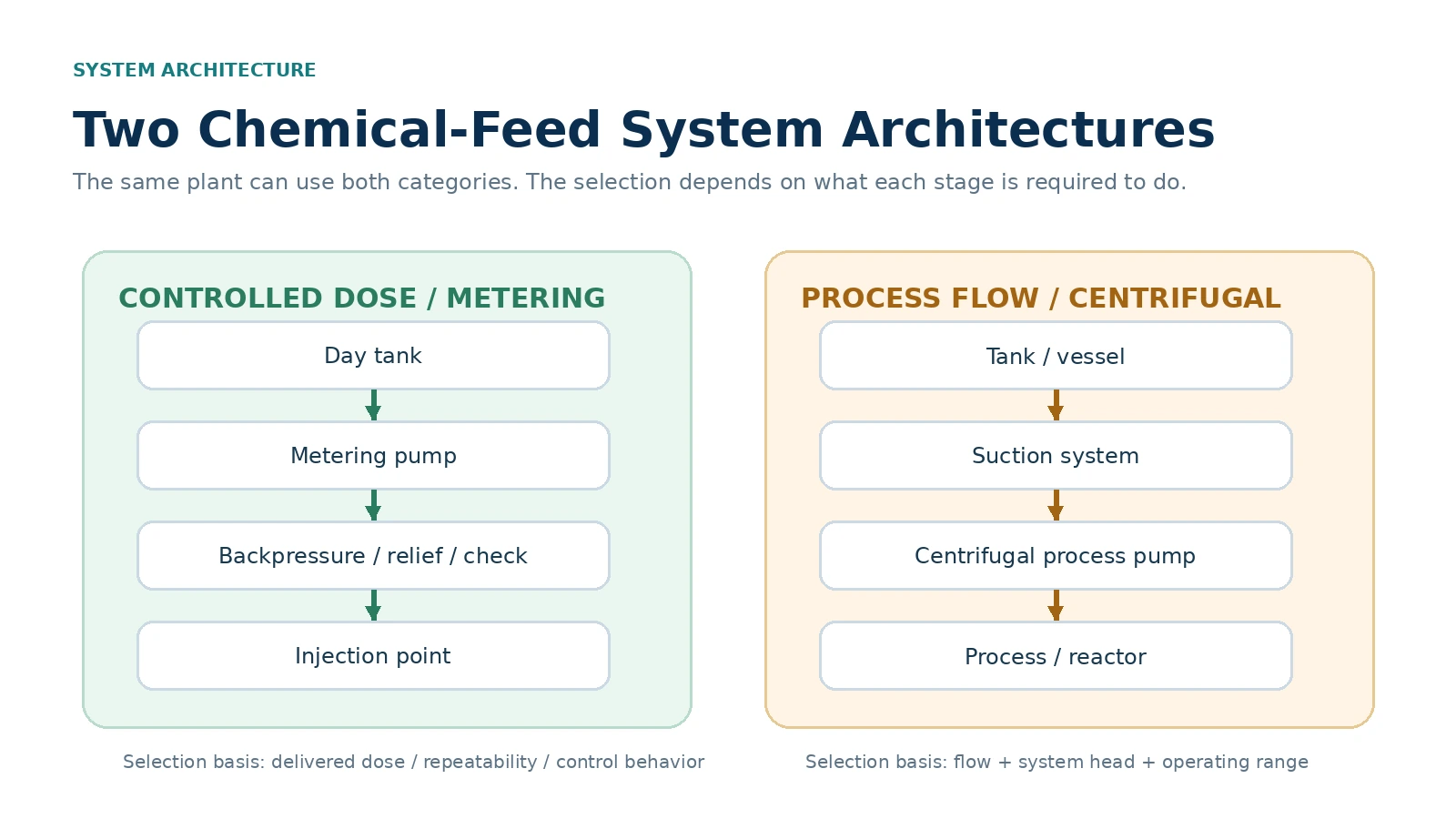
A chemical-feed system can contain more than one pumping function. Bulk chemical may be moved from storage to a day tank with one pump category and then injected into the process with a metering pump. Treating every stage as the same duty can produce an incorrect pump selection.
| Engineering question | Controlled-volume / metering route | Process-flow / centrifugal route |
|---|---|---|
| What must be controlled? | Delivered dose, ratio, repeatability or control response | Flow through a hydraulic system at the required head |
| Primary selection basis | Required capacity range, pressure, control behavior, suction/discharge conditions and calibration | Flow, TDH, system curve, suction conditions, operating range and pump curve |
| Typical flow behavior | Controlled displacement; may be reciprocating and pulsating | Rotodynamic flow determined by the pump/system interaction |
| Typical process role | Treatment chemical injection, inhibitor addition, catalyst/additive dosing, ratio or feedback-controlled feed | Bulk transfer, unloading, recirculation, continuous feed or batch vessel transfer |
| Next engineering evidence | Metering-pump specification, control philosophy, calibration and system accessories | TDH/NPSHa calculation, fluid review and an actual centrifugal pump curve |
Two Chemical-Feed System Architectures
Both routes may exist in the same plant; they are not mutually exclusive technologies for every chemical-feed system.
What Data Defines a Chemical-Feed Duty?
Before choosing a pump type, collect the process data that can change the selection. A chemical name and one normal flow point are not enough. Keep minimum, normal and maximum conditions together so the engineering review can distinguish dosing control from process hydraulics.
What API 675 Covers—and What It Does Not
API 675 applies to a specific controlled-volume reciprocating pump scope for petroleum, chemical and gas industry services. The current API publication basis identifies hydraulic-diaphragm and packed-plunger designs within that scope and excludes rotary positive-displacement pumps and direct mechanically actuated diaphragm pumps. It should therefore not be used as a blanket label for every chemical dosing or chemical-feed pump.
Hydraulic Institute controlled-volume metering-pump guidance uses the broader metering-pump context for reciprocating positive-displacement pumps used for accurate liquid dispensing or dosing. For this article, the important point is category discipline: chemical feed is the application, while API 675 or another pump standard applies only when the selected technology and project specification fall within that standard’s scope.
Page-ownership boundary
This article does not reproduce a detailed API 675 performance table or a metering-pump sizing method. Its job is to classify the chemical-feed duty. Detailed controlled-volume pump specification belongs in the metering/injection engineering workflow.
When a Centrifugal Chemical Process Pump Enters the Decision
A centrifugal process pump becomes a candidate when the service is fundamentally a rotodynamic hydraulic problem: the process needs a defined flow through a system, and the operating point must be checked against the pump and system curves. This can include selected bulk transfer, unloading, recirculation, continuous process feed or batch vessel-transfer duties.
ASME B73.1 applies to horizontal, end-suction, single-stage, centerline-discharge chemical-process centrifugal pumps within its scope and includes dimensional interchangeability requirements and design features. That does not mean every B73.1 pump is automatically suitable for every chemical-feed service. Hydraulic performance, materials, sealing, driver power, suction conditions and the actual operating range remain configuration-specific.
Chemistry, Density, Viscosity, Solids and Gas Release Matter Together
Do not select a pump material or pump type from the chemical name alone. Concentration, temperature, impurities, oxidizing/reducing conditions, solids, viscosity, specific gravity, vapor pressure and gas evolution can change the practical selection. Use the chemical resistance guide as a screening resource, then verify the complete wetted system for the actual service.
For acid-service decisions that require a broader pump-category and safety review, use the acid transfer pump selection guide. The material table in that article and the site resistance guide remain the material owners; this chemical-feed article should not create a second corrosion database.
| Fluid behavior | What to verify | Why it can change the decision |
|---|---|---|
| High specific gravity | Density/SG, duty and driver power | Centrifugal absorbed power changes with liquid density at a given hydraulic condition |
| Higher viscosity | Viscosity at operating temperature and pump-specific correction method | Centrifugal flow, head, efficiency and power may differ from water-based expectations |
| Outgassing / gas release | Suction arrangement, gas accumulation and selected pump-head behavior | Gas can disrupt metering-pump filling or centrifugal-pump suction performance |
| Crystals / solids | Particle size/loading, settling, valves/impeller passage and flushing strategy | Check valves, small passages, seals and impellers can respond differently to solids |
| Corrosive mixture | Exact chemistry, concentration, temperature and every wetted material | A casing alloy alone does not approve the complete pump or feed system |
Verify TDH, NPSHa, Power and the Actual Pump Curve
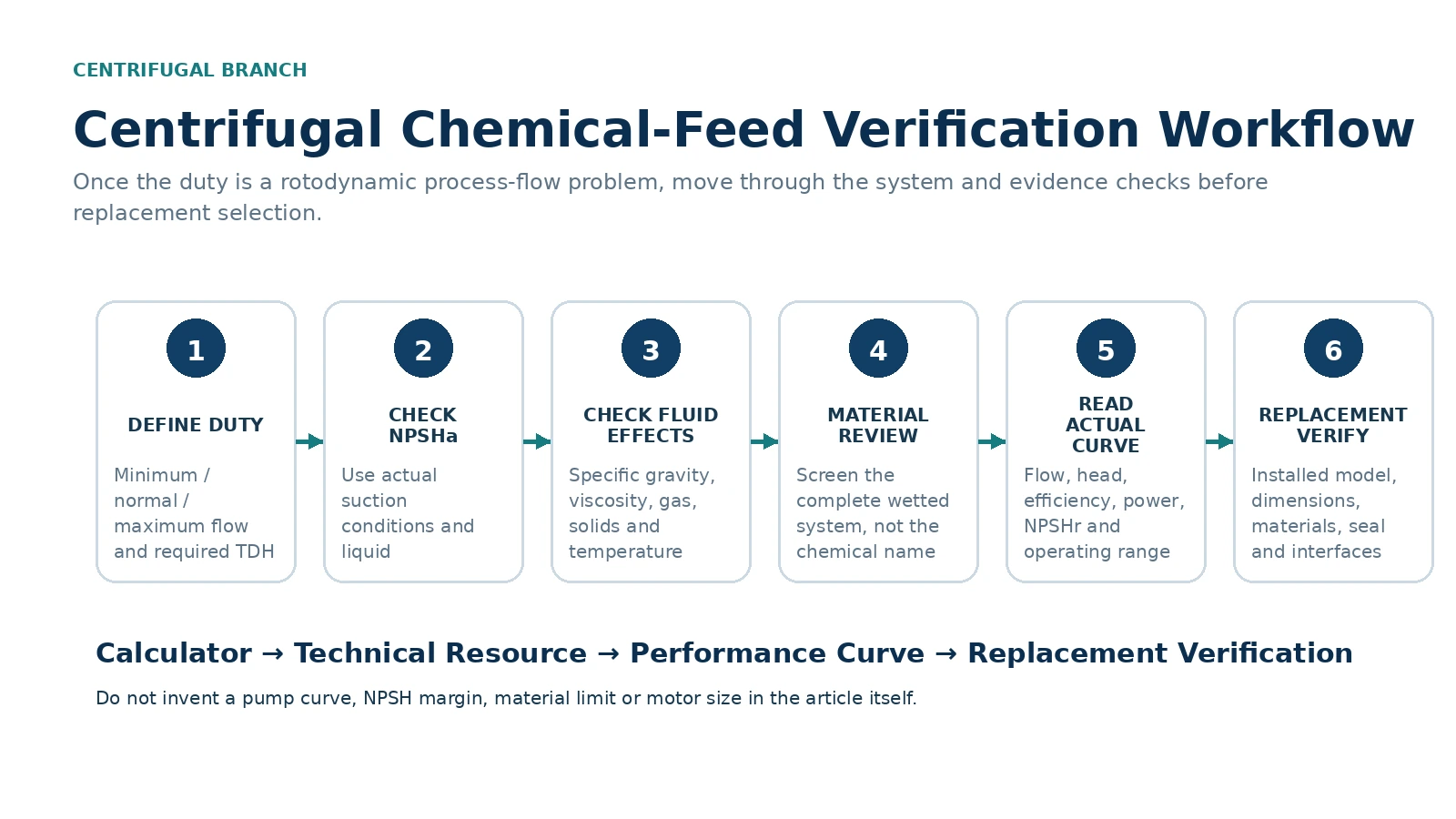
Once the chemical-feed duty is classified as a centrifugal process-flow application, move the calculations out of this article and into the tools that own them. Start with the pump engineering calculators to build the hydraulic duty. Use the NPSHa calculator for the system-side suction check, and keep pump-side NPSHr tied to the selected performance curve.
If density is materially different from water, review specific gravity and centrifugal pump power rather than applying an unsupported motor multiplier. Final hydraulic confirmation belongs on the pump performance curves route, where flow, head, efficiency, power and NPSHr can be read from approved pump data.
Centrifugal Chemical-Feed Verification Workflow
Use the calculator and technical-resource owners instead of rebuilding those calculations inside this NEWS article.
Metering-System Installation and Calibration Checks Still Matter
When the service remains a controlled-volume dosing problem, the pump should be evaluated as part of the complete feed system. Suction condition, potential siphoning, discharge backpressure, relief protection, check-valve behavior, pulsation, gas accumulation, injection-point design and control response can all affect delivered chemical feed.
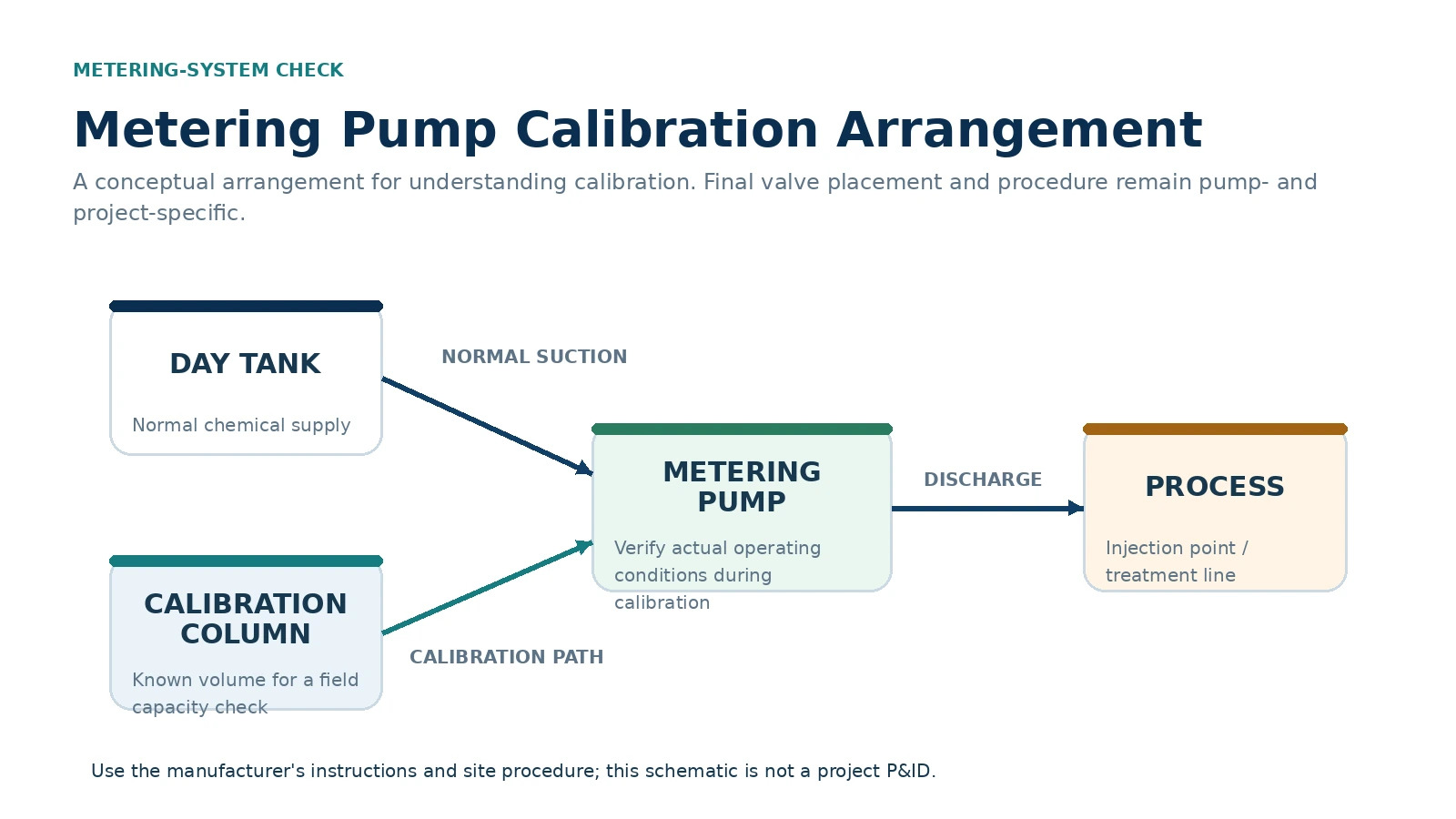
Field calibration should confirm actual delivered volume or mass over a defined time using the pump manufacturer’s instructions and the site’s approved procedure. Do not assume that a dial, stroke setting or control signal alone proves the delivered dose under the actual liquid and pressure conditions.
Metering Pump Calibration Arrangement
Conceptual arrangement for understanding the calibration path; final piping and valve topology remain project-specific.
When an ANSI B73.1 Pump Is—and Is Not—the Same Job
For water and wastewater facilities, the related guide on where ANSI process pumps fit in water treatment shows why bulk chemical transfer and precise dosing should remain separate decisions. The same boundary applies more broadly to chemical-feed systems.
| Potential ANSI process-pump fit | Do not treat as the same job without separate review |
|---|---|
| Continuous or batch chemical movement defined by flow and system head | Controlled dosing where repeatable displacement or dosing accuracy is the primary requirement |
| Actual centrifugal curve provides a valid operating range for the duty | Duty cannot be supported by a verified curve or suction condition |
| Materials, seal arrangement and pressure boundary can be verified for the service | Chemical compatibility is assumed from the casing material or chemical name only |
| Installed interfaces can be documented for a replacement project | A cross-OEM or same-standard replacement is assumed to be drop-in without dimensional verification |
High feed rate is not a sufficient reason to change pump category
A centrifugal process pump should not be selected merely because the required chemical-feed rate is considered “high.” Confirm the process objective and the valid operating envelope of the candidate technology.
When the Chemical-Feed Duty Becomes a Replacement Verification
If the centrifugal branch is confirmed and an existing ANSI pump is being replaced, the next question changes from “Which pump type?” to “Which replacement configuration matches the documented duty and installation?” For an installed Goulds 3196 family pump, continue to the Goulds 3196 replacement verification route. For an installed Flowserve Durco Mark III family pump, use the Durco Mark III replacement route.
Keep the evidence chain together before quotation: actual duty range, fluid condition, suction data, motor/speed, pump curve if available, materials, seal arrangement, nameplate, GA drawing and installation dimensions. The existing model name is useful identification evidence, but it does not replace hydraulic and dimensional verification.
Chemical Feed Pump FAQ
Is a chemical feed pump the same as a metering pump?
Not always. In water-treatment and dosing practice, “chemical feed pump” commonly refers to a metering or dosing pump, but the application term can also appear in systems that include bulk transfer, day-tank transfer or process-feed duties. Classify the process function before assigning a pump technology.
How do I choose between a metering pump and a centrifugal process pump?
Start with what the process must control. If the primary requirement is a repeatable delivered dose, ratio or control response, evaluate a metering-pump route. If the primary requirement is a continuous or batch flow through a hydraulic system, evaluate a process-pump route using flow, TDH, suction conditions and an actual pump curve.
Is there a GPM cutoff where I should switch to a centrifugal pump?
No universal flow-rate cutoff applies across chemical-feed applications. Flow ranges can overlap between technologies. The correct category depends on process function, pressure/hydraulics, control requirement, liquid behavior and the verified operating envelope of the selected pump.
Does API 675 apply to every chemical dosing pump?
No. API 675 covers a defined scope of controlled-volume reciprocating pumps. The current API publication basis includes hydraulic-diaphragm and packed-plunger designs and excludes rotary positive-displacement pumps and direct mechanically actuated diaphragm pumps.
What should be verified before using an ANSI B73.1 pump for chemical-feed service?
Verify the required flow and head, suction conditions and NPSHa, fluid properties, complete wetted materials, sealing/containment requirements, driver power, actual performance curve, operating range and any installation or replacement interfaces.
Technical Sources
- Hydraulic Institute — Controlled-Volume Metering Pumps, ANSI/HI 7.1–7.5:2023 scope and terminology.
- American Petroleum Institute — API Standard 675 publication basis, scope and exclusions.
- ASME — B73.1-2026, Specification for Horizontal End Suction Centrifugal Pumps for Chemical Process.
- Veolia Water Technologies — Chemical Feed Systems, feed-system components, metering pumps, calibration and controls.