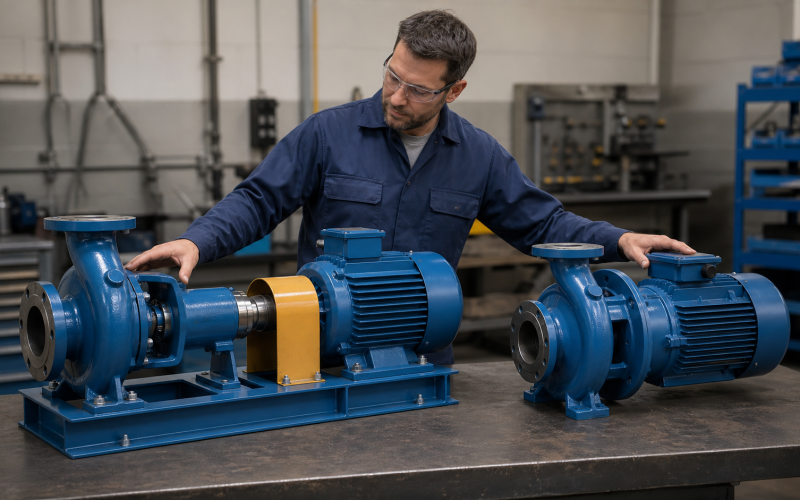
Neither arrangement is automatically more reliable.
A close-coupled pump usually reduces equipment length and conventional coupling work. A frame-mounted pump uses a separate pump shaft and bearing frame and can provide major maintenance advantages when paired with a spacer coupling and back-pull-out construction.
The decision should come from the complete mechanical and operating context—not the mounting label alone.
What Is a Frame-Mounted Centrifugal Pump?
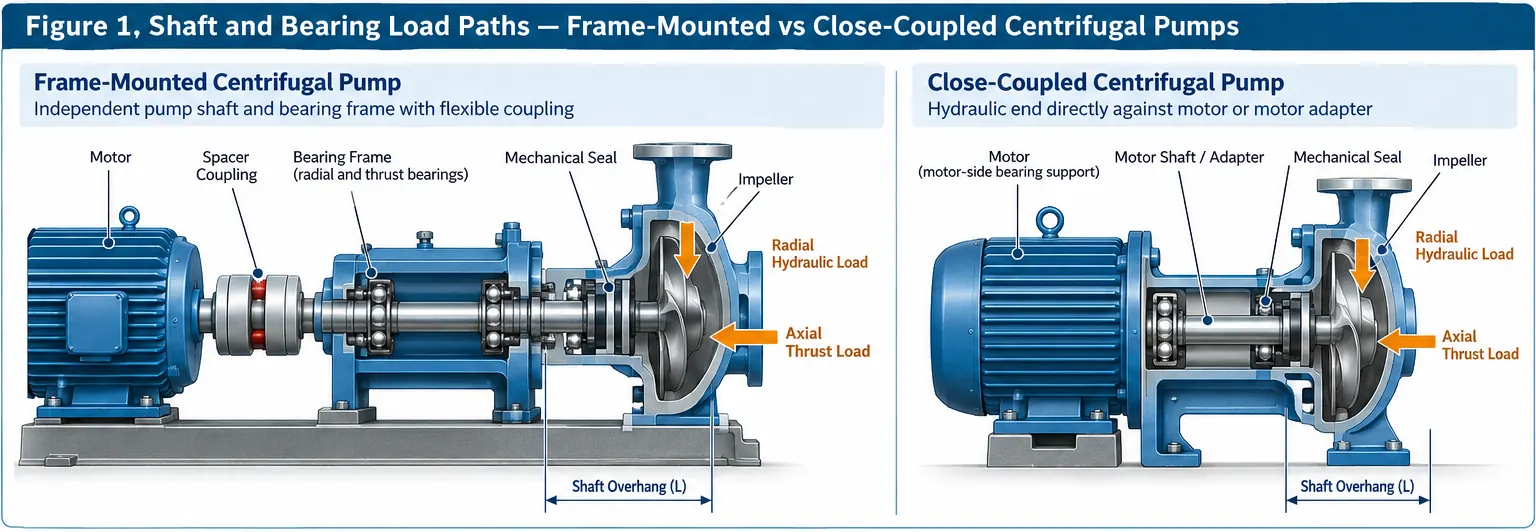
A frame-mounted pump supports the pump shaft with its own bearing system and connects to the driver through a flexible coupling.
Typical mechanical path
What Is a Close-Coupled Centrifugal Pump?
In a close-coupled arrangement, the hydraulic end sits directly against the motor or motor adapter. The conventional flexible pump-to-motor coupling is eliminated, reducing package length.
Compact footprint
Useful for packaged skids, utility systems and space-constrained installations.
Motor interface
Frame, shaft extension, flange/register and impeller attachment can become part of pump fit.
“No coupling” ≠ no mechanical control
Runout, pipe strain, motor register and rotating-component condition still matter.
Frame-Mounted vs Close-Coupled: Engineering Comparison
This is a screening tool, not a winner table.
Footprint
Back Pull-Out
Driver Interface
Bearings / Loads
Alignment
Retrofit Risk
Footprint, Baseplate and Maintenance Envelope
A compact pump may use less floor space but still require motor-side or overhead removal clearance. Review the whole installation drawing—not just the pump outline.
Nozzle centerlines
Controls piping interface in replacement work.
Shaft centerline
Affects motor and base compatibility.
Back-pull-out distance
Defines whether the rotating assembly can actually be withdrawn.
Lifting path
Matters when motor or rotating assembly must be removed.
Shaft, Bearings, Hydraulic Load Path and Deflection
Centrifugal impellers generate radial and axial loads that change with flow, impeller diameter, speed and operation relative to BEP. The right question is not simply whether a bearing frame exists—it is how the load path is supported in the actual design.
| Term | Meaning | Why it matters |
|---|---|---|
| Shaft runout | Rotational / geometric deviation | Do not confuse with operating shaft bending |
| Dynamic shaft deflection | Shaft bending under hydraulic load | Can influence seal behavior |
| L³/D⁴ | Geometric shaft-stiffness indicator | Highlights sensitivity to overhang and shaft diameter |
| Bearing L10 | Statistical rating life under defined loading | Depends on actual load assumptions |
Back Pull-Out Maintenance: Why the Spacer Coupling Matters
In an appropriate back-pull-out arrangement, removing the spacer creates axial clearance so the rotating assembly can be withdrawn while the casing remains connected to process piping and the motor remains on the base.
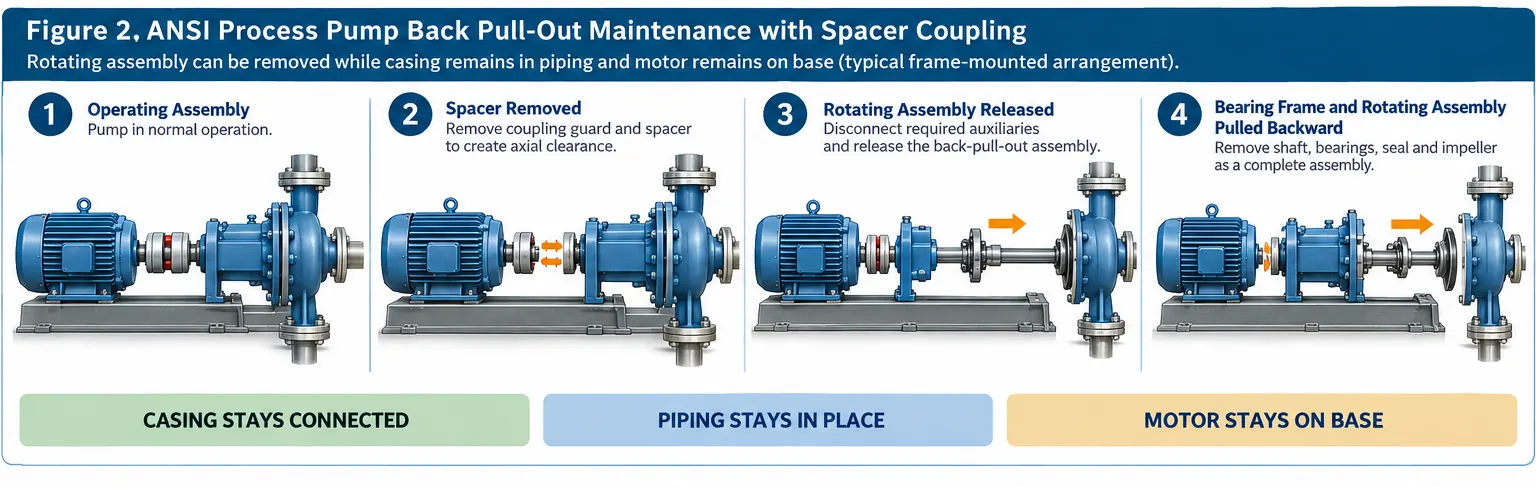
Casing
Remains in the process piping.
Suction & Discharge Piping
No need to disturb the retained piping solely for the pull-out.
Motor
With an appropriate spacer arrangement, the driver remains on its base.
JM, JP and Independent Motor Arrangements
In North American close-coupled pump applications, NEMA JM and JP shaft configurations are common examples of dedicated pump-motor interfaces. The procurement lesson is to verify the exact frame, shaft extension, flange/register, seal arrangement and impeller connection.
Thermal Growth and High-Temperature Service
Temperature can affect casing growth, shaft alignment, lubricant condition, seal behavior and motor environment. Frame-mounted equipment gives the designer a separate bearing frame and coupling arrangement, but configuration alone does not define maximum liquid temperature.
ANSI-Dimensional Does Not Automatically Mean the Same Mechanical Arrangement
ASME B73.1 dimensional interchangeability is valuable in chemical-process replacement work, but the word “ANSI” alone is not enough to approve a change from a classic frame-mounted process pump to a close-coupled derivative.
Nozzle centerlines
Base / foundation
Motor envelope & interface
Seal arrangement
Maintenance clearance
Hydraulic curve
Goulds 3196 replacement engineering review · Durco Mark III replacement engineering review
Which Configuration Deserves Deeper Review?
Compact integration matters
Space is constrained, the exact motor interface is documented, load capability is confirmed and maintenance access remains acceptable.
Maintenance architecture matters
Independent bearing support, spacer-coupled back pull-out, driver flexibility and retention of an existing ANSI layout are important.
Converting an existing ANSI pump arrangement?
Send the existing pump model, motor frame, GA drawing and operating duty.
Compare the Installed System, Not the Pump Price
There is no defensible universal percentage saying one arrangement is always cheaper. Compare equipment, foundation, alignment, motor availability, seal service, spares and downtime exposure.
RFQ Checklist for a Configuration Review
Existing equipment
Pump model, size, motor model/frame, speed, coupling/adapter, base drawing and seal.
Operating duty
Flow, TDH, liquid, temperature, SG, viscosity, solids and suction condition.
Replacement objective
Footprint, maintenance, motor replacement, corrosion, reliability, capacity or complete-pump replacement.
Frequently Asked Questions
Is a frame-mounted pump always more reliable?
Does a close-coupled pump eliminate alignment problems?
Why is a spacer coupling important?
What are JM and JP pump motors?
Is an ANSI-dimensional close-coupled pump the same as a B73.1 frame-mounted pump?
Can a Goulds 3196 or Durco Mark III installation be changed to close-coupled?
Engineering Sources to Support the Final Production Article
- ASME B73.1 — Specification for Horizontal End Suction Centrifugal Pumps for Chemical Process
- KSB Centrifugal Pump Lexicon — Back Pull-Out Design
- U.S. MOTORS / Nidec — Close-Coupled Pump Motors
- Griswold 811 Installation, Operation and Maintenance Manual
- Griswold 811CC — ANSI-Dimensional Close-Coupled Pump
- Flowserve Durco Mark 3 — ASME/ANSI Chemical Process Pump