Replacing an installed Goulds 3196 requires more than matching the pump name or nominal size. A replacement review should confirm the installation interfaces, operating duty, materials, seal arrangement and the exact equipment being supplied. Use the installed pump’s records and an approved drawing for the specific size and configuration before treating a candidate as a drop-in fit.
ASME B73.1 describes dimensional interchangeability for pumps with the same standard dimension designation at defined installation interfaces. That standard-level basis does not, by itself, establish hydraulic equivalence, material suitability or a match for every frame, option or operating condition. Review those items separately against the actual pump data.
Identify the installed pump before comparing replacements
Start with the complete nameplate and the documents for the installed unit. A model family name alone may not identify its hydraulic size, frame, impeller trim, materials or seal configuration.
- Record the model and pump size, frame designation, serial number and rated speed.
- Record the installed impeller diameter or trim, driver information and coupling arrangement.
- Confirm casing and rotating-element material codes, seal-chamber type and mechanical-seal arrangement from the order record or bill of materials.
- Describe the required supply scope: complete pump, bare pump, wet end, power end or individual parts. State which existing components will be retained.
- Collect the current operating flow and head, liquid composition, temperature, density or viscosity, solids content if applicable, and suction conditions.
If the nameplate is unreadable or the records are incomplete, note that uncertainty rather than inferring a configuration from a nearby unit. A clear nameplate photograph, overall installation photographs and available drawings help resolve the initial identification.
Compare the installation and mechanical interfaces
Compare the installed pump and proposed replacement using drawings that share a clear datum and revision. Record the drawing number and revision for each side, then document the measured or drawing-based result and any deviation. Do not rely on a generic frame chart when the installed configuration has not been identified.
- Mounting: Compare the pump-foot and baseplate arrangement, hold-down locations and the reference height used to position the pump and driver.
- Suction and discharge: Compare nozzle size, center locations, orientation, flange rating, facing and drilling. Confirm the actual piping connection requirements.
- Shaft and coupling: Compare shaft extension, diameter, keyway and coupling interfaces, including the driver and spacer-coupling arrangement where applicable.
- Seal and bearing interfaces: Compare the seal chamber or stuffing-box arrangement, shaft sleeve, bearing frame and parts that the replacement scope expects to retain.
- Access and maintenance: Check the available room for coupling removal, seal work, lifting and the intended pull-out or maintenance procedure.
When a dimension or interface differs, classify it as an open deviation and ask the responsible engineer to determine its effect on piping, alignment, the driver, the baseplate and maintenance access. A pump should not be described as requiring no field changes until the relevant interfaces have been checked for the exact configuration.
Confirm hydraulic duty, materials and seal arrangement
Dimensional fit and hydraulic suitability are separate checks. Compare the required operating point with a performance curve for the proposed pump size, speed and impeller condition. Review the expected operating range, available NPSH, absorbed power and driver margin using the project’s design conditions and applicable engineering criteria.
Describe the pumped liquid and the conditions that affect material selection: composition, concentration, temperature, pressure, contaminants, solids and potential erosion or corrosion. Confirm wetted materials against the actual service and the supplier’s bill of materials. A list of available alloys is not, by itself, evidence that a material is suitable for a particular application.
Also confirm the mechanical-seal type, seal-chamber geometry and any required flush, quench or other support arrangement against the approved seal plan and process conditions. Do not assume that a seal option, material or auxiliary plan transfers unchanged because another pump shares the same nominal size.
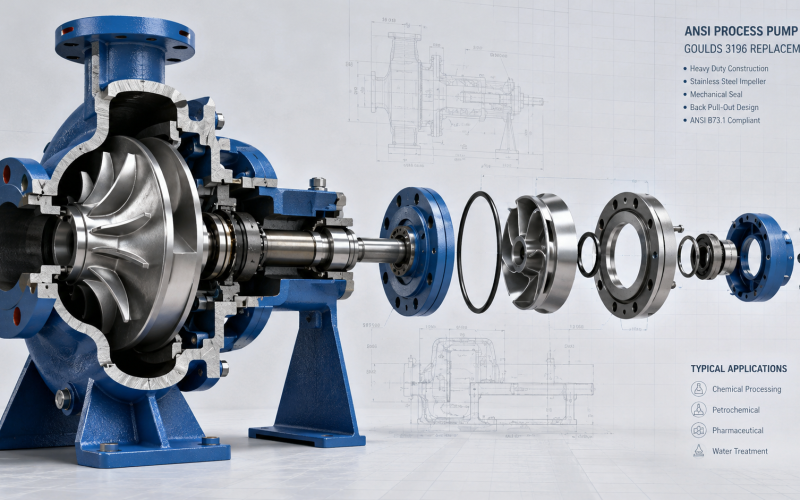
The Goulds 3196 replacement pump page describes the available G196 replacement scope. Use it to identify the product route, then confirm the exact model, size, frame, duty and interfaces for the proposed order.
View Goulds 3196 replacement pump options
Review the documents before approving a replacement
Request the documents that apply to the quoted configuration and purchase scope. Agree on required inspection and test records before placing the order.
- An approved general-arrangement drawing with the relevant installation and connection dimensions.
- A performance curve or selection record tied to the quoted pump size, speed and impeller condition.
- A bill of materials identifying wetted and pressure-containing materials, seal arrangement and retained or supplied components.
- Dimensional inspection, material certificates, PMI, balance records or pressure-test reports when they are specified for the order and included in the supplier’s scope.
- A written deviation list showing unresolved differences, their disposition and the person approving them.
Check each report for the tested component, procedure, acceptance criteria, units, date and traceability to the quoted pump. Terms such as “certified,” “balanced” or “tested” are useful only when the record identifies what was inspected and to which requirement.
Use a repeatable replacement review
- Identify the installed model, size, frame, speed and supply scope from the nameplate and records.
- Capture the operating duty, liquid, temperature, materials, seal details and suction conditions.
- Compare mounting, nozzle, shaft, coupling and seal interfaces using the applicable drawings.
- Review hydraulic performance and driver requirements at the project operating conditions.
- Confirm the quoted materials, inspection documents, tests and retained components.
- Resolve deviations in writing before describing the proposed configuration as a drop-in replacement or approving the purchase.
Useful starting information includes the pump nameplate, photographs of the installed pump and baseplate, available general-arrangement drawings, current flow and head, liquid and temperature, and the requested supply scope. If a measurement is unavailable, mark it as unknown so it can be reviewed rather than guessed.
Frequently asked questions
Does ASME B73.1 mean every pump from every supplier is interchangeable?
The standard describes interchangeability for pumps with the same standard dimension designation at defined installation interfaces. The installed size and configuration still need to be identified, and duty, materials, seal arrangement and supply scope require separate review.
Is matching the frame designation enough to confirm fit?
No. Confirm the pump size and configuration, mounting and nozzle interfaces, shaft and coupling arrangement, seal interface and operating duty. Use the applicable drawings and records for the installed and proposed units.
What information is needed to review a wet-end replacement?
Provide the installed model and size, frame, speed, impeller condition, casing and material information, seal arrangement, operating duty and the parts that will remain in service. The proposed bill of materials and interface drawings determine what else must be checked.
What if the nameplate or drawings are missing?
Send clear photographs of the nameplate and the complete installation, plus any dimensions, order records or parts references available. Mark uncertain values as unknown; do not infer them from another pump without confirming the configuration.