
What the HI 30.1 Specification Covers
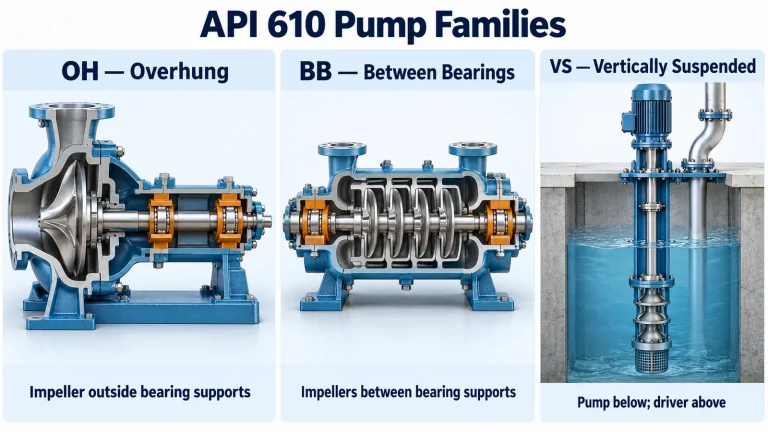
ANSI/HI 30.1 is a purchaser-facing specification for general-purpose OH1 rotodynamic pumps. OH1 identifies a horizontal, overhung, flexibly coupled pump with a foot-mounted casing. The specification organizes requirements for the application, pump and auxiliaries, factory testing, delivery, installation and field execution.
Its stated scope is limited to defined general-service conditions. It describes single-stage end-suction pumps with radial or mixed flow, semi-open or enclosed impellers, and clear liquids with less than 2% solids by volume that are nonhazardous, nonflammable and nontoxic. The standard also sets service limits for flow, working pressure, temperature and specific speed. Confirm the exact values and units in the applicable HI 30.1 edition before approving a project duty.
Use the standard edition named in the purchase documents
The Hydraulic Institute lists HI 30.1 as the 2021 edition. A general reference such as “per Hydraulic Institute standards” does not identify the exact requirements. State the standard number and edition, then record project-specific additions and deviations.
What to Put in the Pump Purchase Data Sheet
A useful specification ties each requirement to a duty, configuration or deliverable. Ask the supplier to identify exceptions against the same data sheet and approved drawing revision.
| Area | Purchaser input | Evidence to review |
|---|---|---|
| Duty and operating cases | Minimum, normal and rated flow; required head; speed; operating hours; start/standby cases; driver and control range. | Guaranteed duty points, approved pump curve, motor data and stated assumptions. |
| Liquid and suction conditions | Composition, concentration, temperature range, specific gravity, viscosity, vapor pressure, solids, gas and suction-system conditions. | Written service basis and an NPSH assessment using system-specific NPSHA and the manufacturer’s pump-specific NPSHR data. |
| Mechanical arrangement | OH1 configuration, casing support, shaft and bearing arrangement, lubrication, coupling, driver, baseplate, nozzle orientation and maintenance access. | General arrangement and sectional drawings, component schedule, driver/coupling data and vendor-marked deviations. |
| Materials and sealing | Wetted-part materials, corrosion/erosion basis, packing or mechanical seal, seal environment and any required auxiliary piping. | Material schedule, seal data, agreed material certificates and traceability scope, plus any approved substitutions. |
| Inspection and acceptance | Applicable test standard and edition, guarantee points, acceptance grade, certified or witnessed tests, inspection hold points and report format. | Inspection and test plan, calibrated-instrument basis, test records, deviations and final document register. |
| Delivery and site execution | Preservation, shipment, installation responsibilities, field checks, commissioning records, spares and required manuals. | Approved drawings, preservation instructions, packing list, installation/operation documents and agreed handover records. |
Do not turn a guide value into a universal acceptance limit
Specify the operating region and NPSH margin for the actual pump, liquid and system. HI guidance treats these as application-dependent; confirm the manufacturer’s curve and the project’s required operating cases instead of assuming a fixed percentage of BEP.
How HI 30.1 Relates to the Other Pump Standards
These references answer different engineering questions. A project may cite more than one when its service and installation requirements call for it.
| Reference | Primary role | Buyer question it helps answer |
|---|---|---|
| ANSI/HI 30.1 (2021) | Specification for general-purpose OH1 rotodynamic pumps. | What requirements and responsibilities should be written into this pump purchase and execution package? |
| ANSI/HI 14.1-14.2 (2024) | Rotodynamic-pump nomenclature and definitions. | What pump type does an OH1 designation describe? |
| ANSI/HI 14.3 (2024) | Rotodynamic-pump design and application guidance. | How should pump design and application be evaluated for the duty? |
| ANSI/HI 9.6.1 (2024) and 9.6.3 (2024) | NPSH margin and operating-region guidance. | What suction margin and operating range are appropriate for this pump and system? |
| ANSI/HI 14.6 (2022) | Hydraulic performance acceptance testing, with associated test provisions. | Which guarantee points, acceptance grade, test scope and reports are required? |
| ASME B73.1-2026 | Design/specification standard with defined dimensional interchangeability for pumps bearing the same standard dimension designation. | Which specified external mounting and connection interfaces should be checked for installation fit? |
OH1 and B73.1 are different kinds of information
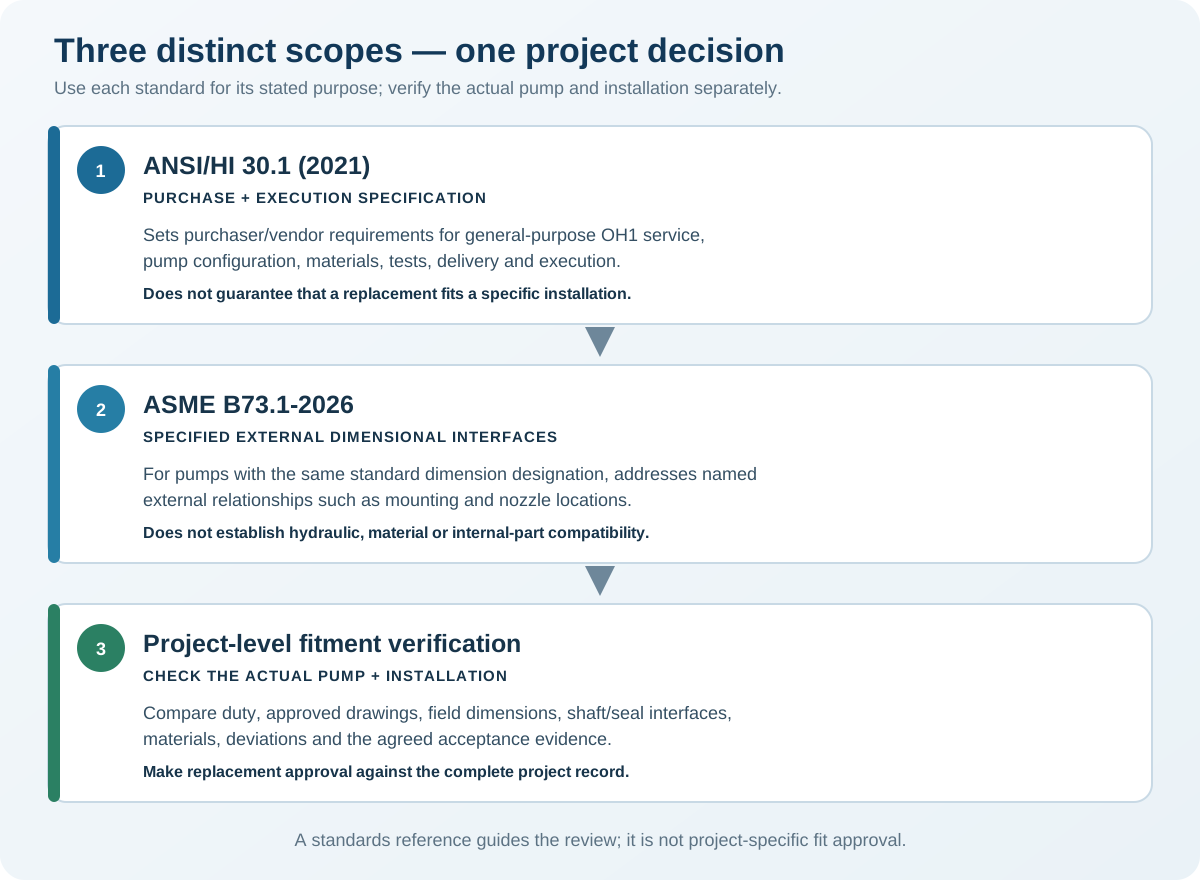
OH1 describes a pump arrangement. ASME B73.1 defines a chemical-process pump standard and specified external interfaces. A shared OH1 description or a B73.1 reference does not, by itself, verify internal parts, hydraulic performance, materials or a specific installed replacement.
Move from Service Basis to Acceptance Evidence
Close the purchase package in a sequence that keeps the duty, pump configuration and acceptance basis connected.
Buyer review sequence
Each step produces the information needed for the next decision.
Define service
Record liquid properties, site conditions and minimum, normal and rated cases.
Confirm scope
Check the requested configuration and duty against the cited HI 30.1 edition.
Complete data sheet
State mechanical, material, sealing, driver and auxiliary requirements.
Agree acceptance
Set test points, grade, witnessing, inspection and reporting before order release.
Verify installation fit
Use drawings and dimensions; apply B73.1 only where its designated scope fits.
Set the Test and Acceptance Basis Before Order Release
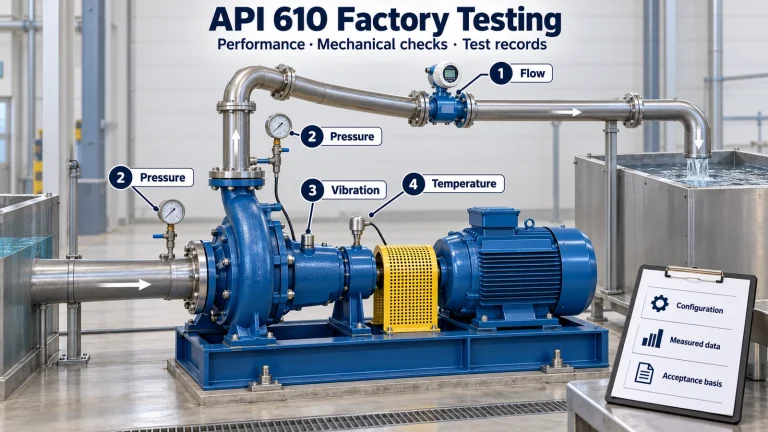
HI 30.1 points hydraulic-performance verification to ANSI/HI 14.6 and its hydrostatic test provisions. The buyer still needs to state the applicable edition, guarantee points, acceptance grade and required test scope in the data sheet or inspection and test plan.
For grade interpretation and test-report detail, see the ANSI/HI 14.6 acceptance-test guide.
Does an HI 30.1 Specification Guarantee a Replacement Will Fit?
No. HI 30.1 provides a general-purpose OH1 pump purchase specification; a reference to it does not establish that a replacement matches an installed pump’s footprint, nozzles, shaft, seal chamber, baseplate, curve or materials.
ASME states that pumps from different sources with the same B73.1 standard dimension designation are intended to be interchangeable for specified external relationships, including mounting dimensions, nozzle size and location, input shafts, baseplates and foundation bolt holes. Verify the actual designation and approved drawings; field modifications and nonstandard arrangements still need review.
Use the ASME B73.1 standard guide to understand its scope, then follow the pump interchangeability verification workflow for model- and installation-specific checks.
What to Send With an OH1 Pump Inquiry
- The exact specification number and edition, completed data sheet, and project deviations.
- Minimum, normal and rated flow/head cases; speed and driver data; liquid properties and suction conditions.
- Approved or existing general-arrangement drawings, pump size/designation, nozzle arrangement, base and maintenance constraints.
- Material and sealing requirements, operating environment and required traceability.
- Test edition, guarantee points, acceptance grade, witness/hold points and final documentation list.
- For a replacement, the installed nameplate, model, size, drawings and field dimensions available for comparison.
For selection questions that extend beyond HI 30.1, use the broader ANSI pump selection framework. For an actual replacement review, submit the pump identity, duty and fitment evidence through the site’s standard engineering-review path.
Frequently Asked Questions
What does HI 30.1 cover?
HI 30.1 is a specification for general-purpose OH1 rotodynamic pumps. It organizes purchaser, product, factory-test, delivery, installation and execution requirements within its stated service scope.
Is OH1 the same thing as ASME B73.1?
No. OH1 is a pump arrangement designation. ASME B73.1 is a chemical-process pump design/specification standard with defined external dimensional interfaces. Check the project documents to see which requirements apply.
Does a reference to HI 30.1 prove a pump will fit an existing installation?
No. Confirm the pump designation and compare approved drawings and field dimensions. Verify hydraulic duty, shaft, seal, materials and base interfaces separately.
Which acceptance grade should I specify?
Select and agree the acceptance grade, guarantee points, test scope and report requirements with the supplier before order release, using the applicable ANSI/HI 14.6 edition.
Sources
- Hydraulic Institute: General Purpose OH1 Rotodynamic Pump Specification
- Hydraulic Institute: Rotodynamic standards and listed editions
- ASME B73.1: Horizontal End-Suction Centrifugal Pumps for Chemical Process
- Hydraulic Institute: ANSI/HI 14.6 acceptance-test standard
- Hydraulic Institute: ANSI/HI 9.6.1 NPSH margin guideline
- Hydraulic Institute Data Tool: POR and AOR definitions