“Vertical Pump” Is Not One Pump Type
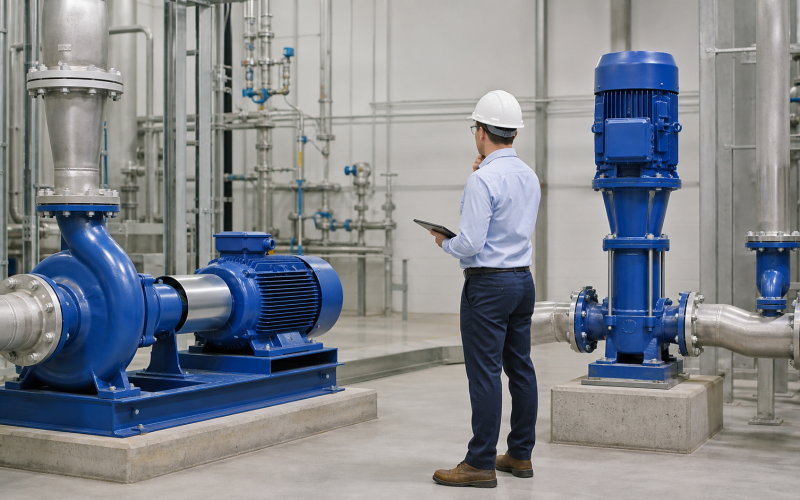
The first selection mistake is comparing one horizontal pump against a single generic “vertical pump.” In chemical and industrial service, a vertical in-line pump and a vertically suspended wet-pit pump solve very different installation problems. Classify the arrangement before comparing footprint, NPSH, maintenance or replacement options.
Three Configurations to Separate
Horizontal end-suction, vertical in-line and vertically suspended pumps should not be treated as one two-column comparison.
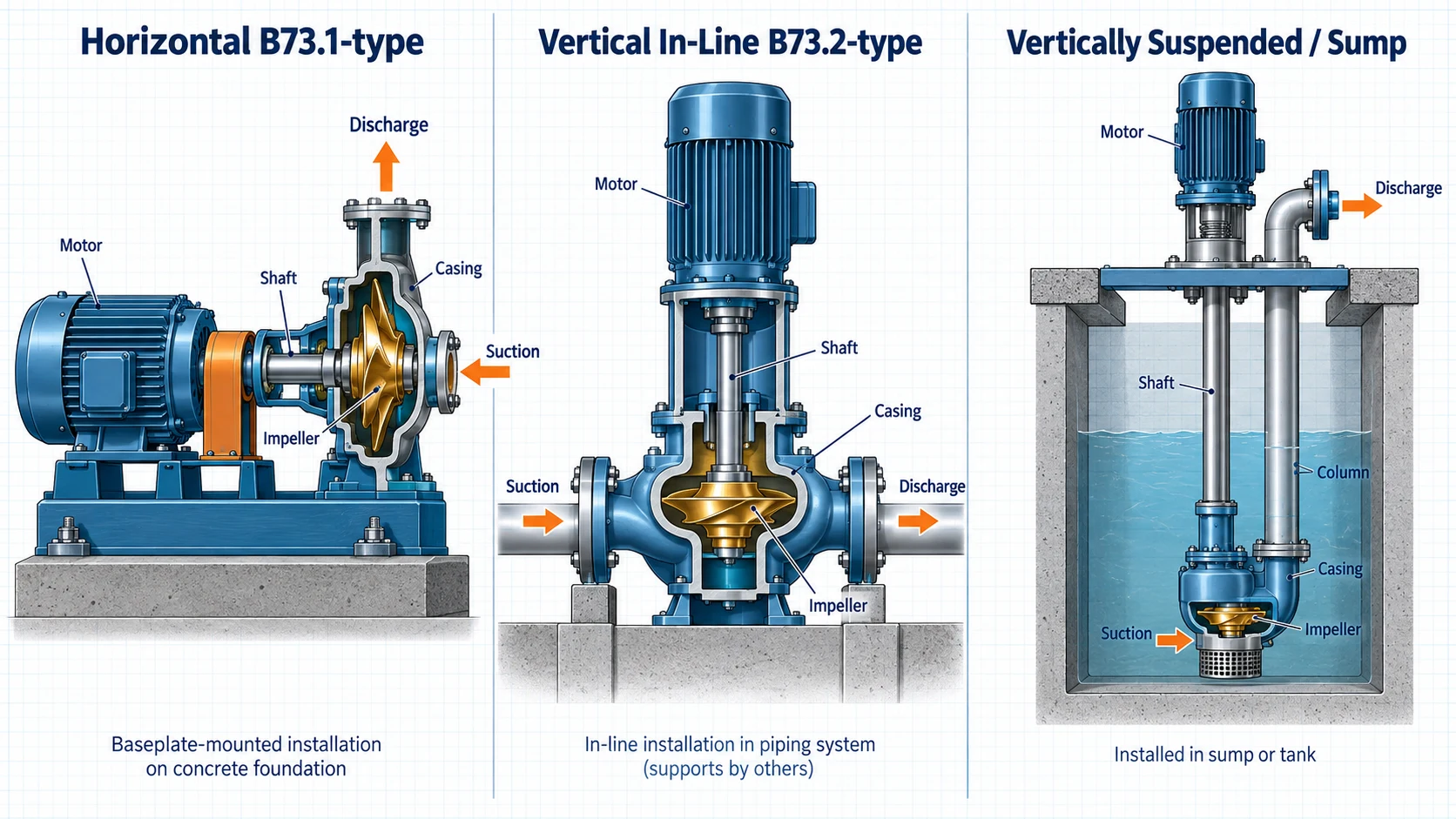
ASME B73.1, ASME B73.2 and Vertically Suspended Pump Families
| Configuration | Typical standards / families | What the label tells you |
|---|---|---|
| Horizontal end-suction chemical-process pump | ASME B73.1-2026 | A defined horizontal, end-suction, single-stage, centerline-discharge chemical-process configuration with standardized external interfaces for the same standard dimension designation. |
| Vertical in-line chemical-process pump | ASME B73.2-2023 | A vertical-shaft, single-stage metallic pump with suction and discharge nozzles in-line. It is not the standard for every vertical pump. |
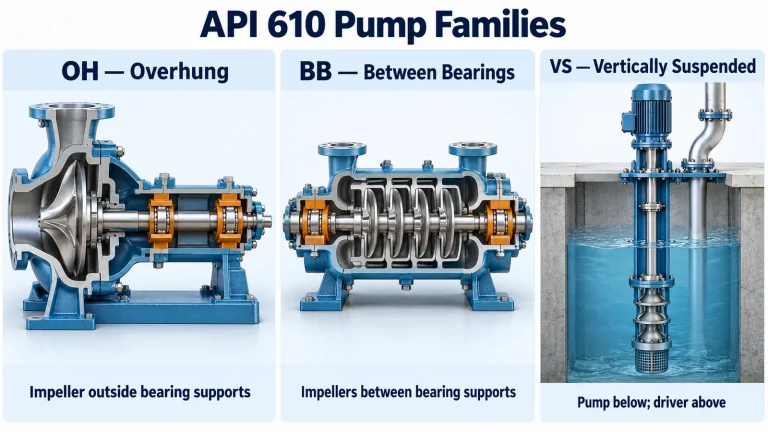
| API overhung vertical in-line families | OH3 / OH4 / OH5 families | Vertical in-line overhung configurations used in API classification; the governing project specification still controls. |
| Vertically suspended pumps | VS families such as VS1 / VS2 / VS4 / VS5 | Wet-pit, sump or vertically suspended architectures with different intake, column, shaft and maintenance considerations. |
Do not use B73.2 as a synonym for every vertical centrifugal pump
A B73.2 vertical in-line pump and a vertically suspended sump/turbine configuration have different hydraulic, structural and maintenance questions.
Footprint vs. Headroom: Compare the Full Maintenance Envelope
Vertical equipment can reduce floor-area demand, but the saved floor area can reappear as headroom, lifting and removal requirements. Horizontal equipment usually needs more plan-view space, yet many arrangements provide direct lateral access to coupling, bearing frame and rotating assembly. The correct comparison is the complete installed and maintenance envelope—not pump footprint alone.
Installation Space ≠ Pump Footprint
Draw the removal path before the layout is approved.
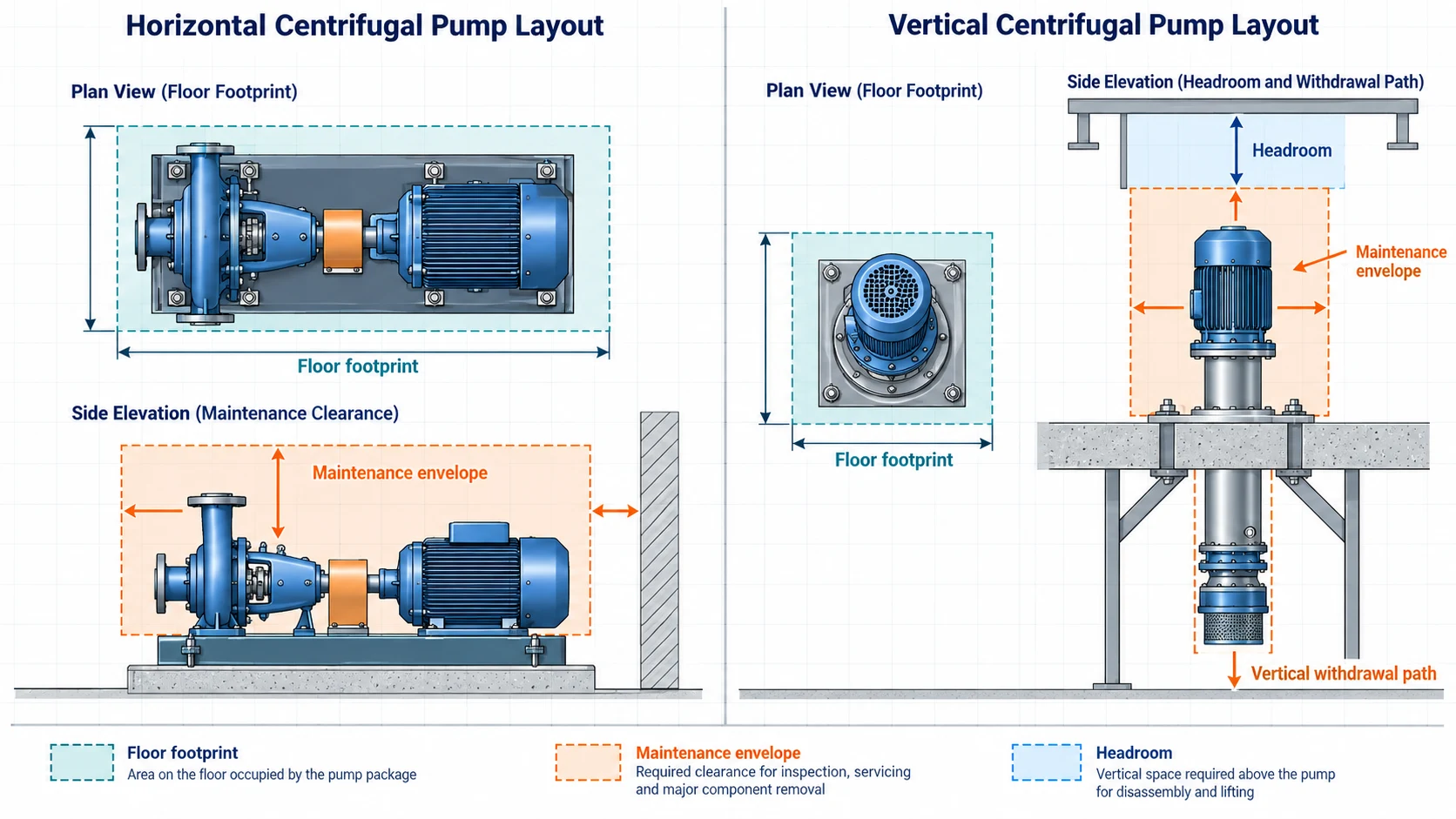
Horizontal vs Vertical In-Line vs Vertically Suspended
| Decision factor | Horizontal B73.1-type arrangement | Vertical in-line B73.2-type arrangement | Vertically suspended / sump arrangement |
|---|---|---|---|
| Floor space | Conventional baseplate and driver footprint. | Can reduce floor footprint, subject to support and access requirements. | Top-side footprint may be compact; pit/wet-well and civil geometry become part of the installation. |
| Headroom / lifting | Lateral service space is often important. | Motor and upper assembly removal may require overhead space. | Column, shaft or bowl removal can require substantial vertical extraction space. |
| Suction hydraulics | Depends on system NPSHa and inlet piping quality. | Still depends on system NPSHa and connected piping. | Adds wet-well/intake geometry, submergence and vortex considerations. |
| Piping / nozzle loads | Baseplate, alignment, pipe strain and nozzle loads must be controlled. | Support/load path and nozzle loads are critical because compact layout does not eliminate external piping loads. | Discharge head, column/support and connected piping require configuration-specific review. |
| Maintenance access | Many ANSI process designs use back-pull-out architecture, but actual access depends on the model and installation. | Upper access, motor removal and safe lifting should be confirmed. | Shaft, column, intermediate bearings or bowl assembly can expand maintenance scope. |
| Retrofit | Good candidate where an external floor-mounted arrangement matches the site and suction system. | Requires in-line piping/support fit and dimensional review. | Pit/intake geometry is integral to the system; replacement is rarely just a pump-only decision. |
Orientation Does Not Create NPSH—The System Does
A vertical motor or vertical shaft does not automatically solve cavitation risk. NPSHa is created by the suction system: pressure at the liquid source, static liquid level/elevation, vapor pressure, suction losses and the pump datum all matter. Compare system NPSHa with the selected pump’s NPSHr at the actual operating condition.
Use the NPSHa Calculator for the suction-side calculation, and the NPSHa vs NPSHr / POR / AOR guide when the operating range also needs review.
Vertically Suspended Pumps Add Submergence and Intake-Quality Requirements
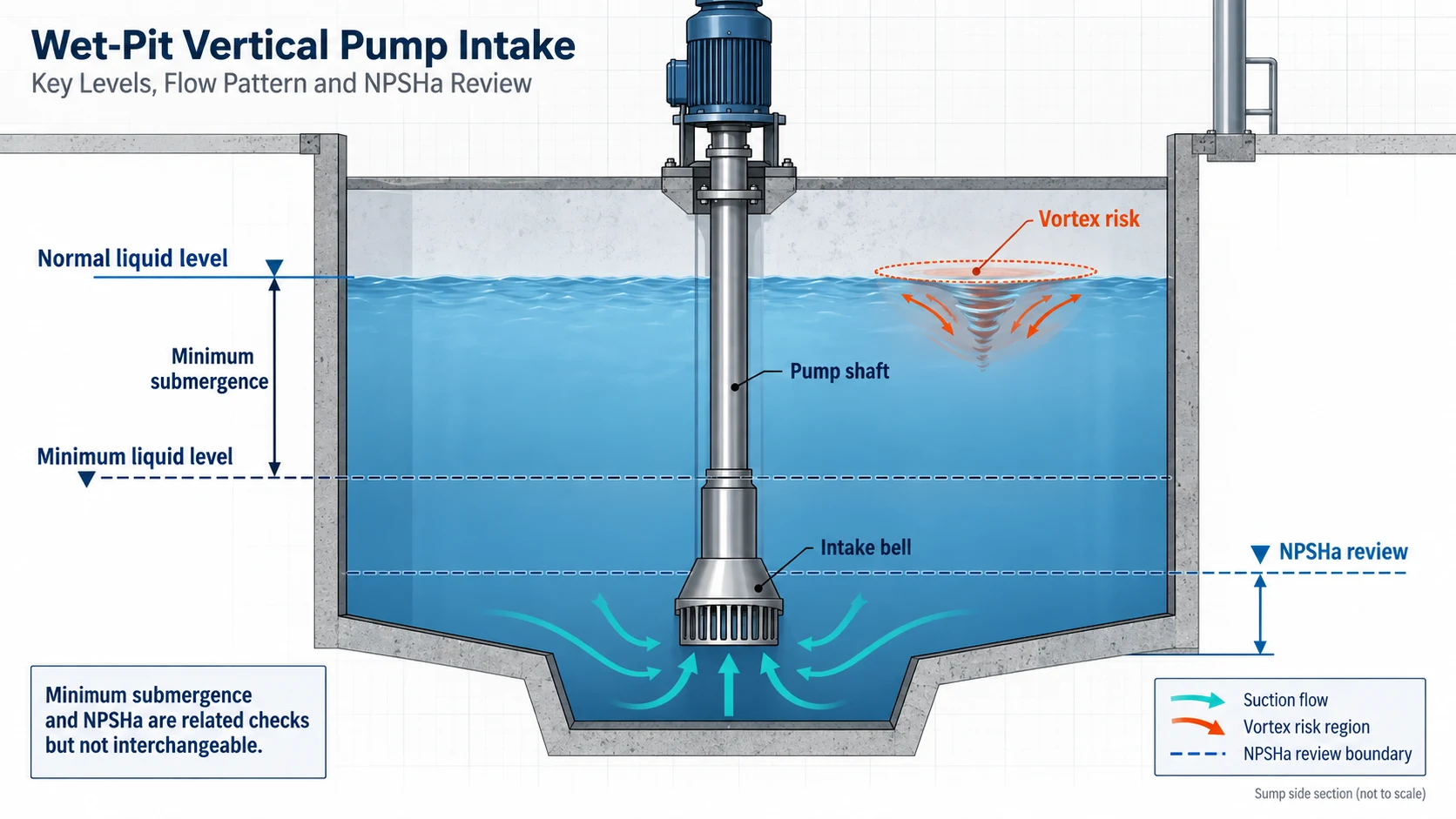
For a wet-pit or formed-intake arrangement, NPSHa is only part of the suction-side review. Free-surface vortices, air-core formation, inlet velocity, bell geometry, sump dimensions and minimum submergence can affect hydraulic quality before the liquid reaches the impeller.
NPSHa and Minimum Submergence Are Related—but Not the Same Check
HI intake guidance uses configuration-specific intake relationships to reduce vortex risk.
Compact Layout Does Not Eliminate Nozzle Loads or Pipe-Strain Risk
Horizontal and vertical in-line pumps both transmit forces and moments through their nozzles and support structure. The load path should keep external piping forces from distorting the casing, moving the shaft alignment or overloading the intended support arrangement.
For a deeper reliability review, use the pump nozzle loads and piping-force guide. For system-level head and suction modeling, use the Pump System Hydraulic Calculator.
Shaft Support, Bearings and Alignment Change With the Configuration
A horizontal frame-mounted process pump, a vertical in-line pump and a long-shaft suspended pump do not manage shaft support in the same way. The correct engineering question is not “Which orientation has better bearings?” but which support arrangement matches the shaft length, hydraulic loads, driver arrangement, service conditions and maintenance plan.
Do not generalize one failure mode to every vertical pump
Long-shaft bearing and column issues apply to specific suspended architectures. They should not be used as a blanket criticism of B73.2 vertical in-line pumps.
Maintenance Access Is a Layout Requirement
Many horizontal ANSI chemical-process pumps use back-pull-out arrangements that can allow the casing and connected process piping to remain in place while the rotating assembly is removed, subject to the actual model and installation. Vertical in-line and suspended configurations have different removal paths, and some may require motor or upper-assembly lifting before the rotating element is accessible.
No universal maintenance-time claim
Do not use fixed “one-hour” or “two-person” repair claims without the exact pump, lifting method, isolation procedure and site conditions.
Compare Installed and Lifecycle Cost—Not a Generic Orientation Multiplier
| Cost layer | What to include |
|---|---|
| Equipment | Pump, driver, base/support, coupling, seal system and required accessories |
| Civil / structural | Foundation, pit/wet-well, barrel, structural steel, headroom and lifting provisions |
| Piping | Rerouting, supports, reducers, valves, flexibility and nozzle-load control |
| Energy | Efficiency at the actual duty range, throttling/control losses and annual operating hours |
| Maintenance | Isolation, labor access, lifting, seal/bearing work, spare assemblies and outage consequences |
There is no reliable universal rule that one orientation is always a fixed percentage cheaper over its life. Use project-specific installed and operating data.
When a Horizontal Self-Priming Route May Be Worth Evaluating
A troublesome vertical sump pump can sometimes be reconsidered as an external horizontal arrangement, but that is a system conversion—not a drop-in pump substitution. The suction source, static lift, priming method, NPSHa, vapor pressure, solids, drainage, containment and piping reroute all have to be reviewed.
For an installed Goulds 3796-type application or a new self-priming duty, see the 3796 self-priming process pump replacement route.
Changing Pump Orientation Is a System Change, Not a Model Cross-Reference
A horizontal B73.1 pump should not be treated as a direct dimensional replacement for a B73.2 vertical in-line pump, and neither should be treated as a direct replacement for a vertically suspended sump/turbine arrangement. Even within the same standard family, external dimensional standardization does not prove identical hydraulics, internals, materials or seal configuration.
Duty range
Flow, TDH, NPSHr, efficiency, power and operating range.
GA interfaces
Nozzles, supports, foundation/pipe centerlines, shaft/coupling and service envelope.
Configuration
Bearings, seal chamber, driver, rotation, shaft support and maintenance access.
Liquid & materials
Chemistry, temperature, viscosity, solids and seal/containment requirements.
Use the ANSI pump interchangeability verification guide before treating a dimensional standard as a complete compatibility proof. For installed horizontal ANSI pumps, review the Goulds 3196 replacement or Durco Mark III replacement routes after the configuration has been confirmed.
A Seven-Step Pump-Configuration Selection Workflow
Screen the System Before Choosing the Orientation
Use the configuration as the result of the engineering review—not as the starting preference.
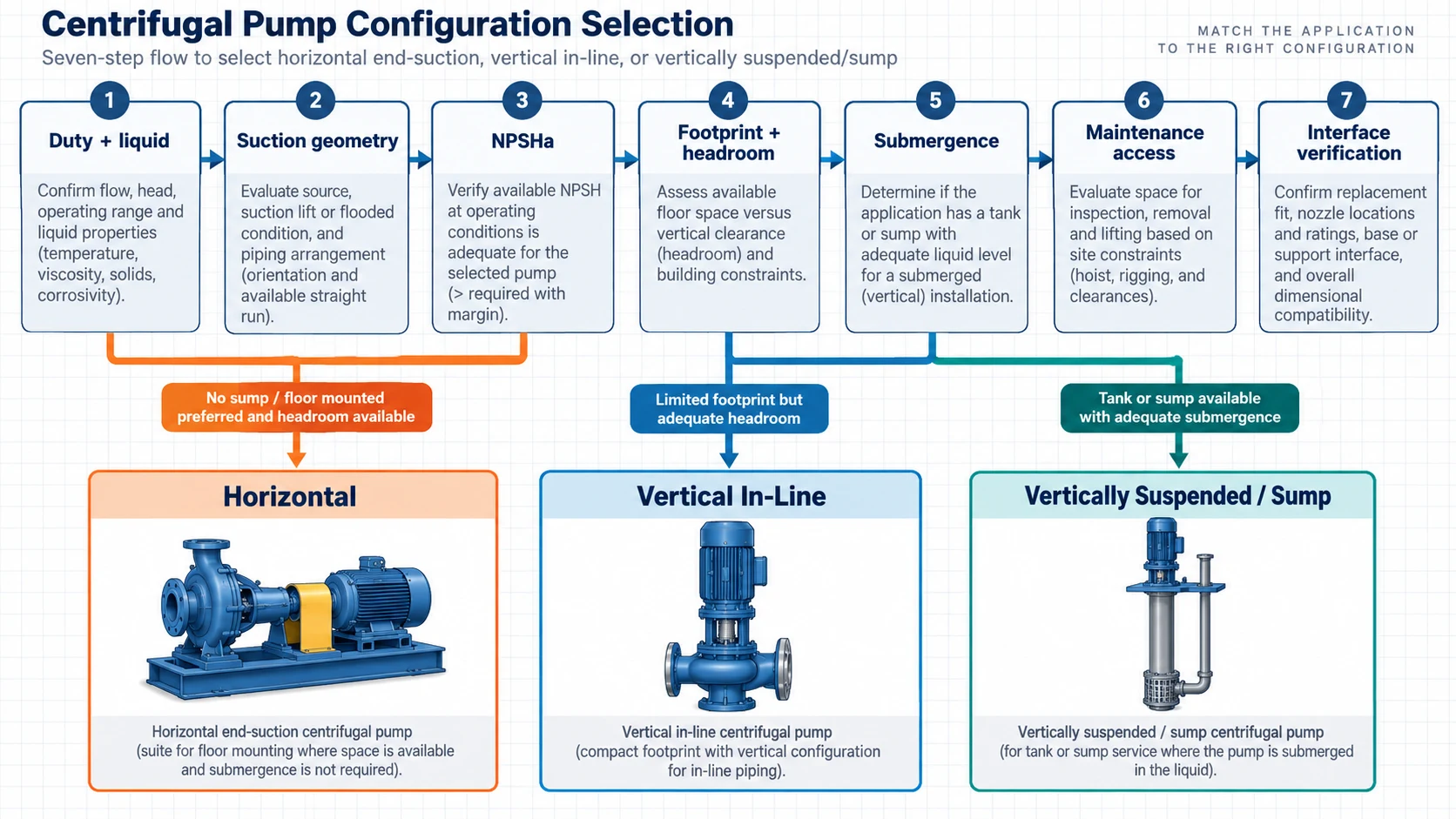
If the pump family itself is not yet defined, use the ANSI Pump Selection & Replacement worksheet to organize the known duty and installed-equipment information.
What to Send for a Configuration Review
Start with what you have.
A nameplate, duty point and simple site sketch are often enough to identify which missing inputs matter next.
Horizontal vs Vertical Centrifugal Pump FAQ
Is a vertical centrifugal pump always better when NPSH is limited?
No. A vertical in-line pump still depends on the connected suction system. A vertically suspended pump can place the first-stage inlet lower relative to the liquid surface, but NPSHa, NPSHr, intake geometry and minimum submergence still require engineering review.
What is the difference between ASME B73.1 and ASME B73.2?
ASME B73.1-2026 covers a defined horizontal end-suction chemical-process pump family. ASME B73.2-2023 covers vertical-shaft, single-stage metallic chemical-process pumps with suction and discharge nozzles in-line. B73.2 is not a blanket standard for every vertical pump.
Does a vertical pump eliminate cavitation risk?
No. Cavitation risk still depends on the actual suction-system NPSHa, the selected pump’s NPSHr and, for wet-pit arrangements, the intake and submergence conditions.
Can a horizontal B73.1 pump directly replace a vertical B73.2 pump?
Not as a simple model substitution. Changing orientation changes support, piping, maintenance access and often dimensional interfaces. The hydraulic duty, GA interfaces, process conditions and structural/load path must be reviewed.
When should a vertical sump pump be reconsidered as a horizontal self-priming arrangement?
Only when the suction lift, priming cycle, NPSHa, vapor pressure, solids, containment, drainage and piping reroute can support the external horizontal arrangement. It is a system conversion rather than a direct drop-in replacement.
Technical Sources
- ASME B73.1-2026 — Specification for Horizontal End Suction Centrifugal Pumps for Chemical Process
- ASME B73.2-2023 — Specification for Vertical In-Line Centrifugal Pumps for Chemical Process
- Hydraulic Institute Data Tool — Submergence in Pump Systems / ANSI/HI 9.8 context
- ANSI/HI 9.6.2-2021 — Assessment of Applied Nozzle Loads
- ANSI/HI 9.6.6-2022 — Rotodynamic Pumps for Pump Piping
- API Standards Plan — API Standard 610, 13th Edition (2026)