
Compare the same scope on both quotations. A complete pump, a wet-end assembly, and one replacement part have different interfaces and different evidence requirements. A lower purchase price or a familiar ANSI designation cannot answer those questions by itself.
Treat an aftermarket option as a candidate until its specific configuration, installation interfaces, hydraulic duty, materials, inspection scope, and commercial terms have been reviewed against the installed pump and project requirements.
What are you comparing?
State whether the purchase covers a pump package, a complete pump, a wet end, a power end, or one replacement part. Suppliers may define package scope differently, so list what each quote includes and which components remain in service. That boundary determines the drawings, measurements, and operating data to review. For configuration-specific fitment, use the Goulds 3196 replacement verification guide.
Choose the replacement boundary
The required evidence changes with the equipment being supplied and the components that will remain in service.
Pump package
Pump, driver, baseplate, coupling, and agreed auxiliaries. List every included item.
Complete pump
Pump unit and installation interfaces. State the driver, baseplate, and seal scope.
Wet end
Casing, cover, impeller, shaft-side interfaces, and seal chamber; note the retained power end.
Power end
Bearing frame, shaft, bearing arrangement, lubrication scope, and mating interfaces.
Individual part
OEM reference, installed size and frame, material, mating interfaces, and service.
Do not assume that a part number, pump-family name, or shared standard designation identifies the complete installed configuration. Check nameplate information, drawings, previous modifications, and the component actually being replaced.
OEM and aftermarket comparison checklist
| Decision area | Evidence to compare | Buyer check |
|---|---|---|
| Scope and configuration | Complete pump, wet end, or individual part; model, size, frame, revision, and retained components | Are both quotations for the same supply boundary and installed configuration? |
| Installation dimensions | Approved drawings and the interfaces relevant to the quoted scope | Are dimensions referenced to the same datums, and are site modifications identified? |
| Hydraulic duty | Curve for the proposed size, speed, impeller configuration, and stated liquid basis | Does it meet the required operating range, power, and suction conditions? |
| Materials | Specified component grades, heat identification, certificates, and service conditions | Does the documented material match the purchase specification and actual fluid? |
| Inspection and testing | Inspection and test plan, applicable acceptance basis, records, and witness points | Are the method, scope, acceptance criteria, and deliverables agreed in writing? |
| Seal and power end | Interfaces included in the supply and any retained shaft, frame, seal, or driver | Are retained parts explicitly checked against the proposed assembly? |
| Schedule and cost | Quoted delivery date, included scope, freight, inspection, installation, and stated exclusions | Are the dates and total costs based on equivalent materials, quantity, and inspection? |
| Warranty and remedies | Written coverage, exclusions, claim process, nonconformance response, and support | Can the team identify what happens if inspection or commissioning finds a mismatch? |
ASME B73.1 covers design and specification requirements for horizontal end-suction chemical-process pumps, including dimensional interchangeability for pumps with the same standard dimension designation. It does not, by itself, verify a particular supplier’s pump against a specific site, establish internal-part interchangeability, or prove that a proposed curve meets the required duty. See dimensional interchangeability versus component compatibility for that distinction.
Separate fit, performance, and material approval
Verify dimensions against the actual replacement scope
For a complete pump, compare the installation dimensions and interfaces shown on the approved drawings with the existing base, piping, driver, and coupling arrangement. For a wet end or individual part, check the relevant casing-to-frame, shaft, impeller, cover, and seal-chamber interfaces. Identify any retained components, field modifications, or measurements that still need confirmation.
B73.1 dimensional conformity can support an installation review, but it is not a substitute for checking the exact configuration. For a broader explanation, see the pump interchangeability verification workflow.
Compare the proposed curve at the required duty
Review a performance curve for the proposed pump configuration, including its stated speed, impeller diameter or trim, flow, head, efficiency, absorbed power, and required NPSH data where available. Compare it with the project duty and expected operating range. Do not infer hydraulic equivalence from matching flanges, a pump model name, or a similar curve image.
Use the site’s performance-curve resources for published pump data. A pump calculator can organize system-side duty inputs; it does not replace a pump curve or certify a pump selection. If curve data are not available for the quoted configuration, record that as an open engineering item.
Match material records to the service
Use the specified material grade for each wetted component rather than a broad label such as “stainless,” “duplex,” or “Hastelloy.” Review the actual process fluid and its concentration, temperature, contaminants, solids, velocity, and relevant operating changes. Confirm the material standard and grade on the quotation and agree which components require heat-number traceability, material test reports, positive material identification, or other documentation.
A material name alone does not establish suitability or grade equivalence. Where chemistry or grade identification is uncertain, keep approval open until the project’s material basis and supplier records have been reviewed.
Agree inspection and test evidence before ordering
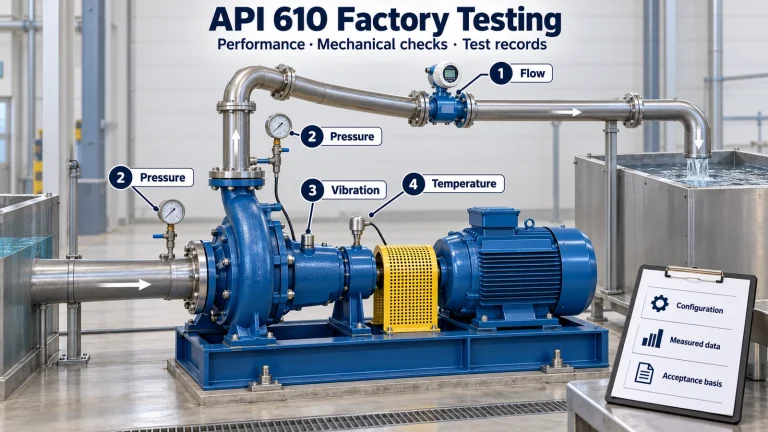
Ask which inspections and tests apply to the quoted components and what records will be delivered. Depending on scope and purchase requirements, the plan may cover dimensional inspection, material traceability, balance records, pressure testing of pressure-containing parts, or performance testing of a complete pump. Specify the governing procedure and acceptance basis in the purchase documents. Do not apply one tolerance, balance grade, or test duration to every pump and component without an applicable specification.
The replacement-parts inspection guide explains the records and interfaces buyers can request. Make sure the inspection report identifies the part, drawing revision, measurement basis, result, and any agreed deviations.
Confirm seal and power-end interfaces
If any part of the existing assembly will be retained, list it explicitly. Verify the relevant shaft and sleeve arrangement, seal chamber and gland interface, impeller connection, frame register, bearing arrangement, coupling, and maintenance envelope against current drawings and the installed equipment. A casing that matches the piping does not prove that a retained seal, power end, or rotating assembly will fit or perform as required.
Compare schedule, total cost, and warranty on equal terms
Lead time is meaningful only when the quoted scope is comparable. Check the date basis, material availability, quantity, inspection and witness requirements, shipping term, and whether the date is confirmed or estimated. Do not rely on a general OEM or aftermarket lead-time range in place of dated quotations for the actual order.
Compare total project cost using the same supply boundary. Include the quoted equipment or parts, required documentation and tests, freight, installation work, any base or piping changes, commissioning, and the project’s own downtime assumptions. Do not present a universal savings percentage: cost and risk depend on the installation, scope, and site consequences.
Review warranty duration and exclusions alongside the written remedy for nonconforming parts, the evidence required to open a claim, response expectations, and technical support during installation. Record unresolved items as commercial or engineering exceptions before approval.
When to retain the OEM route or qualify an alternative
For a part-number search, use the OEM part-number cross-reference. For a complete-pump supply scope, review the Goulds 3196 replacement options. The replacement-parts category is the relevant route for individual components. These pages address product scope; final fit and service suitability still depend on configuration-specific review.
Information to include with both quotations
- Whether the request is for a complete pump, wet end, or individual component.
- Nameplate data, model, size, frame, serial number, and OEM part references where available.
- Approved outline or sectional drawings, current configuration, and known modifications.
- Required flow, head, speed, operating range, liquid properties, temperature, and motor information.
- Material specification by component, documentation needs, and any inspection or witness requirements.
- Seal arrangement, retained equipment, coupling or baseplate constraints, and required delivery date.
- Quotation validity, delivery basis, included scope, exclusions, warranty, and nonconformance remedy.
This information allows the engineering and commercial teams to compare proposals against the same requirements and identify remaining decisions before purchase approval.
Frequently asked questions
Does ASME B73.1 make every aftermarket Goulds 3196 pump interchangeable?
No. B73.1 defines dimensional and design requirements within its scope. A specific replacement still needs review against the installed pump, the required duty, the quoted configuration, and the project specification.
Can I keep the existing power end or mechanical seal?
Possibly, but only after the relevant interfaces and configuration have been checked. Confirm the frame register, shaft and sleeve, impeller connection, seal chamber, gland, seal envelope, and any other retained parts against the proposed assembly and current drawings.
Does an aftermarket pump need to reproduce the OEM curve exactly?
Not necessarily. The proposed curve must be evaluated against the required duty and operating range for the specified configuration. A curve comparison or test record should state the speed, impeller configuration, and basis used; a calculator result or similar-looking graphic is not pump performance evidence.
Which material and inspection documents should I request?
Specify the material grade by component and request the agreed traceability and inspection records, such as heat identification, material reports, PMI, dimensional inspection, balance, pressure-test, or performance-test documentation where required by the purchase scope.
How should I compare OEM and aftermarket lead time and price?
Compare dated quotations for the same quantity, material, supply scope, inspection requirements, shipping basis, and delivery point. Include installation changes and project-specific downtime assumptions in the total-cost review rather than relying on a general savings or lead-time claim.
Compare OEM and Aftermarket Quotes on the Same Scope
Send both suppliers the same technical scope and record each response against it. A missing item is an open question, not an included cost or an approved deviation. This sheet supports a purchasing decision after technical compatibility has been reviewed.
| Comparison line | Offer A / OEM route | Offer B / aftermarket route |
|---|---|---|
| Configuration and scope | Record exact pump/part reference, quantity, material, included components and exclusions. | Record the same fields; flag any different supply boundary. |
| Duty and acceptance documents | List proposed curve, drawing revisions and agreed inspection/test deliverables. | List the equivalent documents and unresolved requirements. |
| Price and delivery basis | Record currency, validity, Incoterm/delivery point, freight, duties and taxes as applicable. | Use the same basis or show the adjustment separately. |
| Schedule and installation | Record dated lead time, approval milestones, transit and any site modifications. | Record dependencies, modification work and commissioning scope. |
| Warranty and service | Record warranty start, duration, covered items, exclusions and support process. | Record the same terms and any unresolved difference. |
Build total evaluated cost from the quoted supply price, agreed documentation/testing, logistics, installation changes and project-specific outage assumptions. Keep each assumption visible and use the same boundary for both offers. Do not turn a generic savings percentage or an undated lead-time statement into a project estimate.
For a component enquiry, use the Goulds replacement-parts route. For the assembled pump, use the Goulds 3196 replacement enquiry. The compatibility verification guide supplies the separate technical review. Share your requirements and open questions; competitor quotations are not required.
Open the copyable review worksheet
Edit the known fields, leave missing information marked as pending, and copy the text into your maintenance record or enquiry. This worksheet does not submit data.
Request a quote against your defined scope
Technical references
- ASME, B73.1 — Specification for Horizontal End Suction Centrifugal Pumps for Chemical Process.
- ITT Goulds Pumps, Model 3196 i-FRAME ANSI process pump product bulletin (English); confirm the applicable model, revision, and configuration against the installed pump.
- ANSI Pumps Pro, pump performance curves; use only data for the stated pump configuration and duty basis.
Goulds and 3196 are used to identify the installed equipment and replacement reference. ANSI Pumps Pro is an independent aftermarket supplier and is not affiliated with or endorsed by ITT Goulds Pumps.