
Direct answer
An ANSI process pump should not be selected from a model number, flange size or one duty point alone. Define the operating envelope, liquid properties, suction conditions, installation or replacement interfaces, supplier evidence and lifecycle requirements first. Then verify the proposed pump against the actual curve, ASME B73.1 interface requirements and the documented project data before order release.
ANSI Pump Selection: Five Questions That Lead to a Verifiable RFQ
The purpose of the five-question framework is not to replace hydraulic calculations or a manufacturer curve. It is to keep the engineering decision connected from the first process input through quotation and final verification.
Selection Decision Map
Move left to right. Each step creates evidence needed by the next one.
Duty
Flow · TDH · suction · speed · operating range
Liquid
SG · viscosity · vapor pressure · chemistry · solids
Fitment
Nozzles · base · shaft · coupling · retained interfaces
Evidence
Curve · GA · materials · tests · deviations
Lifecycle
Energy · maintenance · spares · modification · downtime
What Duty Must the Pump Deliver?
Define the complete operating envelope rather than one preferred point. Record minimum, normal and maximum flow, total dynamic head, suction condition, speed, driver limits, operating hours and any VFD range. A pump that passes one nominal point can still be unsuitable at low flow, maximum system resistance, low tank level or another credible operating case.
| Duty input | What to define | Selection question |
|---|---|---|
| Flow | Minimum / normal / maximum flow | Does the curve cover the credible operating range? |
| Head | TDH at the relevant operating cases | Are elevation, pressure, velocity and line losses on a consistent basis? |
| Suction | Tank pressure/level, suction losses, temperature and vapor pressure | Is system NPSHa adequate relative to pump NPSHr and the project-required margin? |
| Speed / driver | RPM, motor power, voltage, VFD range and starting/control method | Does the driver cover absorbed power over the required range? |
| Operating cycle | Hours, starts, standby, transient and minimum-flow cases | Is the selected pump suitable for how the plant will actually operate it? |
Three calculations that define the selection
Use the Total Dynamic Head Calculator when the required pump head must be built from system inputs rather than copied from one pressure gauge.
Use the Pump Power & Motor Sizing Calculator for a transparent power check, then verify the final driver against the proposed performance curve.
BEP, POR and AOR belong in the curve review
Review operating-region concepts in the NPSH, BEP, POR & AOR guide, then confirm the actual proposed pump on the Pump Performance Curves page.
What Does the Liquid Change About the Selection?
A liquid name is not a pump specification. Provide the actual operating chemistry and physical properties that can change hydraulics, materials, sealing and maintenance. The same chemical can create a different selection when concentration, temperature, impurities, solids or gas content change.
Viscosity: use correction guidance, not a fixed cSt trigger
Published rotodynamic pump curves are commonly based on water. When the process liquid is materially more viscous, head, flow, efficiency, input power and NPSH behavior can change. Evaluate the applicable correction method using ANSI/HI 9.6.7 instead of assuming that one universal 20 cSt, 30 cSt or 50 cSt cutoff applies to every pump.
For preliminary metallurgy screening, use the Chemical Compatibility & Resistance Guide. Keep the final material decision tied to the exact concentration, temperature, component form and project requirements.
What Must Match the Existing Installation?
For a new installation, layout and maintainability are part of the selection. For a replacement, the retained installation becomes a design input. Do not infer fit from a brand family, flange size or “ANSI” label alone.
ASME B73.1 Replacement Interface Map
Separate standard-controlled external interfaces from configuration-specific engineering checks.
| Interface group | What to verify | Why it matters |
|---|---|---|
| Nozzles | Size, rating, orientation, centerline, face and projection | Avoid forced piping fit and unplanned field modification |
| Pump / base | Feet, bolt pattern, shaft centerline, base and foundation | Controls installation height and alignment |
| Driver / coupling | Shaft extension, coupling position, motor frame and guard | Controls retained-driver fit and alignment range |
| Seal / auxiliaries | Seal chamber, auxiliary connections, drain/flush/vent and available space | Prevents a dimensionally similar pump from creating a sealing or piping conflict |
| Maintenance | Lifting path, back-pull-out/removal space and access | A pump that fits but cannot be serviced is not a good replacement |
Use the ASME B73.1 guide for the standard boundary and the ANSI pump replacement-dimensions checklist for a deeper field-fitment workflow.
What Evidence Should Exist Before the Pump Is Released?
A strong quotation is traceable to the quoted pump, not a generic catalog statement. Ask the supplier to connect the pump configuration, curve, drawings, materials, tests and deviations to the order being reviewed.
| Evidence | What it should establish | Buyer question |
|---|---|---|
| Duty sheet + performance curve | Flow, head, speed, trim, efficiency, power and NPSHr basis | Are minimum/normal/maximum operating cases reviewable? |
| Approved GA / sectional drawing | Installation and retained interfaces | Can the existing base, piping, coupling and auxiliaries be checked? |
| Material schedule / traceability | Specified component grades and required records | Are casting/wrought forms and required MTR/heat linkage clear? |
| Inspection / test scope | Agreed dimensional, pressure, balance, performance or NDE requirements | Which tests are included in this order and which are not? |
| Seal / auxiliary basis | Specified sealing arrangement and connections | Does the configuration match the process and retained installation? |
| Deviation register | Any difference from the purchaser’s requested basis | What still needs approval before manufacturing? |
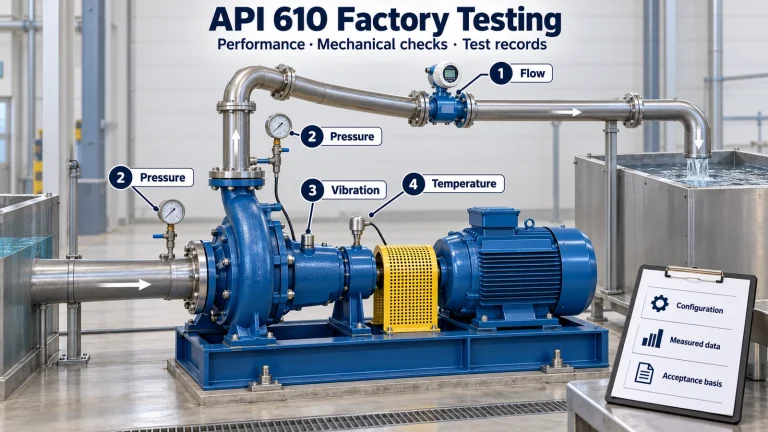
Where hydraulic acceptance testing is required, define the acceptance basis before the order rather than after the test. See the ANSI/HI 14.6 pump acceptance-test guide.
What Will the Pump Cost to Own, Install and Maintain?
Purchase price is only one line in the decision. Compare the complete project and operating consequence of the candidate pump using values that belong to the actual plant.
From an Incomplete Inquiry to a Selection-Ready RFQ
A useful worked example does not need to invent a final pump model, metallurgy or seal plan. The engineering value is in showing how an incomplete request becomes a package that can actually be checked against curves and drawings.
| Stage | What the buyer knows | What must be added before selection |
|---|---|---|
| Initial inquiry | “Need an ANSI chemical pump. Existing pump is old. Normal flow about 150 GPM.” | No final model can be approved from this information. |
| Duty review | Normal flow identified | Minimum/maximum flow, TDH, suction condition, speed, operating hours and VFD range |
| Liquid review | Chemical service | Exact chemistry, concentration, temperature, SG, viscosity, vapor pressure, solids/gas and upset cases |
| Replacement review | Existing pump available on site | Nameplate, pump size/frame or designation, GA/photos, nozzle/base/shaft/coupling interfaces and field modifications |
| Evidence requirement | Project needs a replacement quote | Required curve, drawing, material records, test scope, deviation register and documentation package |
| Selection-ready output | Duty + liquid + fitment + evidence are defined | Compare candidate pumps using actual curves and drawings; only then release a model/configuration for quotation |
ANSI Pump Selection Checklist Before You Compare Models
Use the Right Tool for the Next Decision
This guide owns the selection framework. The calculations and configuration evidence belong in the dedicated tools and technical resources below.
| Next question | Use this resource | What it produces |
|---|---|---|
| What head must the pump develop? | TDH Calculator | Traceable head requirement from system inputs |
| How much suction head is available? | NPSHa Calculator | System-side NPSHa for comparison with pump NPSHr |
| What shaft/motor power does the duty imply? | Pump Power Calculator | Hydraulic/shaft power and a reviewable motor-sizing range |
| Is my duty package complete? | Centrifugal Pump Sizing Calculator | Structured duty package; no automatic model promise |
| Does the candidate pump cover the duty? | Pump Performance Curves | Flow/head/efficiency/power/NPSHr review from actual curve data |
| Which selection/replacement route should I submit? | ANSI Pump Selection & Replacement | Selection brief ready for engineering confirmation |
What to Send With an ANSI Pump Selection Request
Supported commercial scope
For public quotation routing, keep the supply scope to complete replacement pump, bare pump / defined pump assembly, or supported standalone components: casing, cover, impeller, shaft and selected drawing-based metallic mechanical-seal components. Other internal items may be discussed as retained interfaces during engineering review without being presented as standalone sales scope.
Build the request directly in the ANSI Pump Selection & Replacement worksheet. Start with the information you have; missing fields can be closed during engineering review.
ANSI Pump Selection FAQ
What is the first step in ANSI pump selection?
Define the operating envelope: minimum, normal and maximum flow, required TDH, suction conditions, speed/control range, liquid properties and operating cycle. Do not begin from flange size or a model family alone.
Should every pump operate within the same percentage of BEP?
No. Preferred and allowable operating regions depend on pump type, specific speed, design and application guidance. Use the applicable pump curve, manufacturer information and ANSI/HI 9.6.3 rather than one universal percentage range.
How much NPSH margin should I use?
There is no single universal margin for every pump and service. Calculate system NPSHa, read pump NPSHr at the actual duty and apply the margin required by the pump design, application, project specification and applicable ANSI/HI guidance.
Does ASME B73.1 mean any ANSI pump will fit the same installation?
No. B73.1 provides dimensional-interchangeability requirements for defined interfaces on pumps with the same standard dimension designation. The installed pump, field modifications, hydraulics, internal parts, materials, sealing and retained interfaces still require verification.
What should a supplier provide before I release the pump order?
Request the configuration-specific performance curve/duty basis, GA or sectional drawing, material schedule and required traceability, agreed test/inspection scope, seal/auxiliary basis, IOM documentation and a clear list of deviations or exclusions.
Can the selection tool automatically choose the final pump model?
No. The site tools organize duty and replacement information for engineering review. Final model selection still requires the actual pump curve, service conditions, materials, interfaces and project requirements.
Technical Sources
- ASME — B73.1-2026, Specification for Horizontal End Suction Centrifugal Pumps for Chemical Process.
- Hydraulic Institute — ANSI/HI 9.6.1-2024, Rotodynamic Pumps Guideline for NPSH Margin.
- Hydraulic Institute — ANSI/HI 9.6.3-2024, Rotodynamic Pumps Guideline for Operating Regions.
- Hydraulic Institute — ANSI/HI 9.6.7-2021, Effects of Liquid Viscosity on Rotodynamic Pump Performance.
- Hydraulic Institute — Pump FAQs, pump-curve, viscous-performance and operating-region guidance.
- ITT Goulds Pumps — Centrifugal Pump Selection Guide.
- ANSI Pumps Pro — Pump Performance Curves.