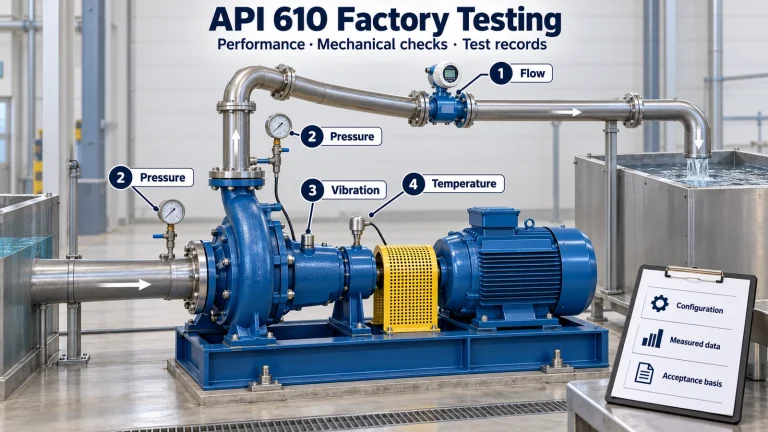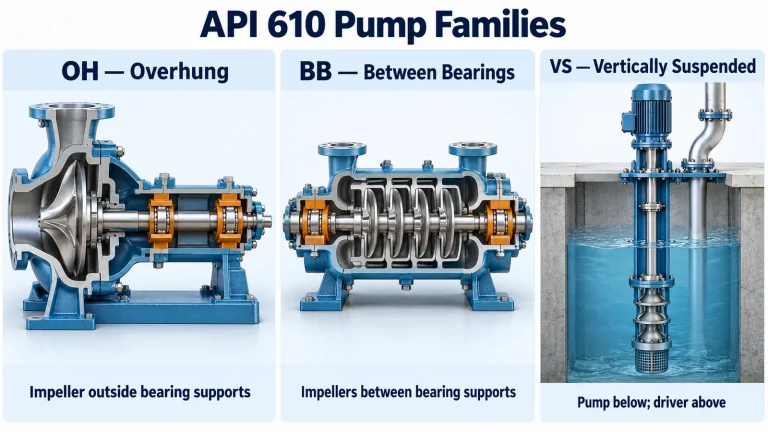

Engineering note: This guide is for preliminary screening and RFQ preparation. It is not a universal corrosion-resistance chart or approval for a specific service.
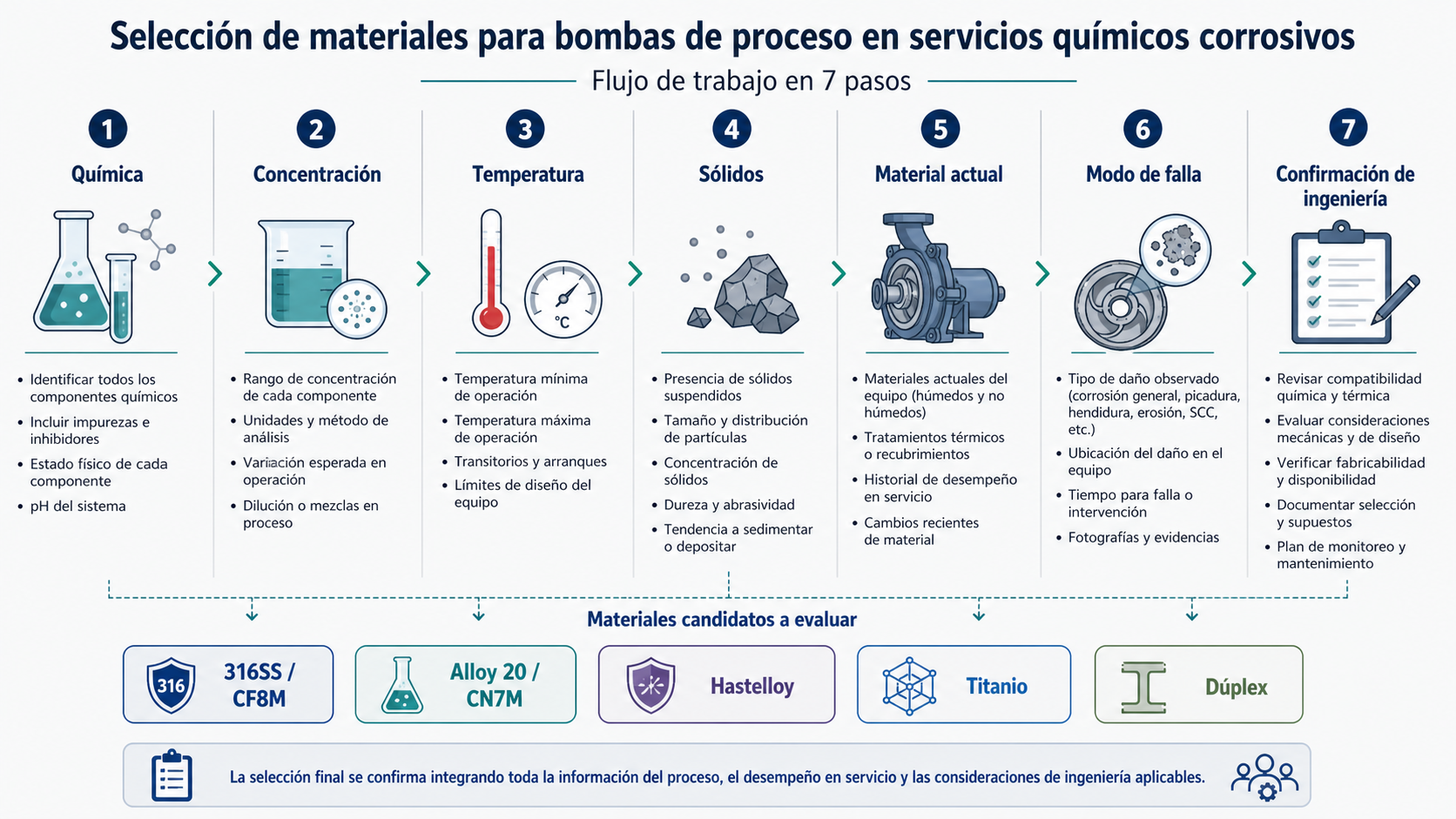
Start with the complete operating envelope
Before comparing pump materials, document the conditions the pump will see during normal operation and credible deviations. A chemical name alone does not describe concentration changes, contamination, cleaning, start-up or shutdown conditions.
| Information to collect | Examples | Why it matters |
|---|---|---|
| Chemical composition | Main chemical, mixture components, contaminants and cleaning chemicals | Defines the environment each wetted component must withstand |
| Concentration | Normal range, minimum, maximum and dilution conditions | Material performance can change as concentration changes |
| Temperature | Normal, maximum, start-up, shutdown and cleaning temperatures | Corrosion and mechanical limits are temperature-dependent |
| Pressure and duty | Suction and discharge pressure, flow, head and speed | Confirms the pump selection and operating range |
| Solids and gas | Solids concentration, particle size, crystals, entrained gas and settling tendency | May add erosion, abrasion, impact or cavitation to corrosion |
| Installed equipment | Manufacturer, model, size, frame, seal configuration and wetted materials | Supports replacement and interface checks |
| Failure evidence | Pitting, cracking, erosion, leakage, deposits or repeated seal failures | Helps identify whether the cause is material, mechanical or hydraulic |
If the process can vary, record the expected range rather than only the normal operating point. Cleaning, flushing, dilution, shutdown and storage may expose components to conditions different from the main process. Include pressure cycles, exposure time and any known process changes in the review.
Evaluate each wetted component
A pump is not made from one material. The casing, impeller, shaft, shaft sleeve, seal chamber, wear components, seal faces, gaskets and elastomers each have different exposure and mechanical requirements. Identify the component and product form being evaluated. Cast pump components and wrought shafts or sleeves may use different specifications even when their commercial alloy names appear similar.
Where certification is required, define the applicable material specification, inspection scope and traceability requirements in the purchase documents. A material family name by itself does not confirm the exact grade, product form or suitability of a component.
Compare material families as candidates
The material families below can be considered during initial screening. They are candidates for review—not universal recommendations for a chemical, concentration or temperature.
| Material family | Initial screening context | Checks before selection |
|---|---|---|
| 316 stainless steel / CF8M | Common stainless-steel family used in many industrial services | Confirm chemical mixture, temperature, chlorides, deposits, velocity and component form |
| Alloy 20 / CN7M | May be evaluated for certain sulfuric-acid and other chemical services | Verify concentration, temperature, impurities, aeration, velocity and specified product form |
| C-276 / CW2M | May be evaluated for selected aggressive chemical environments | Confirm alloy specification, product form, fabrication condition and service-specific data |
| Titanium | May be evaluated for certain oxidizing or chloride-containing services | Check temperature, crevices, galvanic contact, velocity and component design |
| Duplex stainless steels | May be evaluated where strength, chloride exposure or solids are relevant | Confirm exact grade and evaluate corrosion, erosion, temperature and fabrication requirements |
Do not use a single concentration threshold or chemical name as a stand-alone selection rule. Corrosion data should match the relevant composition, concentration, temperature and test conditions. Published laboratory data can help screen candidates, but field conditions may differ. For example, Haynes International’s C-276 data presents corrosion results by concentration and temperature and identifies the laboratory conditions behind the measurements.
For cast stainless and nickel-alloy components, verify the cast grade specified for the part instead of assuming it is identical to a wrought grade with a similar trade name. The Nickel Institute’s guidance on stainless-steel castings discusses the distinction between common wrought designations and cast equivalents.
Consider corrosion and erosion together
When a process contains particles, crystals or entrained gas, corrosion may occur alongside erosion, abrasion, impact or cavitation. Solids can damage protective surface films, change clearances and accelerate wear on impellers or seal chambers. Review particle size, hardness, concentration, settling tendency and flow conditions.
Also confirm that the pump operates at a suitable point for the system. A material change alone may not solve a problem caused by unsuitable hydraulics, deposits or operation outside the intended range.
Review the complete sealing system
The seal system should be reviewed against the process fluid, temperature, pressure, solids, operating pattern and consequences of leakage. Check the seal faces, secondary seals, gaskets, sleeve and any flushing or support system as a complete arrangement.
API Standard 682 provides requirements and recommendations for pump shaft-sealing systems in applicable services. Treat it as a project or specification reference where required—not as an automatic prescription for a particular seal or piping plan. Confirm that the selected seal and auxiliary system suit the intended service with the relevant purchaser and supplier.
For hazardous, toxic or otherwise high-consequence service, involve the seal supplier and process safety team early. Do not describe any configuration as guaranteeing “zero emissions” without defining the system boundary, operating conditions and measurement basis.
When to consider a replacement wet end
A replacement wet end may be considered when the installed power end, base and coupling can remain in service. Before specifying or quoting a replacement, verify the pump manufacturer, model, size, frame or group, casing configuration, impeller, shaft, seal chamber, interfaces, materials, speed, performance curve and operating duty.
Do not rely on the pump family name alone to establish interchangeability. Confirm dimensional interfaces and hydraulic requirements for the specific installed configuration. A change to a more corrosion-resistant alloy also does not correct an unsuitable duty point or an unrelated mechanical failure.
For related replacement information, see Goulds 3196 replacement pumps, Durco Mark III replacement pumps and the chemical resistance guide. Use the installed model, configuration and duty to confirm the scope before quotation.
Prepare an engineering review request
For an initial review, provide as much of the following information as is available:
- Chemical name or mixture composition
- Concentration range and operating temperature
- Flow, head, pressure and speed
- Solids, crystals or entrained gas
- Pump manufacturer, model and size
- Current wetted materials and seal configuration
- Observed failure mode and service history
- Nameplate, drawings, material certificates or failure photographs
The review should identify candidate configurations and any information still needed for verification. A preliminary screening result should not be presented as final material approval.
Frequently asked questions
Is 316 stainless steel suitable for every corrosive chemical?
No. Suitability depends on the actual chemical composition, concentration, temperature, contaminants, flow conditions and component form. Review the specific service before selecting a material.
Is Alloy 20 a universal choice for sulfuric acid?
No. Alloy 20 or a corresponding cast grade may be considered for some services, but the specific concentration, temperature, impurities, aeration, velocity and product form need to be checked.
Are C-276 and CW2M identical?
Do not assume that a wrought alloy designation and a cast grade are interchangeable in every specification or component. Verify the required product form and material documentation for the part being supplied.
Can a replacement wet end keep the existing power end?
Possibly, if the specific pump configuration, interfaces, shaft, seal, materials, performance curve and duty are compatible. Confirm the installed model and dimensions before specifying a replacement.
What information should I send before requesting a quote?
Start with the chemical composition, concentration, temperature, pump model and size, operating duty, current materials, seal configuration and failure history. Drawings, nameplate photographs and material records can help verify the configuration.