

The fastest way to create a bad pump quotation is to start with a model number and skip the service conditions. A defensible ANSI pump selection starts with the duty, then checks the liquid, materials, fitment, quality evidence and lifecycle requirements. These five questions help buyers reduce quotation comparisons based only on price or flange dimensions.

What decision is this framework designed to support?
Use it for a new ANSI process pump, a Goulds 3196 or Durco Mark III 2 replacement, a wet-end replacement, a power-end change or a cross-reference request. It is especially useful when several suppliers claim compatibility but provide different levels of drawing and test documentation.
The framework does not replace a certified selection. It makes sure the request contains the information needed for a responsible selection.
Question 1: What duty must the pump deliver?
Define normal, minimum and maximum flow; total head or suction/discharge pressure; speed; liquid temperature; density; viscosity; solids; vapor pressure; and NPSH available where relevant. Include startup, standby, parallel-pump and control conditions.
Check the operating point against the pump curve and preferred operating region. A nameplate flow or a copied model number is not a substitute for the current process duty.
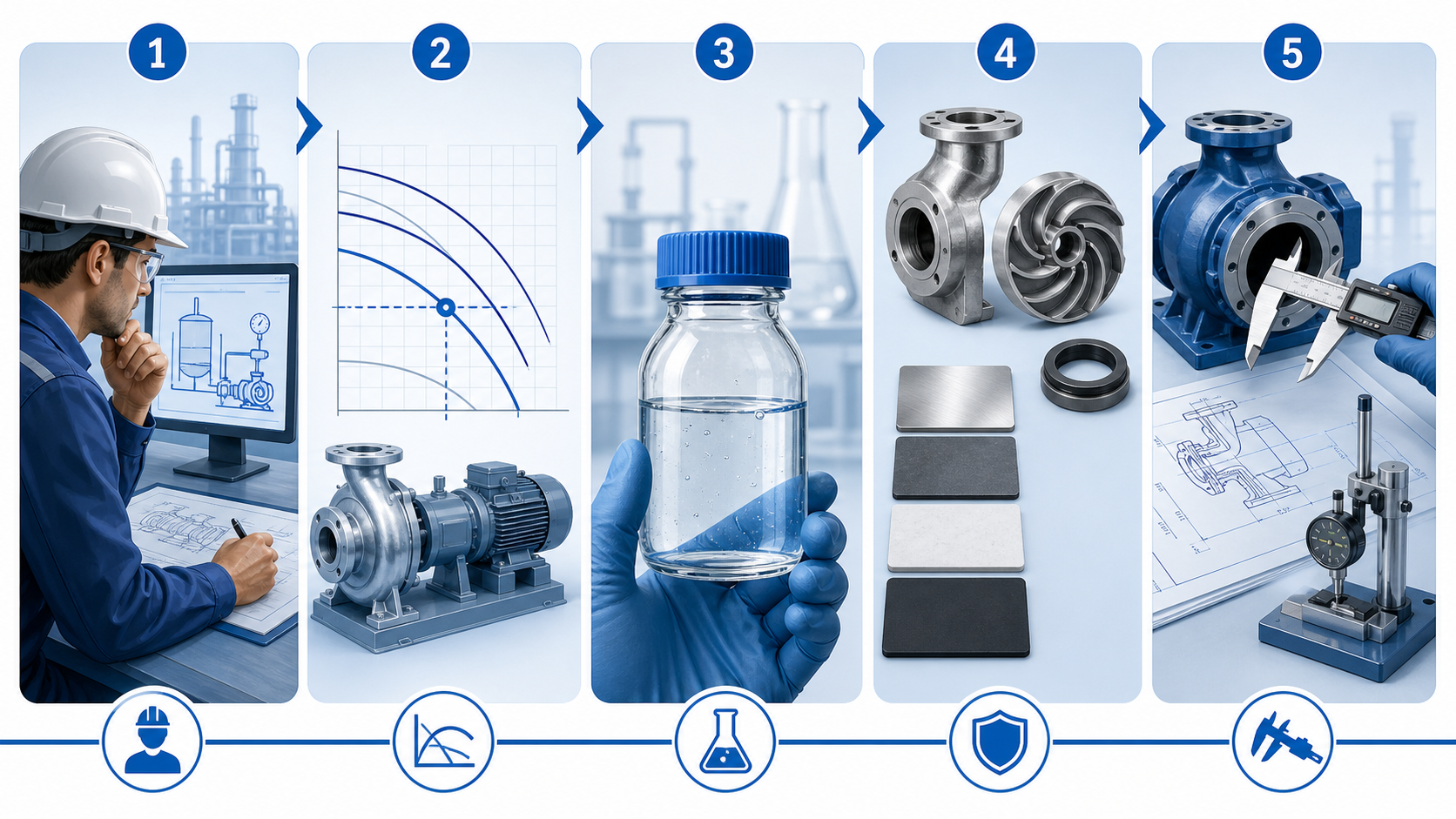
Question 2: What does the liquid demand from the materials?
Material selection depends on concentration, temperature, contaminants, chlorides, pH, oxidizing or reducing conditions, solids and velocity. Distinguish wetted casing, impeller, shaft, wear rings, seal faces, elastomers and gaskets.
Alloy 20 and CN7M, or C-276 and CW2M, should not be treated as interchangeable labels. Confirm the exact wrought or casting grade, required traceability and the corrosion basis for the application.
Question 3: What kind of compatibility is required?
Separate five checks: dimensional (flanges, centerline, footprint), mechanical (shaft, bearings, coupling and seal chamber), hydraulic (curve, impeller trim and duty), material (wetted parts and seals), and operating (temperature, speed, NPSH and control range).
Flange similarity can be useful, but it does not prove that internal parts or the hydraulic curve are interchangeable. Request drawings and a written fitment statement for the exact size and frame.
Question 4: What evidence proves supplier quality?
Request approved drawings, dimensional inspection, material certificates or heat-number traceability where required, PMI for alloy verification where specified, hydrostatic test records, balance information, performance evidence and deviation approval. The required documents depend on the project and service risk.
A technical quotation should identify what is included, what is equivalent, what requires site verification and what remains conditional on final duty confirmation.

Question 5: What does lifecycle support look like?
Compare spare-parts availability, seal and bearing standardization, repair access, documentation, testing, packaging, lead-time assumptions and supplier response. Consider the cost of a failed pump, not only the purchase price.
For an export buyer, request a clear parts list, inspection points, nameplate data, preservation method and commissioning guidance. These details reduce delay when the pump reaches site.
Buyer decision table
| Question | Evidence to request | Red flag |
|---|---|---|
| Duty | Actual flow/head range, curve and liquid data | Selection based only on model number |
| Materials | Wetted-parts list, grade and corrosion basis | Generic “stainless” or “alloy” description |
| Fitment | Drawing, shaft/seal/bearing details and interfaces | “Same flange” presented as full interchangeability |
| Quality | Inspection, test, balance and traceability records | No defined acceptance evidence |
| Lifecycle | Spare parts, service and commissioning information | Low price with unclear support scope |
What a useful RFQ should contain
Include service description, liquid properties, normal/minimum/maximum duty, design pressure and temperature, motor and power requirements, materials, seal plan, installation drawing, preferred standards, inspection and test requirements, delivery scope and documentation. Attach the current pump nameplate and dimensional drawing when replacing an installed unit.
When a cross-reference needs engineering confirmation
Ask for a technical review when the pump handles hazardous or corrosive liquid, the operating range is wide, the current failure is unexplained, the replacement changes materials or seal construction, or the supplier claims interchangeability without a drawing comparison. The right answer may be a component replacement, a modified wet end or a complete pump—not always a one-to-one model swap.
What to send for a quotation
Send the nameplate, pump size and frame, duty point, liquid data, photos of flanges and base, seal information, motor data, required documents and delivery location. Clear inputs help ANSI Pumps Pro prepare a model-specific fitment and material review.
What to send for a useful quotation or review
Include the pump model or dimensional drawing, actual duty range, liquid properties, motor data, installation constraints, operating history, photos and required documentation. Model-specific inputs make the selection more defensible and reduce commissioning surprises.
Need help reviewing an ANSI pump selection?
ANSI Pumps Pro helps buyers compare ANSI process pump duty, materials, fitment, testing and lifecycle support.
Sources and related reading
Use the applicable manufacturer documentation, project specification and site procedures. For system-level pumping guidance, see the U.S. Department of Energy pumping systems resources and the Hydraulic Institute. These links provide general engineering context; final limits are project-specific.
Frequently asked questions
What is the first question in ANSI pump selection?
Define the actual normal, minimum and maximum duty, including flow, head, speed, liquid properties and NPSH conditions before choosing a model.
Does the same flange pattern prove ANSI pump interchangeability?
No. Check dimensional, mechanical, hydraulic, material and operating compatibility for the exact size, frame, shaft, seal chamber and duty.
What material information should buyers request?
Request the exact wetted-part grades, casting or wrought designation, seal and elastomer materials, traceability requirements and the project-specific corrosion basis.
What documents should accompany an ANSI pump quotation?
At minimum, request a dimensional drawing, performance curve, materials list and the inspection, testing, balance, deviation and spare-parts scope applicable to the project.