
⚡ Executive Summary: A substandard Titanium or Hastelloy C casting can fail catastrophically in weeks — releasing hazardous chemicals. Use this 7-point verification protocol to audit alloy purity and casting quality before you buy. Full documentation packages provided with every order.
The Risk of Getting Exotic Alloys Wrong
A 4×3-13 ANSI pump in Hastelloy C costs $40,000–$65,000 from an OEM. In Titanium, $35,000–$55,000. When you write a check that size, you need absolute confidence in the material.
With standard 316SS, minor chemistry variations still give years of service. With exotic alloys handling aggressive acids at temperature, getting it wrong means failure measured in weeks — or days.
| Alloy | What Happens If Chemistry Is Wrong | Real-World Consequence |
|---|---|---|
| Titanium Gr.2 | Iron contamination >0.3% Fe destroys passivity | Rapid pitting in nitric acid service |
| Titanium Gr.7 | Insufficient palladium eliminates crevice resistance | Crevice attack at gasket surfaces in hot brine |
| Hastelloy C-276 | Low molybdenum <15%; wrong Cr/Mo ratio causes intermetallic precipitation | Premature failure in oxidizing acids; intergranular attack |
| Alloy 20 (CN7M) | Low copper <2.5% destroys H₂SO₄ passivation | Corrosion 10-50× faster than specification |
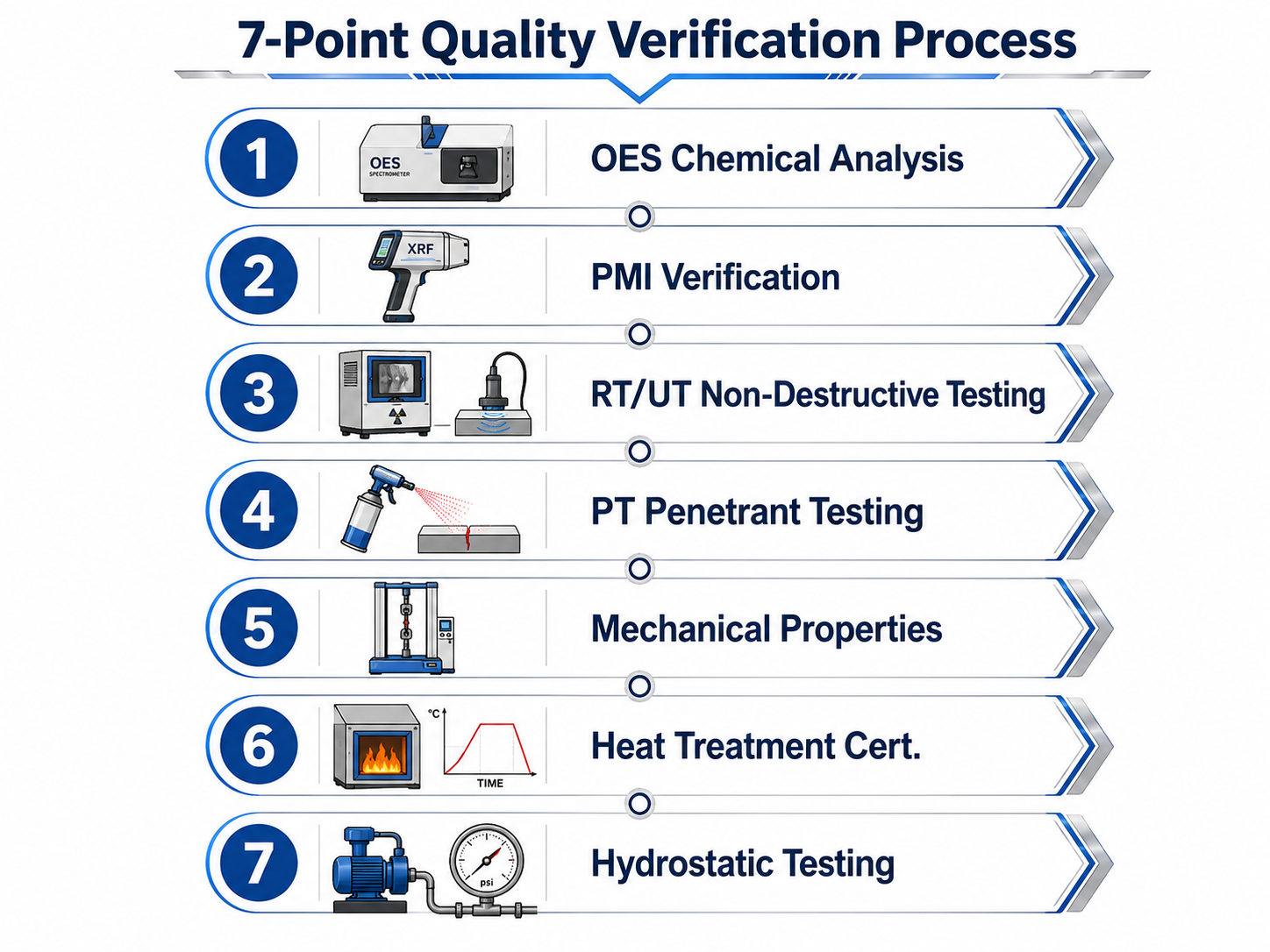
The 7-Point Exotic Alloy Verification Protocol
✅ Point 1: OES Chemical Analysis — Non-Negotiable
Optical Emission Spectroscopy provides a complete elemental breakdown. Every exotic alloy casting must come with an OES report from the specific heat used to pour that casting — not a “typical” analysis for the grade.
✅ Point 2: PMI Verification — Confirm on the Actual Part
Positive Material Identification using portable XRF should be performed on the casting you receive — not just a test coupon. Verify major alloying elements (Ni, Cr, Mo, Fe, Cu) at multiple locations. For Titanium: verify iron content across the casting surface.
✅ Point 3: Radiographic or Ultrasonic Inspection — Look Inside
Exotic castings are prone to micro-porosity invisible from the surface. Require RT per ASTM E446/E1320 or UT per ASTM A388 for pressure casings.
✅ Point 4: Liquid Penetrant Inspection — Surface Defects
PT per ASTM E165 catches surface-breaking cracks, porosity, and cold shuts. Inexpensive ($100-300 per part) and effective.
✅ Point 5: Mechanical Property Verification
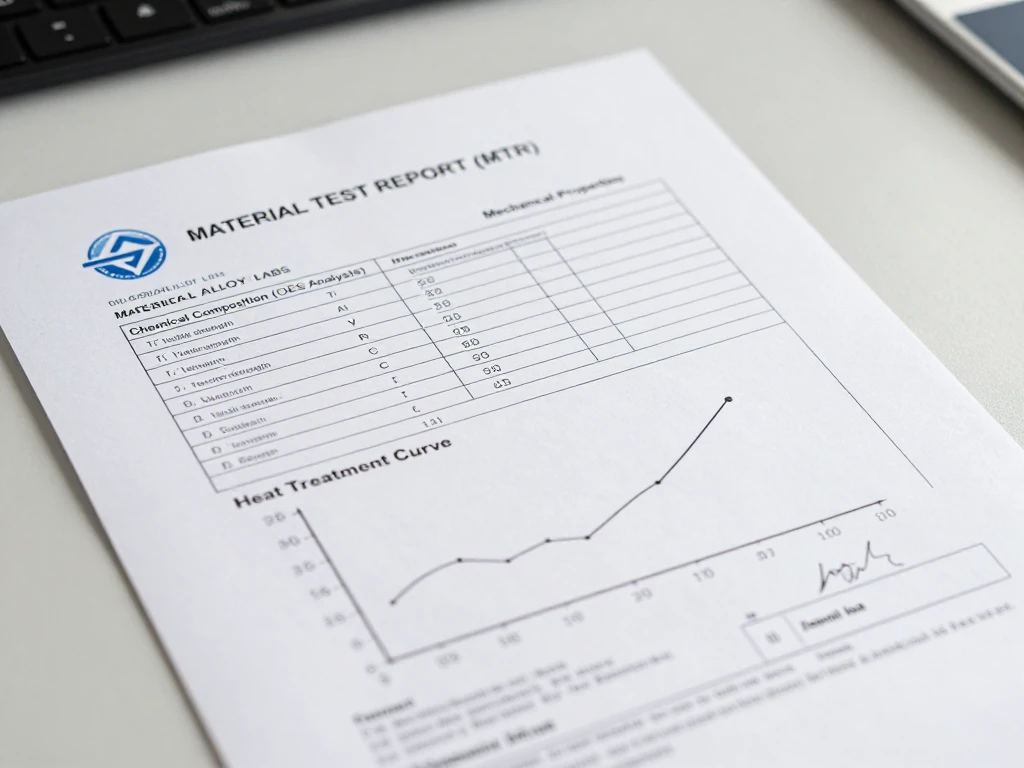
The MTR must include tensile, yield, elongation, and hardness from a test bar poured from the same heat and heat-treated with the casting.
✅ Point 6: Heat Treatment Chart Recorder Trace
Hastelloy C requires solution annealing at 2050°F minimum followed by rapid quench. Request the time-temperature chart. An improperly heat-treated exotic alloy can have corrosion resistance no better than 316SS — at 5× the price.
✅ Point 7: Hydrostatic Test — Proof Under Pressure
1.5× MAWP, 30-minute hold, zero leakage, zero pressure drop. Certificate must reference the component serial number.
5 Red Flags: Substandard Exotic Alloy Castings
| Red Flag | Why It Is Dangerous | Action |
|---|---|---|
| ❌ MTR shows “typical” values | Not a real test — it is a marketing document | Reject |
| ❌ No heat number on casting | Cannot trace MTR to your part | Reject |
| ❌ XRF reading ≠ MTR values | Chemistry mismatch — wrong alloy or wrong part | Quarantine. Investigate. |
| ❌ Titanium priced like 316SS | Raw Ti costs 8-12× more than 316SS | Suspect material substitution |
| ❌ Supplier refuses NDE reports | They know what the inspection will find | Walk away |
⚠️ Our Documentation Package — Every Exotic Alloy Shipment
✅ OES chemical analysis (full elemental breakdown, not pass/fail) | ✅ PMI verification report (XRF on actual casting) | ✅ Mechanical test results (tensile, yield, elongation, hardness) | ✅ Heat treatment chart recorder trace | ✅ CMM dimensional inspection report | ✅ Hydrostatic test certificate (1.5× MAWP) | ✅ NDE reports as specified (PT, MT, RT, UT) | Full material traceability from heat number to your receiving dock.
Sourcing Checklist — Bring This to Your Supplier
- Request OES report from the specific heat — not a generic datasheet
- Require PMI (XRF) on the actual casting surface
- Specify RT or UT for all pressure casings
- Get PT on all accessible finished surfaces
- Verify mechanical properties with measured values
- Demand heat treatment chart recorder trace
- Require hydrotest at 1.5× MAWP with serial-numbered certificate
🔗 Related Reading
📥 Download: 7-Point Exotic Alloy Verification Checklist (PDF)
Print-ready checklist to bring to your supplier audit. Covers OES, PMI, RT/UT, PT, mechanical, heat treat, and hydrostatic verification with acceptance criteria for each point.
Get a Quote with Full Documentation
📋 Request a Quote — Response Within 24 Hours
Our engineering team reviews every inquiry and provides a detailed quote with compatibility confirmation.