
Quick Answer: Change the Source, Not the Acceptance Criteria
OEM and independent aftermarket can both be valid sourcing routes. The decision should follow the installed configuration, project requirements and the engineering evidence needed to verify fitment, materials, performance and documentation.
OEM Route Usually Required
- Owner specification explicitly requires OEM supply.
- Warranty or contractual controls apply.
- Certification depends on the original design or documented OEM configuration.
- A proprietary upgrade or latest revision controls the replacement.
- The original configuration cannot be independently verified.
Independent Aftermarket Can Be Evaluated
- Model, size and installed configuration are known.
- Critical component interfaces are measurable or documented.
- Material requirements are defined.
- Acceptance criteria can be stated before manufacture.
- Inspection, traceability and documentation can be agreed.
Escalate Before Choosing Either Route
- Nameplate, BOM or controlling drawing is missing.
- The pump has been field-modified.
- Metallurgy or seal configuration is uncertain.
- There is repeated seal or bearing failure.
- Available drawings conflict or the problem is hydraulic rather than simple wear.
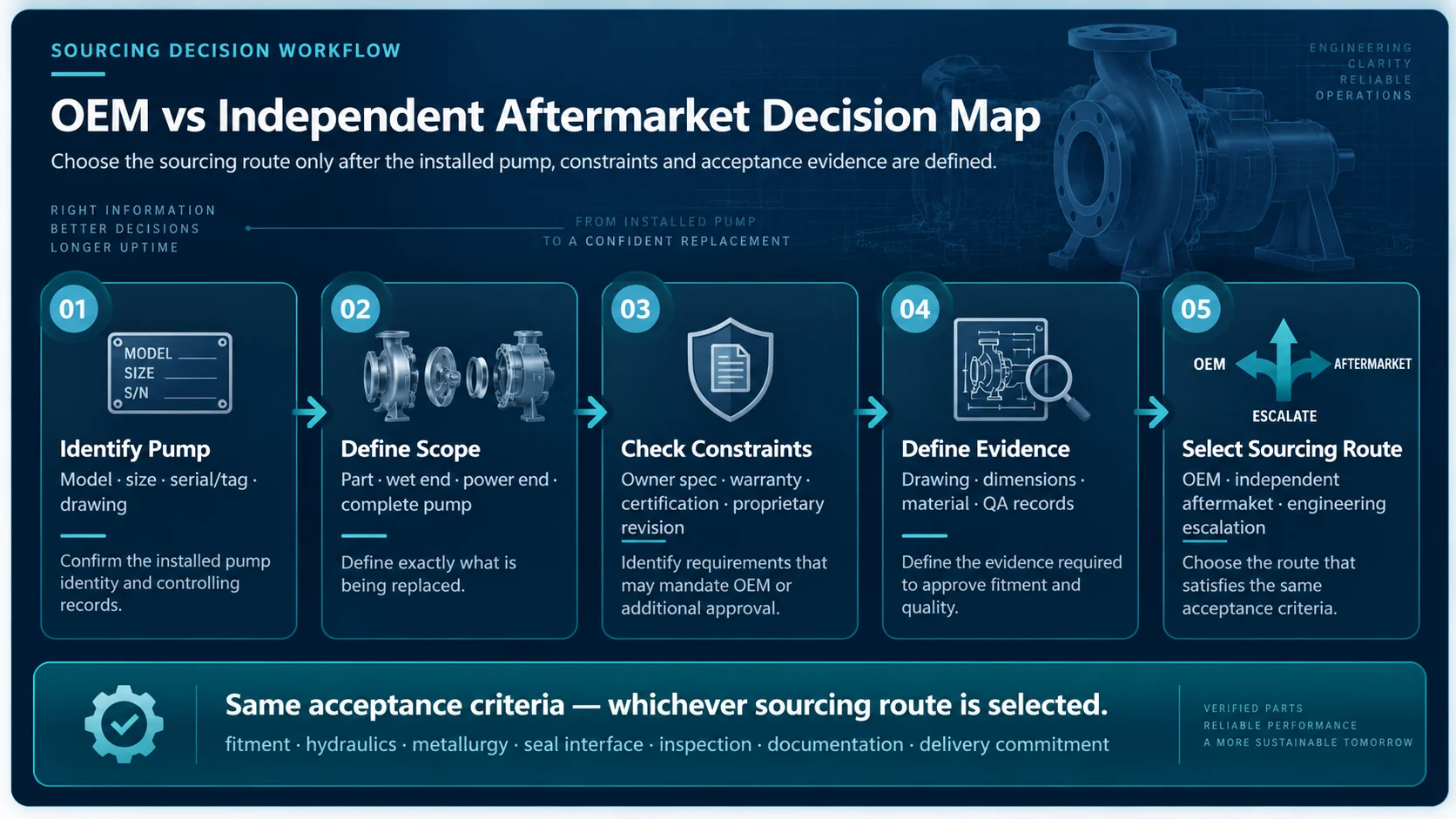
OEM vs Independent Aftermarket Decision Map
Use the workflow below before comparing price or promised lead time. The sourcing route is selected only after the installed pump, replacement scope, constraints and required evidence are defined.
Identify the Installed Flowserve / Durco Family First
Different pump families use different hydraulic, mechanical and dimensional architectures. Do not transfer Mark 3 ASME Group data into an ISO-platform or another Flowserve process-pump family simply because the brand name is the same.
| Installed family | Why it matters | ANSI Pumps Pro review route |
|---|---|---|
| Durco Mark 3 / Mark III (ASME) | Group, size, wet end, impeller, seal chamber and power-end configuration control the review. | Dedicated Durco Mark III Group 2 replacement parts guide route. |
| Durco Mark 3 ISO | ISO 2858 / ISO 5199 architecture; do not mix ASME Group data with ISO frame data. | Separate engineering review. |
| Other Flowserve process-pump families | Model-specific geometry, materials and documentation may differ substantially. | Project-specific review only; no universal coverage implied. |
What Changes—and What Must Stay the Same—When the Source Changes
A supplier change can alter who owns the manufacturing drawing, how the part is produced, what inspection package is supplied and how deviations are handled. It should not silently change the agreed duty, fitment interfaces, metallurgy, sealing requirements or acceptance criteria.
| Decision area | Questions to resolve before release |
|---|---|
| Fitment | Which model, size, group/frame and drawing revision control the part? |
| Hydraulics | Does an impeller or wet-end scope support the required flow, head, speed and operating range? |
| Materials | What casting or wrought specification is required, and what process conditions control suitability? |
| Sealing | Do the seal chamber, shaft/sleeve, gasket and auxiliary connections match the installed arrangement? |
| Evidence | Which drawings, MTRs, PMI, dimensional reports, balance records or tests are part of the purchase requirement? |
| Delivery | What is the committed delivery date for the exact configuration and agreed inspection/documentation package? |
What Must Be Verified for Each Replacement Part?
A casing, impeller, shaft, seal chamber and bearing housing do not carry the same fitment risks. Define the evidence at component level rather than relying on a generic statement that the part is “for a Flowserve pump.”
| Component | Main fitment risk | Engineering evidence to define |
|---|---|---|
| Casing | Nozzle location, register/cover interface, pressure boundary, material. | Installed size, drawing, critical dimensions, pressure/material requirement. |
| Impeller | Hub/thread, vane style, trim, hydraulics, rotation. | Drawing, trim diameter, material, balance requirement, installed shaft interface. |
| Shaft | Bearing fits, seal area, coupling end, runout. | Dimensional drawing, material, critical fits and runout criteria. |
| Shaft sleeve | Seal running surface and axial location. | Dimensions, finish, material and mating shaft data. |
| Rear cover / seal chamber | Bore, gland, gasket/O-ring and impeller relationship. | Drawing, seal arrangement and installed mating interfaces. |
| Bearing housing / carrier | Frame/generation, lubrication, bearing arrangement and adjustment mechanism. | Installed configuration, BOM/markings and interface dimensions. |
| Mechanical seal | Shaft/sleeve, chamber, faces, elastomers and service conditions. | Seal arrangement plus process pressure, temperature and fluid data. |
| Gasket / O-ring | Dimensions, elastomer/material compatibility and temperature. | Drawing/BOM plus service and material requirement. |
What ASME B73.1 Helps Standardize—and What It Does Not
ASME B73.1 is a design and specification standard for applicable horizontal end-suction chemical-process pumps. Its dimensional-interchangeability intent covers external installation interfaces for pumps sharing the same standard dimension designation; it does not establish blanket interchangeability for every internal component.
B73.1 Helps Standardize
- Mounting dimensions
- Suction and discharge nozzle size/location
- Input shaft interface
- Baseplate relationships
- Foundation bolt-hole locations
Still Requires Model-Specific Verification
- Impeller geometry and trim
- Casing internal geometry
- Seal chamber and sleeve interfaces
- Power-end generation and bearing arrangement
- Hydraulic performance
- Metallurgy and project documentation
Review the ASME B73.1 dimensional-interchangeability guide →
OEM and Independent Aftermarket: Compare the Evidence, Not the Label
| Decision area | OEM route | Independent aftermarket route |
|---|---|---|
| Design basis | Original-manufacturer controlled records and revisions. | Verified drawing, measured interfaces or controlled reverse-engineered basis. |
| Revision control | OEM configuration/revision system. | Supplier drawing plus buyer review/approval when required. |
| Fitment | Original configuration data. | Documented dimensions, interfaces, sample part and installed evidence. |
| Material | OEM specification and records. | Agreed ASTM/UNS/project specification and requested traceability. |
| Inspection | OEM QA system and documentation scope. | Agreed inspection/test plan and documentation scope. |
| Warranty | OEM commercial terms. | Independent supplier commercial terms. |
| Lead time | Depends on exact configuration, inventory and service route. | Depends on exact configuration, materials, approvals and manufacturing route. |
| Acceptance | The owner/project acceptance criteria should remain explicit in either route. | |
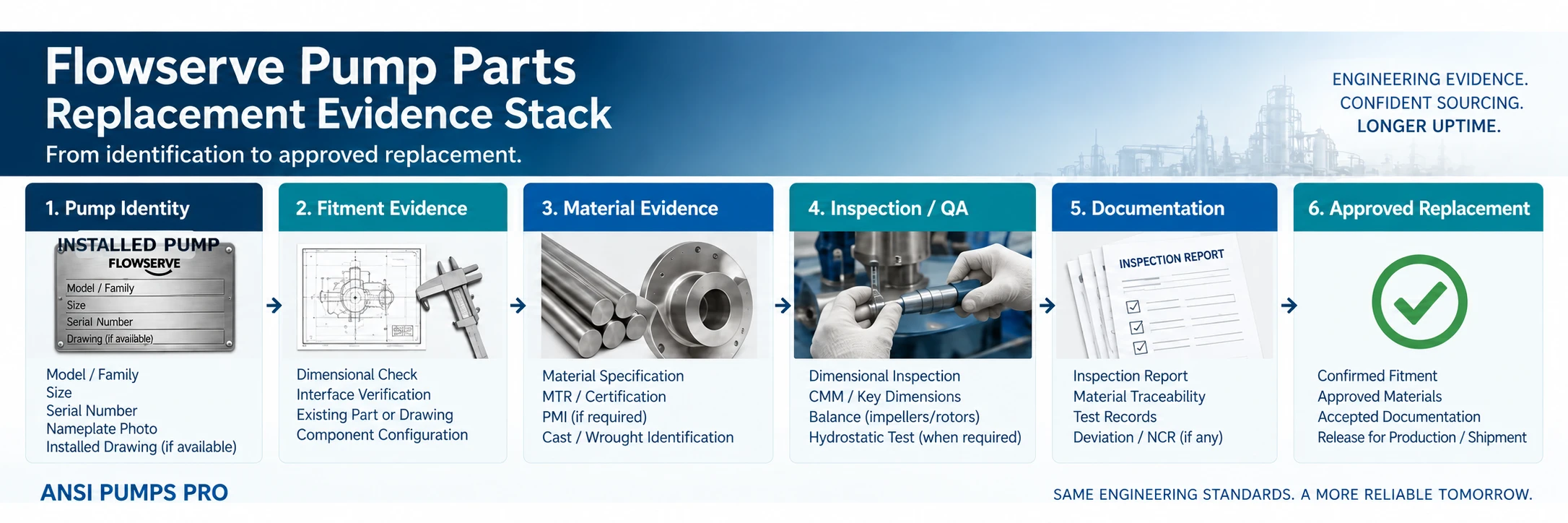
Replacement Evidence Stack: From Identification to Approved Replacement
A sourcing decision becomes much easier when each required piece of evidence is defined before manufacturing begins. The stack below keeps pump identity, fitment, materials, inspection and documentation connected to the final approved scope.
Material Identity Is Not the Same as Chemical Suitability
Do not select a replacement material from the chemical name alone. Concentration, temperature, contaminants, velocity, solids, pH and oxidizing/reducing conditions should be reviewed together with the project specification. Casting grades and wrought/bar specifications also should not be treated as interchangeable simply because they belong to a similar alloy family.
Seal arrangement is equally configuration-specific. Confirm the seal chamber, shaft or sleeve, seal faces, elastomers, flush or quench requirements, available installation envelope and process conditions before releasing a replacement seal or cover.
Define the Evidence Package by Part Type
Not every order requires every document. State what is required in the RFQ and purchase order so inspection and documentation are part of the commercial scope rather than an assumption made after manufacture.
| Part / scope | Typical evidence to define when required |
|---|---|
| Impeller | Drawing, material record, trim diameter, balance requirement and inspection record. |
| Shaft | Drawing, material record, dimensional inspection, critical fits and runout. |
| Casing | Drawing, material record, critical dimensions and pressure test if included in the order. |
| Sleeve / wear component | Material, dimensions, surface finish and mating-interface requirements. |
| Power-end assembly | BOM/configuration, bearing arrangement, shaft/housing dimensions and agreed functional checks. |
Compare Committed Dates, Not Generic Lead-Time Claims
For a planned shutdown, the relevant schedule is more than a single “weeks” number. Record the RFQ date, drawing approval, material release, manufacturing window, inspection/documentation approval and shipment commitment for the exact configuration.
For a Single Part
Confirm the mating geometry, material and inspection scope early enough to avoid field machining or rework during the outage.
For a Higher-Risk Scope
Consider whether a complete inspected assembly, critical spare or staged approval package reduces more outage risk than the lowest-priced individual component.
Start With the Evidence You Already Have
I Have an OEM Part Number
Use the cross-reference tool first, then confirm installed size, material and interfaces before quotation.
I Have a Nameplate / Photo
Start with what you have. Send the nameplate, pump size, photos and known service details for identification review.
I Have a Drawing / BOM / Parts List
Send the controlling drawing or BOM together with material, inspection and required delivery information.
Frequently Asked Questions
Are independent aftermarket Flowserve pump parts automatically interchangeable?
No. The exact model, size, group/frame, drawing revision, material, seal arrangement and mating interfaces still need to be verified.
Does ASME B73.1 mean all internal parts are interchangeable?
No. The standard defines applicable design and dimensional-interchangeability requirements for external installation interfaces; internal components remain model- and configuration-specific.
Is aftermarket always faster than OEM?
No. Delivery depends on the exact part, material, inspection scope, approvals, inventory and manufacturing route. Compare committed dates for the actual configuration.
What should I send for a replacement-parts quote?
Send the nameplate, model and size, serial/tag, OEM part number if available, drawing or BOM, material, seal arrangement, photos, required inspection documents and required delivery date.
Can one part-number cross-reference prove a complete pump replacement?
No. A part-number match is a starting point; a complete-pump scope still requires mechanical, hydraulic, material and operating verification.
Sources
Have a Pump, Part Number or Drawing to Review?
Send the installed model, part reference, drawing/nameplate, materials and required documentation. We will identify the fitment and evidence that need to be confirmed before quotation.