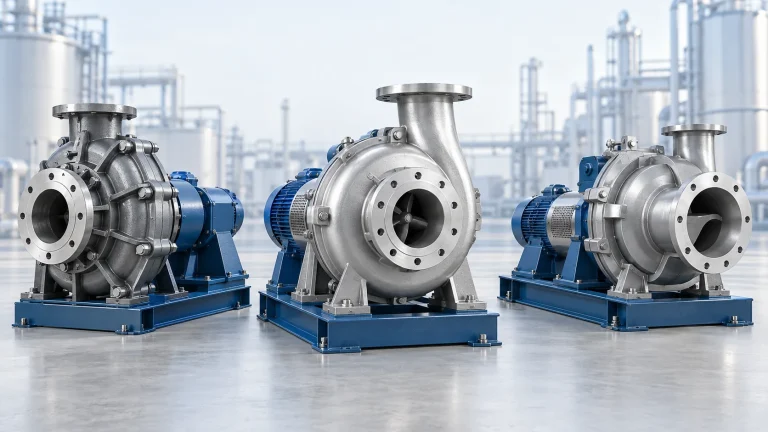

Three different roles
What Do ANSI, ASME and ASTM Each Do?
| Name | Role in the standards system | What a pump buyer may see |
|---|---|---|
| ANSI American National Standards Institute |
Coordinates the U.S. voluntary standards system, accredits standards developers and approves documents that meet the American National Standard process. | An ANSI designation or approval mark on a standard. ANSI is not necessarily the organization that wrote the technical requirements. |
| ASME American Society of Mechanical Engineers |
Develops engineering standards and codes. Its B73 series covers defined chemical-process pump configurations; its Boiler and Pressure Vessel Code includes material specifications. | ASME B73.1 on a pump specification, or an ASME code material designation such as SA-516 in a pressure-equipment context. |
| ASTM ASTM International |
Develops consensus specifications, test methods, classifications and other standards for materials and products. | An ASTM specification and grade on a material schedule, purchase order or material test certificate. |
ANSI approval and standards authorship are separate steps. ANSI explains that independent ANSI-accredited standards developers create the technical documents and may submit them for approval as American National Standards. ASME and ASTM also publish standards that are not necessarily designated ANS.
Hydraulic Institute is another relevant example: it develops pump-industry standards and is an ANSI-accredited standards developer. Its ANSI/HI standards cover topics such as pump terminology, application, operation and testing. See the HI standards overview.
The pump terminology
What Does “ANSI Pump” Mean in a Purchase?
In chemical-process pump purchasing, “ANSI pump” commonly refers to a pump built to the dimensional and design conventions of ASME B73.1. The current ASME listing describes B73.1 as covering horizontal, end-suction, single-stage, centerline-discharge centrifugal pumps made from metallic or solid-polymer materials.
B73.1 includes dimensional interchangeability requirements for pumps with the same standard dimension designation. ASME describes the intended common interfaces, including mounting dimensions, suction and discharge nozzle size and location, input shafts, baseplates and foundation bolt holes. That defined scope helps with installation planning; it is not a blanket promise that every internal component, hydraulic curve, material or seal arrangement is interchangeable.
Terminology tip: “ANSI pump” is useful shop-floor shorthand. In a technical document, state the actual standard and designation—such as ASME B73.1—then state the model, size, configuration and applicable revision where required.
For a replacement, keep dimensional fit separate from mechanical, hydraulic, material and operating compatibility. Our guide to B73.1 dimensional interchangeability versus component compatibility covers those checks in more detail.
Engineering drawing notes
How to Read the Standards Notes on a Pump Drawing
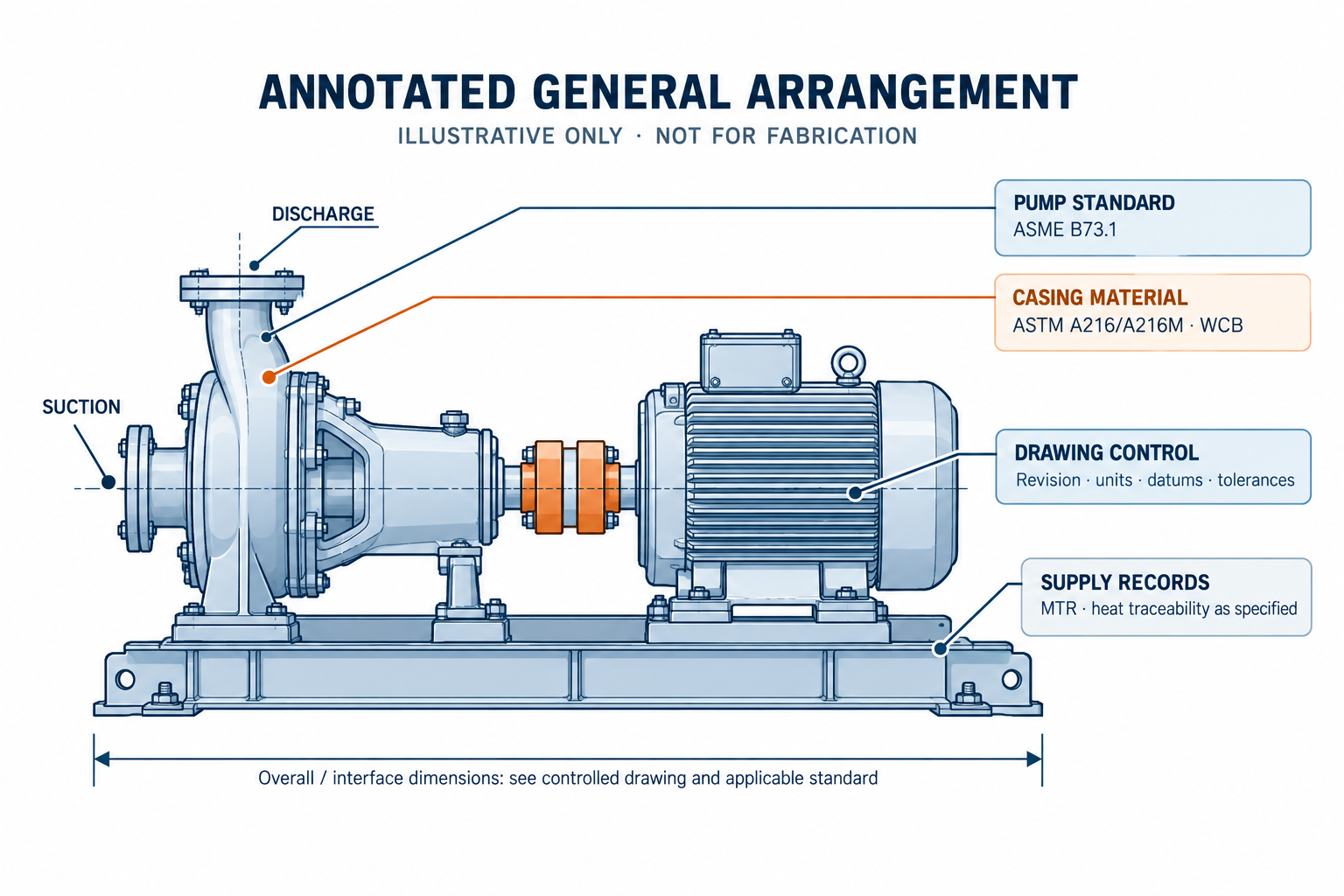
A general-arrangement drawing, or GA drawing, often puts several different kinds of information on one sheet. The standard, the material note and the drawing dimensions answer different questions. This simplified sketch shows where a buyer might encounter those notes.
| Example note | What it tells you | What to verify separately |
|---|---|---|
| Pump standard: ASME B73.1 | The referenced pump design standard and its defined dimensional scope. | Correct pump type and size; the specific interfaces covered; internal component and hydraulic compatibility. |
| Casing: ASTM A216/A216M, Grade WCB | A material specification and grade for a carbon-steel casting. | Whether that grade suits the actual service; the required edition, heat treatment, certificate and inspection scope. |
| GA drawing, Revision C | The supplier’s controlled arrangement and stated dimensions for that configuration. | That the revision is approved and matches the pump supplied; units, datums, tolerances and any field changes. |
| MTR / heat number | Material and traceability evidence when required by the purchase documents. | That the record identifies the delivered component and meets the specified documentation requirements. |
ASTM A216/A216M covers carbon-steel castings suitable for fusion welding for high-temperature service, with grades including WCB. The grade is not, by itself, a corrosion recommendation or a complete pump specification. Check the process fluid, temperature, pressure, product form and project requirements. The material selection guide discusses why service conditions and casting grades need separate review.
Material designations
How Do ASME and ASTM Material Specifications Relate?
ASME BPVC Section II contains material specifications used by other sections of the Code. Its Part A covers ferrous materials and Part B covers nonferrous materials. ASME describes these specifications as identical to or similar to specifications published by ASTM and other recognized organizations; it also notes that some are adjusted for Code use.
That is why an ASME designation may resemble an ASTM one without being safe to treat as an automatic, edition-independent substitution. For example, a pressure-equipment document may call for ASME SA-516 Grade 70, while a material purchase document may reference ASTM A516 Grade 70. Confirm the adopted edition, applicable Code requirements and exact ordered conditions before accepting equivalence.
Keep the nouns precise: ASME does not “certify” each ASTM heat simply because a similar specification appears in Section II. A project or Code may require a particular listed material and defined records; verify the actual item against those requirements.
For cast pump parts, write the product form and casting grade, not only a broad alloy-family name. Separate the material question—what is specified and traceable—from the service question—whether it is suitable for the process conditions.
Before approving a quotation
A Practical Standards and Drawing Checklist
- Name the actual standard. Record the organization, number, part and edition required by the project.
- Separate pump standard from material standard. ASME B73.1 and ASTM A216 answer different questions.
- Check the drawing revision. Confirm the dimensions, units, datums, tolerances and installation interfaces against the approved document.
- Specify every critical material. Identify the component, material standard, grade, product form and any purchaser-specified supplementary requirements.
- Define the required records. State whether MTRs, heat-number traceability, PMI, dimensional reports, hydrostatic tests or performance tests are required. Do not assume an unlisted test is included.
- Review service and fit independently. Standards references support a decision; they do not replace checks of process conditions, duty point, seal arrangement or component interfaces.
For a broader selection comparison, see API 610 versus ASME B73.1. If you have a pump drawing or material note that needs interpretation, send the document revision and service details with your inquiry.
Common buyer questions
Frequently Asked Questions
Does ANSI write the ASME B73.1 pump standard?
No. ASME publishes B73.1. ANSI’s role is to accredit standards developers and approve qualifying standards as American National Standards; that approval process is separate from writing the technical requirements.
Does “ANSI pump” mean ANSI-certified pump?
Not by itself. In pump purchasing, “ANSI pump” is commonly used for a pump type associated with B73.1 dimensions. Confirm the actual standard, certification requirements and supplier documentation in the project specification.
Are ASME SA-516 Grade 70 and ASTM A516 Grade 70 interchangeable?
They are corresponding designations, but do not assume unconditional equivalence. Compare the applicable editions, material requirements and the governing Code or purchase specification.
Does an ASME B73.1 reference prove all replacement parts will fit?
No. B73.1 addresses defined pump design and dimensional requirements. Internal component, seal, material, hydraulic and operating compatibility need separate, configuration-specific checks.
Does an ASTM material grade prove the material suits my chemical service?
No. A grade identifies requirements for the material product; suitability depends on the fluid composition, concentration, temperature, pressure, velocity, contaminants and component design.
Primary references
Sources
- ANSI, Standards FAQs — ANSI’s role and the American National Standards process.
- ANSI, Overview of the ANS process — accreditation of developers and approval of standards.
- ASME B73.1 — scope and stated dimensional interchangeability intent.
- ASME BPVC Section II, Part A — ferrous material specifications, including SA-designated specifications.
- ASTM A216/A216M-26 — current active edition, scope and WCB grade reference for carbon-steel castings.
- Hydraulic Institute standards — ANSI/HI pump-standard categories.
Editorial note: This guide explains standards terminology for pump purchasing. The governing contract, jurisdiction, applicable Code edition and approved project documents control the final requirements. This schematic is not an engineering drawing for fabrication or installation.