
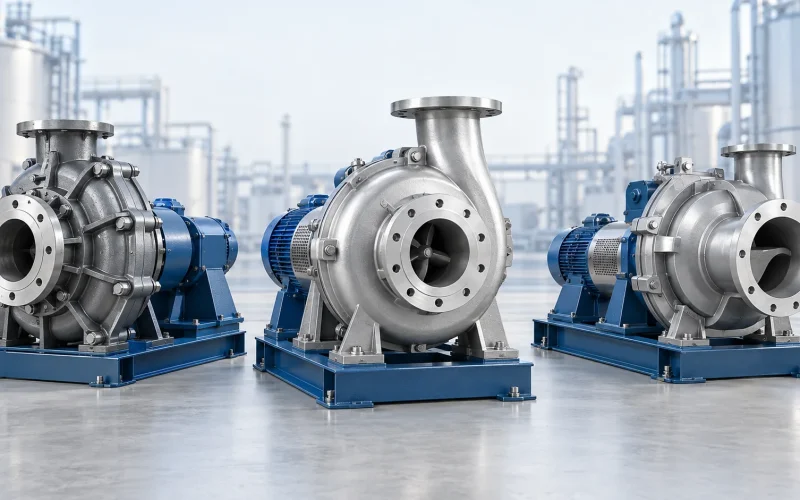
Short answer: Choose a wear-resistant process pump for review when abrasive wear and component life are the main concerns. Start with a non-clogging pump when large solids, fibers or repeated blockages dominate. If both occur, specify and evaluate both requirements for the selected pump and operating conditions.
| Dominant risk | Typical evidence | First review | Ask the supplier to confirm |
|---|---|---|---|
| Wear | Thinning, grooves or short wet-end life | Solids, chemistry, operating point and materials | Proposed materials, speed and basis for expected wear life |
| Clogging | Repeated plugs or fibers collected at the impeller | Blockage location, particle dimensions and fiber behavior | Passage and suitability of the selected configuration |
| Both | Worn parts and recurring obstruction | Combine both records and define both requirements | Passage, material and hydraulic suitability together |
A falling flow rate, changing power draw or vibration warrants investigation, but none identifies a cause on its own. A pipe deposit, suction problem or operating point outside the recommended range can also affect performance.
Start with the failure evidence
Inspect the pump and the surrounding system before selecting a replacement. Wear patterns can suggest a mechanism, but appearance alone does not establish the cause.
| Finding | Possible concern | Record and check |
|---|---|---|
| General thinning of vanes or casing | Abrasive or erosive material loss; corrosion may also contribute | Component and material, photographs, operating hours, liquid chemistry and solids |
| Local grooves or gouges | Particle impact, abrasion or recirculation | Location, particle size and shape, operating flow and internal clearances |
| Pitting near the impeller inlet | Possible cavitation, corrosion or combined damage | Suction conditions, NPSH, operating point and inspection history |
| Material wrapped on a vane or lodged in the eye | Fiber accumulation or restricted passage | Location, recovered material, fiber length and frequency |
| Deposits in a suction or discharge line | Settling or a system operating condition | Pipe layout, flow history and solids properties |
Date and identify photographs, and record the hours and duty since the parts were installed. Compare findings with the operating history; an inspection of the pump alone may miss a piping or suction issue.
Describe the liquid and solids
Selection depends on the mixture and on how it changes during operation. Gather the following, marking estimates and unknowns:
- Required flow and differential head, normal and expected operating range.
- Liquid composition, concentration, pH, temperature and corrosive constituents.
- Solids type, density, hardness if known, shape and concentration. State whether concentration is by mass or volume.
- Typical and maximum particle dimensions and size distribution, including d50 and d90 if available.
- Fiber type, length, flexibility and tendency to form bundles.
- Entrained air or gas, and changes during startup, shutdown and upset conditions.
- Existing pump model, speed, materials, seal arrangement and maintenance history.
A single particle-size number or an unlabeled solids percentage is rarely enough to compare proposals. The largest particle, distribution and fiber behavior may affect passage differently.
Wear-resistant pumps: match material and hydraulics to the duty
Abrasive particles remove material from wetted parts through impact and sliding. Wear depends on the solids, liquid, materials and local flow conditions. Corrosion can occur at the same time and change the material choice.
| Material family | Potential advantage | What to check |
|---|---|---|
| High-chrome white iron, such as selected ASTM A532 grades | Abrasion resistance in suitable service | Corrosion, impact toughness, temperature and component availability |
| Duplex stainless steel | A possible balance of corrosion and erosion resistance | Exact alloy and resistance to the actual liquid and solids |
| Austenitic stainless steel, such as CF8M | Corrosion resistance in suitable chemicals | Abrasive wear, chemistry, concentration and temperature |
| Elastomer lining | May suit some fine-particle slurries | Chemical and temperature compatibility, particle size and cutting damage |
These are material families, not approvals for a specific duty. Confirm the exact grade and component with the supplier. Sulzer’s slurry selection guidance discusses the combined effects of abrasion and corrosion.
Hydraulics matter as well. Depending on the duty, a larger impeller at lower speed and operation near the best efficiency point may reduce wear. Check the complete system: a change in speed or flow must still provide the required duty and adequate solids transport in the piping. Follow the manufacturer’s clearance and maintenance instructions for the selected design.
Non-clogging pumps: check the actual flow path
Impeller and casing geometry affect how particles and fibers move through a pump. Designs make different tradeoffs:
| Impeller concept | Potential benefit | Review before selection |
|---|---|---|
| Wide-channel, few-vane closed impeller | Passage for larger solids with relatively good hydraulic efficiency | Minimum passage, particle shape and potential for fiber accumulation |
| Semi-open impeller | Accessible passages and, on some designs, adjustable clearance | Fiber behavior, wear, adjustment method and actual clearance limits |
| Recessed or vortex impeller | Flow path can accommodate difficult solids and fibers | Efficiency, power, wear of the casing and suitability for the actual mixture |
Ask for the free passage of the selected impeller and casing, its measurement basis and any restrictions. A discharge nozzle diameter does not establish the minimum internal passage. Even a stated spherical solids passage does not guarantee that long fibers or agglomerates will pass without accumulating. Review the actual material and blockage history with the supplier, and agree on a demonstration where needed.
When wear and clogging occur together
Paper stock with grit, or wastewater containing rags and sand, can present both risks. Specify two separate acceptance requirements: what must pass through the pump, and the wear conditions the wetted parts must withstand. Review liquid chemistry, speed, passage, seal and operating range together.
For example, in a fibrous liquid containing hard particles, fiber behavior informs the hydraulic review while particle characteristics and chemistry inform the wear-material review. This is an illustrative selection scenario, not a reported installation. Confirm available impeller and material combinations for the proposed pump before specifying them.
Include the piping system in the review. Solids can settle when system conditions do not keep them moving; increasing pump wear resistance or passage alone does not resolve a line deposit.
Compare the whole duty and installation
Request the performance curve for each proposed configuration and review the duty point, operating range, speed, power and efficiency. Check NPSH available against the supplier’s requirement with an appropriate margin, and discuss any corrections for solids. Confirm motor sizing, seal and flush requirements, and behavior during startup and shutdown. Clean-water curves may need correction for slurry service.
For a replacement, compare the general arrangement drawing with the installation: nozzle location and flange rating, shaft centerline, foundation bolts, coupling, driver and maintenance space. Confirm hydraulic suitability and physical fit separately.
Agree on the evidence and acceptance criteria
Ask each supplier to identify the selected configuration and the basis for its recommendation. Compare the same scope: materials, drawings, certificates, inspection, performance testing, spare parts and seal support.
If passage or wear life determines the purchase, agree on how it will be evaluated: the pump configuration, representative medium and operating conditions, measurement method, duration and acceptance criteria. Do not treat a material designation or a pump-series maximum as proof of performance for a specific service.
Where AC, DW and DN fit
Use the DW wear-resistant process pump as a starting point when abrasion and wet-end life dominate. Use the DN non-clogging process pump when large solids, fibers and plugging are the main concern. AC general process pumps cover a range of process duties; review the actual liquid and solids with engineering. The process-pump family page compares the three routes.
These are starting points for review. The selected size, hydraulic configuration, materials and suitability for combined wear and passage requirements must be confirmed for the duty. The DN product page does not publish a maximum particle size; provide the expected solids and fiber description for review.
Questions buyers ask
Can one pump address both wear and clogging?
Some configurations can address both, but neither a non-clogging label nor a wear-resistant material proves the other requirement. Ask the supplier to assess the mixture, passage and materials together.
How should free passage be confirmed?
Request the passage dimension and measurement basis for the selected impeller and casing. Supply particle dimensions, shape and fiber behavior; agree on a representative demonstration if the purchase depends on passage performance.
When should a slurry pump also be considered?
Consider a dedicated slurry-pump review when the solids loading, particle characteristics, wear severity or required service life exceed what a process-pump candidate can support. The decision depends on the complete duty and supplier assessment, not on a single concentration threshold.
Is the hardest material always best?
No. A hard material may resist abrasion but be unsuitable for the liquid chemistry or impact conditions. Check the exact grade against the full service.
Does a larger outlet guarantee better solids handling?
No. The narrowest internal passages and the way the impeller handles the material also matter.
Request an engineering selection
Send the information you have with your engineering review request:
- Flow and head, including operating range and units.
- Liquid composition and temperature; solids concentration by mass or volume.
- Solids type, size distribution and maximum particle dimensions; fiber type and length.
- Abrasion, corrosion, gas content and any variation in the duty.
- Existing model, nameplate, curve or general arrangement drawing, if available.
- Failure and blockage history, operating hours and dated photographs.
Identify the problem to solve and ask the proposal to state the selected configuration, supporting evidence and outstanding assumptions.
Related reading: Open vs semi-open vs closed impellers and chemical resistance guide.