
Engineering scope: This guide explains preliminary evaluation. It is not a machining instruction or a performance guarantee. Use the pump manufacturer’s data and project acceptance criteria for a specific installation.
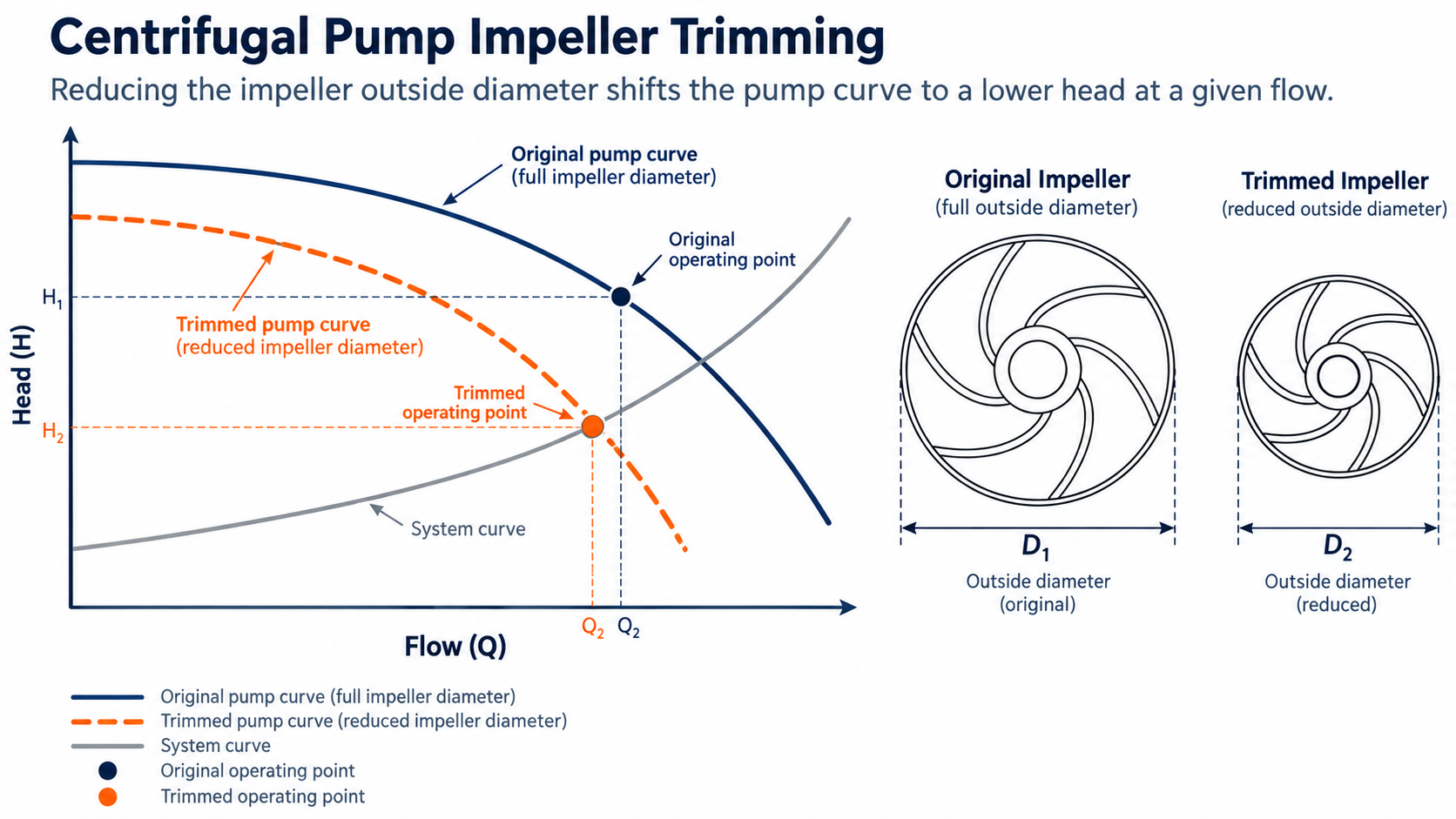
What impeller trimming changes
Impeller trimming is the controlled reduction of an impeller’s outside diameter to adjust the pump curve. It can be considered when a pump has a stable excess of head or flow and is being throttled or bypassed to meet a known process duty. Because material is removed, the change is generally irreversible; it also changes the impeller-to-casing geometry.
Before evaluating a trim, establish the actual flow, total dynamic head, speed, fluid properties, power draw, system curve and operating hours. Confirm whether the excess capacity is real and persistent. A partially closed valve by itself does not prove that the pump should be trimmed.
When trimming may reduce energy use
Trimming may be a candidate when process demand is reasonably stable, the pump is producing more head or flow than the system needs, the resulting diameter remains within the manufacturer’s approved range, and the revised duty preserves suitable hydraulic and mechanical margins.
First distinguish pump excess from system changes. A throttling valve may be controlling flow for a valid process reason, such as a changing operating condition or a required minimum-flow arrangement. If demand varies widely, a variable-frequency drive (VFD), a different control strategy or pump reselection may fit better. Evaluate the whole pumping system rather than selecting a solution from the pump curve alone.
Affinity laws: useful estimates with limits
For the same pump family at the same speed, affinity relationships can provide an initial comparison between corresponding operating points:
Approximate diameter relationships
Q: flow; H: head; P: shaft power; D: impeller diameter. Use consistent units within each ratio.
| Quantity | Diameter-trim estimate | Important qualification |
|---|---|---|
| Flow, Q | Linear diameter-ratio estimate | Approximate relationship at corresponding points |
| Head, H | Squared diameter-ratio estimate | Does not by itself determine the real system operating point |
| Power, P | Cubed diameter-ratio estimate | Assumes comparable efficiency; verify actual absorbed power |
These relationships are not exact performance guarantees for a machined impeller. Trimming changes the impeller geometry relative to the fixed casing; efficiency, losses and the curve shape can change. Use the manufacturer’s trim-corrected curve or test data where available. For substantial changes, unusual impeller designs or critical services, obtain a model-specific engineering review. KSB likewise describes trimming as dependent on vane geometry and notes that higher-specific-speed impellers can be more sensitive to efficiency loss.
Do not calculate a new flow by multiplying the old flow by a diameter ratio and assume the result is the installed duty. The new pump curve must intersect the system curve. Static head, friction losses, control valves and parallel equipment all influence that intersection.
Worked example: DOE impeller-trimming case
The U.S. Department of Energy’s Pumping Systems Tip Sheet #7 gives a worked example for an oversized, throttled double-suction centrifugal pump. It is a published illustration of the calculation method, not a measured ANSI B73.1 chemical-pump result and not a guarantee for another installation.
| Example input or result | DOE case |
|---|---|
| Original impeller diameter | 14 in |
| Required process flow | 3,000 gpm |
| Original operating head | 165 ft |
| Target head at the same flow | 125 ft |
| Estimated trimmed diameter | 12.76 in (approximately 12¾ in) |
| Estimated shaft power before trim | 156 bhp |
| Estimated shaft power after trim | 118.4 bhp |
| Annual operation and motor efficiency assumption | 8,000 h/year; 94% |
| Estimated annual energy reduction | 238,720 kWh/year |
| Example energy price and cost reduction | $0.05/kWh; $11,936/year |
In this DOE example, flow is held at 3,000 gpm while the required head falls from 165 ft to 125 ft. The simplified diameter estimate uses the cube-root relationship for that stated constant-flow case:
Calculation basis
D₁ and D₂: in; H₁ and H₂: ft. The DOE example holds flow at 3,000 gpm.
The savings estimate assumes pump efficiency remains unchanged and uses the stated motor efficiency, hours and electricity price. For a real project, replace those assumptions with the installed pump curve, measured or validated power, actual duty profile, motor/VFD efficiency and current tariff. Calculate the new operating point from the trimmed curve and system curve before estimating savings.
For a simple energy-cost estimate using electrical input power:
Calculation basis
Pbefore and Pafter: electrical input power in kW; t: annual hours; E: kWh; r: electricity price per kWh.
If starting with pump brake horsepower rather than measured electrical input, account for motor efficiency and any VFD losses when estimating grid power. Include the cost of machining, removal, reinstallation, outage and testing when calculating payback.
Find the new operating point
A trimmed pump curve shifts relative to the original curve. The installed flow and head are determined where the revised pump curve intersects the system curve—not by the impeller-diameter ratio alone. Plot the required process duty and review the operating range before approving a trim.
Compare the original and revised flow, head, efficiency, absorbed power and required NPSH at the relevant operating points. Include expected process variations, minimum-flow requirements and any parallel-pump operation. If a manufacturer curve for the proposed diameter is available, use it in preference to a generic ratio estimate.
Review efficiency, power and NPSH
Power may decrease after trimming, but pump efficiency should not be assumed constant outside the conditions used for an estimate. Check absorbed power across the expected operating range and verify motor loading against the revised curve.
NPSH required (NPSHr) also needs a model- and duty-specific review. DOE notes that NPSHr at a given flow can be greater with a smaller impeller and recommends consulting the pump manufacturer for trim-related changes. Compare the revised NPSHr with the system’s available NPSH (NPSHa), using the project’s required margin and actual liquid conditions. Do not apply a single universal NPSH threshold.
Also inspect vibration, bearing and seal conditions, casing/impeller clearance, minimum continuous flow and any process limits affected by the new operating point. A predicted energy reduction is not sufficient if the change compromises reliability or required duty.
Confirm the manufacturer’s permitted diameter
Use the pump curve, installation and operation manual (IOM), or written manufacturer guidance to confirm the minimum permitted impeller diameter. DOE Tip Sheet #7 uses about 75% of maximum diameter as a general screening guideline and warns that excessive trimming can mismatch the impeller and casing, increase internal recirculation and reduce efficiency. This is not a universal machining acceptance limit; the exact pump’s published minimum diameter and project requirements take precedence.
Do not infer a universal cutwater clearance, cut percentage, efficiency correction or allowable NPSH margin from another pump model. The geometry and operating limits are pump-specific. If the proposed trim falls outside the tested or documented range, request a revised curve or select another hydraulic configuration.
Outside-Diameter Trim, Vane Modification and Restriction
Define the surface being modified and the required hydraulic change before requesting a performance correction.
| Intervention | What changes | Approval evidence |
|---|---|---|
| Outside-diameter trim | Impeller outlet diameter | Permitted diameter and corresponding trim curve |
| Vane-outlet modification | Local profile and outlet geometry | Drawing of the modified surface and hydraulic data |
| External orifice or throttling | Discharge-side system losses | Pressure loss, system curve and process need |

KSB describes under-filing the concave face of certain backward-curved vanes as a modification that can increase head. Define the surface on a drawing: workshop terms such as upfiling and under-filing alone do not establish equivalent geometry.
What to request for a vane-modification review
- Impeller identity, material and drawing of the modified surface.
- Before/after curves at the same speed and liquid basis.
- Power, NPSHr and operating-limit review.
- Agreed dimensions, clearances, balance and acceptance criteria.
A positive-slope section of the H-Q curve requires a pump-system and manufacturer-limit review before selecting a modification.
Compare the proposal with variable-speed control, using the applicable curve and available performance data.
Send the nameplate, curve and impeller photographs for review.
Technical basis: KSB: Impeller trimming; KSB: Under-filing; KSB: Unstable H/Q curve.
Trimming vs. VFD vs. pump replacement
| Operating situation | Option to evaluate | Data needed |
|---|---|---|
| Stable demand with confirmed excess head | Impeller trim may be a candidate if the resulting diameter is approved | System curve, pump curve, current and target duty, power and NPSH |
| Demand changes over time | Evaluate VFD or another control strategy against the full duty profile | Load profile, static head, motor/pump speed limits and control requirements |
| Impeller is damaged, corroded or wrong for the fluid | Review repair, replacement impeller, wet end or complete pump | Failure evidence, materials, dimensions, duty and seal arrangement |
| Required diameter is below the documented minimum | Do not approve the trim from affinity-law calculations alone; evaluate reselection or a verified replacement | Manufacturer guidance, revised curve, interfaces and acceptance criteria |
A VFD is not automatically better or worse than trimming. Its value depends on whether the system needs variable flow, the system curve and static head, the speed range, motor and pump limits, and the cost of controls and operation. A fixed trim is irreversible, while speed control can adapt to changing demand. Compare alternatives using the site’s actual load profile and lifecycle costs.
Impeller Trimming vs VFD: Record the Decision Basis
Choose the intervention from the operating pattern and verified curves. Stable excess head may justify a trim assessment; a wide duty range may justify a variable-speed assessment. Changes to the pump or control method still require a review of static head, minimum flow, NPSH, driver limits and process control.
| Route | Useful screening condition | Evidence needed before release |
|---|---|---|
| Impeller trimming | A repeatable duty with verified excess head; proposed diameter remains in the approved range. | Manufacturer trim curve and minimum diameter, revised operating point, efficiency/power, NPSHR, clearances and balance requirements. |
| VFD / variable speed | Duty changes materially over time and speed control may suit the process. | Load profile, system curve including static head, motor/drive suitability, permitted speed range and hydraulic limits. |
| Replacement impeller or pump | Required duty cannot be supported within the existing pump’s approved operating range. | Candidate curves, physical interfaces, materials, installation scope and project cost basis. |
The DOE example above holds flow constant and follows the approximation stated in that source. Do not transfer its diameter estimate or savings to another system. Corresponding-point affinity estimates and a constant-flow duty evaluation answer different questions; use the actual manufacturer curves to settle the proposed trim.
Organize the measurements with the total dynamic head calculator and pump power calculator. For a replacement component, start with the ANSI pump impeller guides and identify the exact model before requesting supply.
Open the copyable review worksheet
Edit the known fields, leave missing information marked as pending, and copy the text into your maintenance record or enquiry. This worksheet does not submit data.
What to verify after machining
- Record the original and final impeller diameter and verify critical dimensions against the approved drawing.
- Check concentricity, surface condition, keyway and any model-specific blade or shroud requirements.
- Set impeller/casing and seal-chamber clearances according to the exact pump IOM.
- Balance the rotor/impeller to the applicable project and manufacturer requirement; specify the standard and grade rather than assuming one grade applies to every configuration.
- Use the revised performance curve or approved calculation to confirm flow, head, efficiency, absorbed power and NPSH.
- At startup, record flow, pressure, power, vibration, bearing temperature and any seal issues against the acceptance criteria.
- Keep the machining, inspection and test records with the pump’s maintenance history.
For balancing requirements, consult the applicable specification. ISO 21940-11:2016 covers procedures and tolerances for rotors with rigid behaviour; it does not mean that one balance grade is automatically mandatory for every pump impeller.
When trimming is no longer the right solution
Consider pump reselection or replacement when the required duty cannot be achieved within the documented diameter range, operating demand varies beyond a practical fixed trim, the current pump is mechanically damaged, the fluid or materials have changed, or the revised curve cannot provide adequate hydraulic and NPSH margin.
For a Goulds 3196 or Durco Mark III replacement review, verify the installed model, size, frame/group, impeller, seal, materials, interfaces and duty. The family name alone does not establish that an impeller or wet end is interchangeable. See Goulds 3196 replacement pumps and Durco Mark III replacement pumps when the engineering data indicate that replacement should be evaluated.
Frequently asked questions
No. They provide an initial approximation under stated assumptions. Use the manufacturer’s curve or test data and confirm the new operating point with the system curve before approving a diameter.
No. It can reduce absorbed power when it corrects verified excess capacity, but actual energy use depends on the new operating point, efficiency, fluid properties, operating hours and control method. Estimate savings from validated or measured input power.
There is no single percentage that applies to every pump. Start with the minimum diameter shown on the pump curve or specified by the manufacturer. General guidance such as DOE’s approximate 75%-of-maximum screening value does not replace model-specific limits.
Sometimes. A VFD may suit a system with variable demand if the pump, motor, controls and available NPSH support the operating range. A fixed trim may suit stable demand with confirmed excess head. Compare both using the system curve, duty profile and lifecycle costs.
Provide the pump model and size, curve, current impeller diameter, speed, flow, head, fluid properties, power, operating hours and NPSH data if available. Include the target duty and any limits from the pump IOM or process specification.
They modify different geometry. Specify the surface and required performance on an approved drawing, then verify the resulting curve, power, NPSHr, dimensions, clearances and balance requirements.
Technical sources
- U.S. Department of Energy — Pumping Systems Tip Sheet #7: Trim or Replace Impellers on Oversized Pumps
- KSB — Impeller trimming
- Flowserve — Durco Mark 3 product information
- ISO — ISO 21940-11:2016, rotor balancing
- ANSI Pumps Pro — technical resources
Related engineering references: read the proposed trim against the pump curve; estimate pump shaft power with the pump power calculator; compare the energy-cost basis.