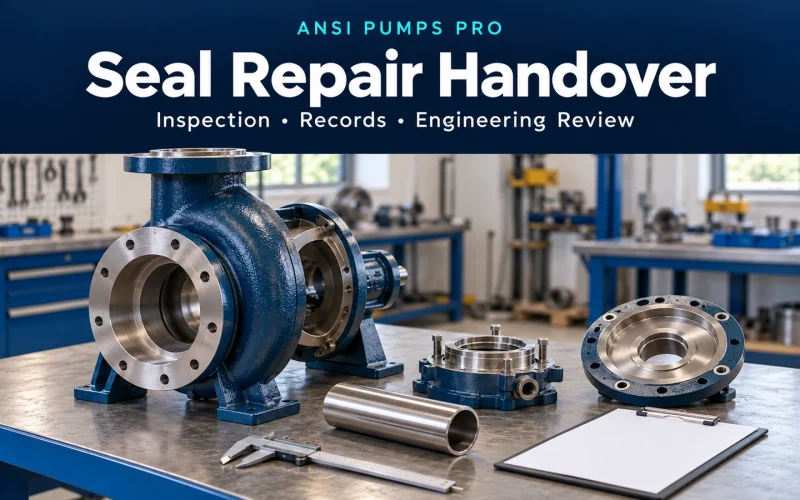
A new mechanical seal has been installed, but the pump still leaks. Before approving another seal order, bring the repair record, component measurements and startup observations into one review. The question is whether the assembled pump and its sealing system meet the requirements for the installed configuration.
For maintenance engineers and MRO buyers, a useful ANSI pump repair handover checklist connects each inspection to its acceptance requirement, evidence and responsible reviewer. It also separates the parts that need replacement from the information that still needs confirmation.
Use the checklist below to organize that handover. It is a proposed documentation framework for qualified maintenance teams; the applicable pump IOM, seal instructions and approved drawings control inspection, assembly and release to service.
Why a New Mechanical Seal Can Still Leak
Seal replacement changes one part of a larger assembly. The shaft or sleeve, chamber, gland, mating ring, secondary seals and auxiliary connections all need to match the installed seal arrangement.
The John Crane Type 58U instructions illustrate this relationship: equipment dimensions, alignment and surface condition affect seal operation, and the seal must be installed at its specified working length. That document applies to the named seal. Obtain the instructions for the seal actually installed before assessing its setting or condition.
Start with three questions:
- Where was leakage observed: the seal area, a static joint, a connection or another location?
- When did it appear: during an authorized static test, initial startup, steady operation or shutdown?
- Which records establish that the surrounding components and installation were accepted?
Leakage location and timing guide the investigation; they do not establish a root cause by themselves. For symptom-based diagnosis, use the existing Goulds 3196 troubleshooting guide. This article focuses on the records needed to close a repair and support the next purchasing decision.
Record the Pump Condition Before Further Rework
Create one traceable equipment record
Assign the handover package to the plant equipment tag and repair work order. Record the installed pump manufacturer, model, size, frame or group and serial information. Add the seal manufacturer, exact designation, arrangement and drawing revision.
Keep removed-part photographs and inspection records linked to that package. Label photographs with the component, location and date. Where practical, include a scale and an orientation reference so that the workshop and supplier can identify the same feature.
Preserve useful evidence before cleaning, polishing or machining changes it. Before handling process-wetted equipment, qualified personnel must complete the site's isolation, pressure-release, draining and decontamination procedure and follow the applicable equipment instructions.
Describe the service conditions at the time of leakage
Record the liquid, concentration, temperature, operating flow, pressure information, speed and recent process changes that are available. Identify the source of each value: instrument record, process specification, operator observation or an unconfirmed estimate.
Keep confirmed data separate from missing data. A maintenance note saying “normal operation” gives the next reviewer little to compare with the original duty. A dated operating record provides a much clearer basis for review.
Verify the Shaft and Shaft Sleeve Evidence
Identify the installed arrangement
Record whether the seal runs on a solid shaft, a pump shaft sleeve or the sleeve supplied as part of a cartridge seal. Include the relevant part references and mating drawing. A pump sleeve and a cartridge-seal sleeve belong to different assemblies and should be identified separately in the RFQ.
For replacement identification, use the pump shaft and shaft sleeve reference page. Submit the model and frame together with the part reference, material and available dimensions.
Make measurements reviewable
For every required inspection, record four things: the feature measured, the actual result, the applicable requirement and the evidence reference. Add units, instrument identification, measurement location and inspector details where the inspection plan requires them.
For example, a record reading “runout acceptable” leaves the reviewer without the result or its basis. A traceable record identifies the measured location, indicator reading and controlling drawing or instruction. The responsible engineer can then assess compliance with the correct requirement.
Describe grooves, corrosion, fretting or surface marks by location. A photograph supports identification; dimensional and condition assessments determine the disposition. Any proposed rework should have an approved scope and a defined method of verifying the finished component.
Manufacturer example: John Crane 58U equipment checks
The John Crane Type 58U IOM, February 2026, pages 1–2 gives the following checks. Select the applicable speed row and record the measuring position and full indicator movement (F.I.M.) with the result.
| Check | 58U requirement | Application condition |
|---|---|---|
| Shaft / sleeve run-out at the seal position | <0.08 mm / 0.003 in F.I.M. | Speed ≤1800 rpm |
| Shaft / sleeve run-out at the seal position | <0.05 mm / 0.002 in F.I.M. | Speed >1800 rpm |
| Shaft end play / axial float | <0.08 mm / 0.003 in F.I.M. | 58U equipment check |
| Shaft / sleeve finish at the seal position | Ra 0.3–0.6 μm, polished | 58U equipment check |
| Seal housing end-face squareness | Use the manual’s housing-squareness graph | Limit varies with shaft speed |
These are requirements for the identified 58U installation. Enter the actual pump model, seal model, drawing revision and approved limit on the handover sheet; reconcile the pump and seal requirements before acceptance. A blank limit stays on Hold.
Verify the Seal Chamber and Gland Interfaces
Match the installed assembly to its drawing
Build an interface list from the actual seal assembly drawing. The review package should identify the chamber, gland, shaft or sleeve and connection arrangement as one assembly.
Suggested record fields include chamber bore and depth, gland locating features, mounting pattern, available axial space and the condition of relevant mating surfaces. Mark each field as verified, awaiting measurement or requiring engineering review. These are documentation prompts; the drawing establishes which features and inspections apply.
Keep external fit and internal compatibility separate
ASME's B73.1 description addresses dimensional interchangeability for specified pump installation interfaces. It does not establish that every seal, sleeve or chamber component is interchangeable across pumps bearing the same standard designation.
Attach the configuration-specific drawing and parts information to a replacement inquiry. “ANSI compatible” alone leaves essential internal interfaces unresolved.

Match Goulds 3196 and Durco Mark 3 by model and part number
For a Goulds 3196 or Durco Mark 3 (Flowserve) repair, include the nameplate, serial number, frame designation, original part number and measured interfaces. Record the sleeve diameter and length, seal location, shaft steps, keyway and the installed seal arrangement. Use those records to request a dimensional review of replacement shafts and sleeves.
ASME B73.1 standard mounting dimensions support pump installation comparisons. Internal shafts, sleeves and seal-chamber components still need a model-specific drawing and material check.
Review Installation and Commissioning Records
Identify the instructions used
Record the document number and revision used for assembly, the installer and completion date. Where the procedure requires setting, adjustment or torque records, include the relevant completed record and its acceptance reference.
The Type 58U instructions also require pre-commissioning checks of alignment, auxiliary connections and the liquid supply to the seal chamber. They warn that dry running damages the sealing surfaces. Use the installed equipment's instructions to define the actual checks, sequence and settings; retain the completed evidence with the work order.
Avoid reconstructing the seal setting from the old collar position or an informal repair suggestion. If the applicable setting reference is missing, refer the item to the seal supplier and responsible engineer before release.
Distinguish workshop completion from release to service
Use separate entries for workshop completion, installation verification and authorized commissioning. Identify the person responsible for each stage and any open items handed to the next team.
Record observations made during the approved test or commissioning procedure, including operating conditions, leakage location and the agreed acceptance requirement. Unacceptable leakage or another unsafe condition requires the site's shutdown and isolation procedure. A handover form does not authorize continued operation or adjustment of a running assembly.

Copyable ANSI Pump Seal Repair Handover Checklist
Take the checklist to the workshop. The editable workbook includes 12 handover checks, fields for measured values and approved limits, status selections, and a separate 58U manufacturer-reference sheet.
Download editable Excel handover checklist Send your photos for a dimensional review
Use one row for each required check. Expand the rows to suit the actual equipment and approved inspection plan.
On small screens, scroll the table to view all columns.
| Handover item | Record to include | Acceptance basis / evidence | Status and reviewer |
|---|---|---|---|
| Equipment identity | Tag, work order, model, size, frame, serial | Nameplate and equipment record | To complete |
| Seal identity | Manufacturer, designation, arrangement | Seal drawing and applicable instructions | To complete |
| Leakage history | Location, timing, observed conditions | Dated operating or incident record | To complete |
| Shaft / sleeve arrangement | Component identity and mating interfaces | Parts list and assembly drawing | To complete |
| Required component inspections | Results, units and measurement locations | Approved criteria and inspection reports | To complete |
| Chamber / gland review | Applicable interfaces and condition findings | Drawing and inspection evidence | To complete |
| Installation record | Procedure revision, installer, required settings | Completed assembly record | To complete |
| Auxiliary connections | Installed arrangement and verification record | Approved piping / seal documents | To complete |
| Installation verification | Required alignment and installation checks | Applicable equipment procedure | To complete |
| Commissioning | Authorized test conditions and observations | Approved acceptance requirements | To complete |
| Open items | Issue, owner, corrective action, due date | Engineering disposition / work order | To complete |
| Final release | Signatory, date and scope of approval | Site release process | To complete |
Use Accepted, Rework required, Replacement review or Hold as documentation statuses. “Hold” means that essential evidence or approval remains open. Final release belongs to the site's authorized personnel.
Decide What the Next Purchase Needs to Cover
Convert a finding into a defined scope
Separate three outcomes in the review:
- Installation or documentation issue: identify the correction and verification required before closing the repair.
- Component issue: identify the affected part, approved disposition and replacement information.
- Wider equipment issue: request a broader engineering review before committing to another isolated part order.
Keep each conclusion linked to evidence. The checklist helps communicate a decision; it does not automatically justify replacing the sleeve, seal chamber or complete pump.
For a broader component assessment after disassembly, refer to the ANSI pump overhaul inspection guide. That guide addresses reuse, repair and replacement decisions across the pump.
Prepare an evidence-based RFQ
A practical replacement inquiry should include:
- Equipment tag, installed pump model, size and frame or group.
- Exact component requested and available part number or drawing revision.
- Mating-part information, photographs and relevant inspection findings.
- Material requirement and confirmed service conditions.
- Quantity, required inspection documents and target delivery date.
- Open technical questions that must be resolved before order acceptance.
State whether you need an individual shaft or sleeve, another identified component, a bare pump or a complete pump package. Give suppliers the same scope when comparing proposals, and ask them to identify assumptions and exclusions.
Request an ANSI Pump Shaft or Sleeve Review
If the repair review identifies a shaft or sleeve replacement requirement, send a parts inquiry to ANSI Pumps Pro. Include the nameplate, part reference, inspection record, photographs and required material. Supply drawings and supporting files through the contact channel indicated on the existing form.
For a wider replacement project, state the complete-pump or assembly scope explicitly so that the quotation can address the duty and installation requirements. Seal assemblies and special chamber components require separate confirmation of specification and supply scope.
Send a nameplate or shaft / sleeve photo
Select the installed pump family, add your work email and upload the available evidence. The review starts with the information you have; dimensions, materials, availability and delivery are confirmed in the quotation.
Frequently Asked Questions
Does a leak after replacement prove that the new seal is defective?
No. Record the leakage and review the equipment, installation and operating evidence before assigning a cause. The finding may require examination by the seal supplier or a wider pump investigation.
Which runout or surface-finish limit belongs on the checklist?
Use the approved pump and seal documentation for the installed equipment. For a concrete example, the 58U table above separates run-out limits at ≤1800 rpm and >1800 rpm and specifies Ra 0.3–0.6 μm. Record the applicable model, speed, measuring position and document revision beside your measured result.
Can an RFQ start without a complete drawing package?
Yes. Submit the information available and identify the gaps. A preliminary inquiry can begin identification; purchase approval still requires the technical and commercial scope to be resolved.
What makes the handover useful to procurement?
A clear component identity, documented finding and approved scope let procurement request comparable quotations. The same records also show which questions belong with maintenance, engineering or the supplier before an order is placed.