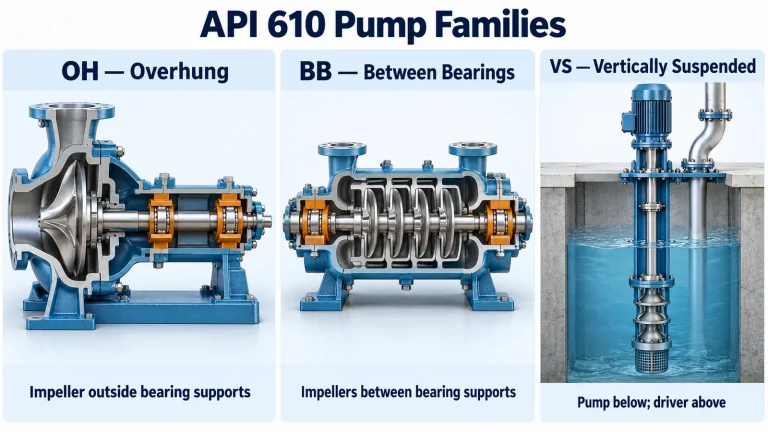
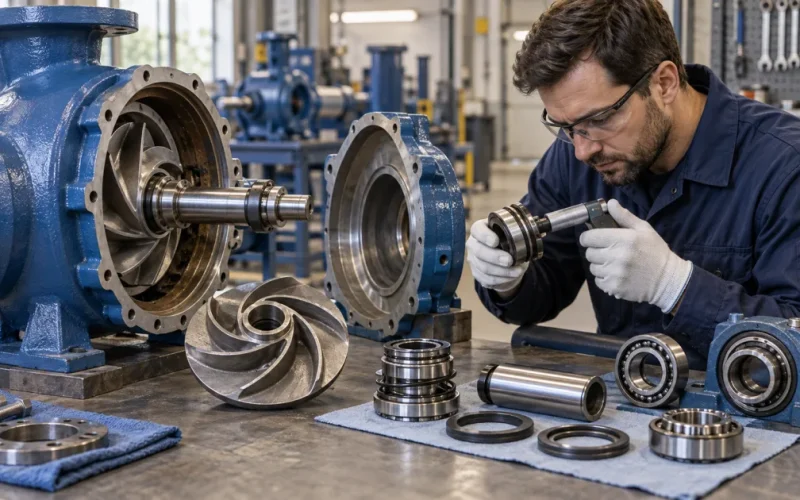
Illustrative image: this is a generic ANSI process pump, not a verified Goulds 3196 photograph. Actual 3196 configurations vary by frame and option.
When a Goulds 3196 leaks, runs hot, loses head, or develops vibration, the symptom alone does not identify the failed component. Start with the installed frame and pump size, the operating point, process conditions, maintenance history, and measurements taken while the problem is present. Use the applicable Goulds IOM and approved seal documentation for the exact configuration before setting clearances or accepting a repair dimension.
This guide helps maintenance and reliability teams organize the first checks for five common problems and decide what evidence is needed before replacing a seal, bearing, wet end, or complete pump.
Safety: Follow site isolation, draining, venting, lockout/tagout, and hazardous-fluid procedures before opening or adjusting the pump. The values below are references from the Goulds 3196 i-FRAME IOM, not substitutes for the current manual, nameplate, seal drawing, or site-approved limits.
Goulds 3196 symptom-to-check matrix
| Symptom | First checks | Evidence to record before selecting parts |
|---|---|---|
| Mechanical-seal leakage | Process change, dry running, seal setting, sleeve condition, flush/barrier arrangement, alignment, and suction conditions | Liquid and temperature; seal type and plan; leakage location/rate; sleeve photos and measurements; pressure and operating point |
| Bearing temperature rise or repeat failure | Oil/grease type and level, contamination, alignment, soft foot, pipe loads, radial load, and operation away from the intended range | Temperature trend and sensor location; vibration; lubricant condition; flow/head/speed; bearing and shaft inspection |
| Low flow, low head, or unstable discharge pressure | Instrument accuracy/location, rotation, speed, prime, suction restriction, valve position, impeller trim, and wear clearances | Flow; suction/discharge pressure; liquid density/viscosity/temperature; speed and motor readings; approved curve and system condition |
| Cavitation-like noise | NPSH margin, suction losses, liquid temperature/vapor pressure, tank level, entrained gas, and operation point | Simultaneous flow and suction data; level; strainer/valve condition; vibration; impeller inspection |
| Vibration or seal-chamber movement | Alignment, baseplate/anchors, pipe strain, bearings, rotor balance, looseness, and hydraulic excitation | Vibration by location/direction and operating state; alignment readings; pipe-support condition; duty point; inspection photos |
Treat this as a triage aid, not a one-symptom/one-fix chart. Several faults can produce the same symptom, and more than one condition may be present.
1. Mechanical-seal leakage
Do not assume a leaking seal is only a seal problem. Record where leakage appears, when it began, whether the process or startup condition changed, and which seal arrangement is installed. Check for dry running, flashing, solids, an incorrect setting, sleeve damage, unsuitable elastomer/material, pipe strain, and misalignment.
- Inspect the shaft and sleeve for scoring, fretting, corrosion, and runout. Use the measurement locations and limits in the applicable 3196 IOM; do not substitute an alignment tolerance for a shaft-runout limit.
- Confirm the seal chamber, gland, sleeve, and seal setting against the approved seal drawing.
- Record the installed flush or support plan. For Plan 11, inspect the actual flush path and restrictions. For dual seals, record the actual barrier/buffer arrangement, fluid, pressure, temperature, and vendor setpoint; do not apply a generic pressure differential.
- Check operating flow, suction pressure, temperature, and vapor-pressure conditions before choosing a different seal face or elastomer.
If a seal fails again soon after replacement, compare the failure pattern and operating record before repeating the same repair. Do not use an unsupported “70%” failure statistic.
2. Bearing temperature rise or repeat bearing failure
A rising bearing temperature is a symptom, not a universal pass/fail number. Compare a stable trend at the same measurement location and operating state. Check lubricant type, quantity, contamination, bearing arrangement, alignment, soft foot, pipe loads, radial load, and whether the pump is operating near its specified range.
For an i-FRAME unit equipped with an i-ALERT condition monitor, include its readings and trend history. Confirm the monitor is actually installed and use its configured alarm criteria. Do not treat a generic 180°F (82°C) threshold as an OEM limit for every bearing and lubrication arrangement.
Before installing bearings, document shaft condition, bearing fits, housing condition, lubrication method and quantity, coupling alignment, baseplate condition, and recent operating data.
3. Goulds 3196 impeller clearance and low performance
If flow or head has fallen, first verify instruments, rotation, speed, prime, valve position, suction condition, and the current operating point. Compare measured flow and head with the approved curve and fluid properties. Only then inspect impeller trim, erosion, wear components, and internal clearances.
This table applies only to standard Goulds 3196 / i-FRAME configurations covered by the cited 3196 i-FRAME IOM. Do not apply it to CV 3196, LF 3196, or another variant unless that model’s current IOM confirms the same values. The table lists cold/ambient impeller-clearance settings by service-temperature band. Confirm the exact pump variant and current IOM revision before adjustment.
| Service-temperature band | STi | MTi / LTi | XLT-i / i17 |
|---|---|---|---|
| -20 to 200°F (-29 to 93°C) | 0.005 in (0.13 mm) | 0.008 in (0.20 mm) | 0.015 in (0.38 mm) |
| Up to 250°F (121°C) | 0.006 in (0.15 mm) | 0.009 in (0.22 mm) | 0.016 in (0.41 mm) |
| Up to 300°F (149°C) | 0.007 in (0.18 mm) | 0.010 in (0.25 mm) | 0.017 in (0.43 mm) |
| Up to 350°F (177°C) | 0.009 in (0.22 mm) | 0.012 in (0.30 mm) | 0.019 in (0.48 mm) |
The IOM warns against setting the maximum clearance more than 0.005 in (0.13 mm) above the listed value because performance can decrease. The setting procedure uses the pump’s adjustment hardware and a dial indicator or feeler-gauge method; follow the applicable IOM steps. Cartridge-seal centering clips and set screws must be handled as the IOM specifies.
For shaft checks, be explicit about what is being measured. The IOM distinguishes shaft runout at the sleeve-fit and coupling-fit locations and whether the sleeve is fitted. It separately says to investigate an assembled shaft-sleeve runout reading above 0.002 in (0.051 mm). These are not universal seal-face, hot-alignment, or frame-based limits. Because the linked manufacturer-hosted IOM is a Spanish-language edition and revisions/configurations can differ, verify the exact table and procedure in the current manual for the installed pump before publishing or using any shaft-runout number.
If casing, impeller, cover, sleeve, or wear components are damaged, record the exact installed size, frame, part reference, trim, material, and measured condition. Dimensional fit alone does not demonstrate hydraulic performance at the required duty.
4. Cavitation-like noise and unstable flow
Noise that resembles gravel can be associated with cavitation, but sound alone is not a diagnosis. Check available NPSH using the actual liquid level, suction pressure, temperature, vapor pressure, and suction-line losses; compare it with the pump’s required NPSH at the measured flow and speed. Also investigate air ingress, entrained gas, a blocked strainer, closed or undersized suction valves, and changing process conditions.
Inspect an impeller for pitting or erosion after documenting the operating conditions. Material selection should follow the actual chemistry, concentration, temperature, solids, and velocity—not the assumption that a different alloy alone will correct a suction problem.
5. Vibration or seal-chamber movement
Record vibration by point, direction, operating state, and time. Review pump-to-driver alignment, soft foot, baseplate and anchor condition, piping loads, bearing condition, rotor balance, and the hydraulic operating point. Compare readings with the site’s applicable alarm criteria and baseline; do not use one unqualified vibration number for all sizes and installations.
If a replacement casing or power end is being considered, compare mounting dimensions, shaft centerline, nozzle positions, seal-chamber interface, shaft arrangement, impeller trim, and the required duty. ASME B73.1 addresses dimensional interchangeability for pumps with the same standard dimension designation; it does not by itself establish interchangeability of every internal component or hydraulic curve.
Repair, wet-end replacement, or complete pump review?
Consider a part-only repair when the duty remains appropriate, the pressure-retaining components are serviceable, the material is suitable, and inspection identifies a defined component problem. Escalate to a wet-end or complete-pump review when the casing is damaged or corroded, the process duty has changed, the material is unsuitable, the power end has recurring problems, or previous repairs have not restored reliable service.
For fitment review, provide the pump nameplate, size and frame, serial or OEM part references where available, general-arrangement drawing, duty point, fluid properties, seal arrangement, material requirements, recent readings, and photos or measurements of failed parts. Review dimensional, mechanical, material, and hydraulic compatibility separately; do not promise universal “drop-in” fitment.
For replacement scope, see the site’s Goulds 3196 replacement options. For broader system-performance diagnosis, see the centrifugal pump troubleshooting guide.
Frequently asked questions
What is the Goulds 3196 impeller clearance?
It depends on the frame group, service-temperature band, and exact 3196 variant. For standard 3196 / i-FRAME configurations covered by the cited IOM, the -20 to 200°F values are 0.005 in STi, 0.008 in MTi/LTi, and 0.015 in XLT-i/i17. CV 3196, LF 3196, and other variants may use different values; check that model’s current IOM before setting clearance.
What shaft-sleeve runout should I accept?
Use the applicable IOM measurement. The IOM’s shaft-fit runout table and its separate assembled shaft-sleeve runout check describe different measurements. Do not substitute a single frame-based number for both.
Is 180°F (82°C) the bearing-temperature limit?
Not as a universal Goulds 3196 limit. Compare the temperature trend and measurement point with the installed bearing, lubrication method, operating conditions, monitor settings, and site limits.
Does Plan 11 or Plan 53A have one standard pressure setting for every 3196 seal?
No. Verify the installed seal plan, seal drawing, process conditions, and seal supplier’s specified settings. Record actual pressures and the barrier/buffer arrangement.
Are all Goulds 3196 replacement wet ends interchangeable?
No. Check the installed size, frame, seal chamber, shaft arrangement, impeller trim, materials, connection interfaces, and duty point. B73.1 dimensional interchangeability does not establish that every internal part or pump curve is equivalent.
What should I send for a troubleshooting review?
Send the nameplate and pump size/frame, operating flow/head/speed, liquid and temperature, seal/flush details, recent temperature and vibration readings, photos of the failed components, and relevant drawings or part references.
Technical references
- ITT Goulds Pumps, Model 3196 i-FRAME Installation, Operation, and Maintenance Manual (manufacturer-hosted IOM; use the latest applicable language/revision for the installed pump).
- ASME, B73.1 — Specification for Horizontal End Suction Centrifugal Pumps for Chemical Process.
For an application-specific review, send the pump nameplate and operating data. ANSI Pumps Pro is an independent aftermarket supplier; references to third-party pump brands identify the installed equipment and do not imply OEM manufacture or authorization.