A pump described as a “Durco Mark III equivalent” is not automatically a drop-in replacement. Before approving a substitute, verify the exact pump configuration, installation interfaces, hydraulic duty, materials, seal arrangement, and supporting records. A match in one area—such as nominal size or an ASME B73.1 dimension designation—does not establish a match in every other area.
This guide is for maintenance, reliability, and procurement teams evaluating a complete pump, a wet end, or an individual replacement part. The checks differ by scope. Confirm what is being replaced and what will remain in service before comparing quotations. For a project-specific review, submit the pump nameplate, installation drawing, operating point, and material requirements through our engineering inquiry form.
1. Identify the exact Durco Mark 3 configuration
“Mark III” and “Mark 3” are commonly used in search queries, but the name alone is not enough to identify a pump. Flowserve product literature uses the Durco® Mark™ 3 name and covers multiple configurations. A standard ASME process pump, an ISO configuration, and specialty variants may differ in dimensions, power-end details, seal chamber, impeller, or adjustment procedure.
Record the information from the nameplate and existing records before requesting a cross-reference:
- Full model or size designation, including every suffix
- Serial number, product type, group, and frame or power-end identification where shown
- Rated speed, motor data, and rotation as installed
- Impeller type, diameter, and material, if documented
- Seal type, seal chamber arrangement, and flush or quench plan
- General arrangement drawing, section drawing, bill of materials, and prior repair records
Do not infer a shaft diameter, bearing frame, or interchange part number from a partial size string. Confirm each item against the applicable OEM documentation and the supplier’s controlled drawing.
2. Separate dimensional fit from full interchangeability
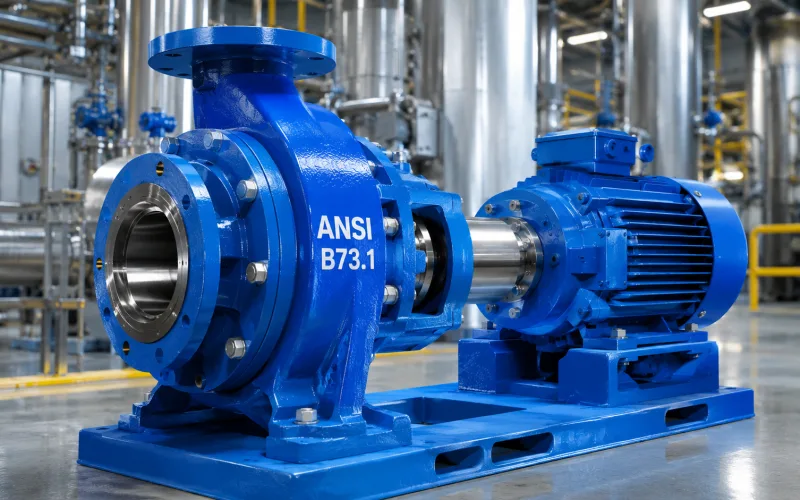
ASME B73.1 establishes dimensional requirements for horizontal end-suction chemical process pumps. The standard explains that pumps with the same standard dimension designation are intended to be interchangeable for specified installation dimensions, including mounting dimensions, nozzle sizes and locations, input shaft, baseplate, and foundation bolt holes. That boundary does not certify identical internal parts, seal interfaces, hydraulic performance, materials, or suitability for a particular service.
Compare the actual installation drawing and measurements. Check suction and discharge nozzle orientation and centerlines, flange facing and drilling, baseplate and anchor-bolt pattern, shaft centerline, coupling location, driver interface, and available maintenance clearance. Verify tolerances and the exact standard designation rather than relying on a nominal pump size.
For a replacement part or wet end, also compare the part’s interfaces with the installed power end and casing. A casing that bolts up may still have a different seal chamber, impeller-to-casing relationship, shaft fit, or allowable operating envelope. Keep the Durco Mark 3 replacement overview and OEM part-number cross-reference guidance in view, but validate every proposed cross-reference against the project records.
3. Confirm reverse-vane impeller and seal details
Some Durco Mark 3 configurations use a reverse-vane impeller with an external axial adjustment arrangement. Do not assume every Mark 3 variant or substitute uses the same impeller, adjustment hardware, clearance target, or procedure. Verify the exact pump type and consult the current instruction manual for that configuration.
Flowserve literature describes indexed movement on applicable reverse-vane arrangements. An indicated increment such as 0.1 mm (0.004 in) describes a movement step in the cited arrangement; it is not a universal target clearance. The required running clearance depends on the specific model, impeller, service, operating temperature, and manufacturer procedure. Never set a replacement by copying an increment as though it were the final clearance.
Before axial adjustment, establish whether the installed mechanical seal can tolerate that movement. Follow the applicable seal and pump instructions, including any required release, reset, or inspection procedure. Do not loosen a seal drive component or locking feature based on generic online advice. Record the as-found position, the procedure used, and the final measured setting.
Where impeller adjustment is central to the decision, see our technical comparison of Goulds 3196 and Durco Mark 3 impeller adjustment. The comparison is configuration-specific and does not replace the applicable IOM.
4. Match the hydraulic duty and operating envelope
A replacement should be evaluated at the required operating conditions—not only by nominal size, rated flow, or motor horsepower. Provide the normal, minimum, and maximum flow; total dynamic head; liquid temperature; density and viscosity; vapor pressure; solids or entrained gas; suction pressure; and system-control method. Include the expected operating hours and any transient or startup condition that affects the pump.
Review the proposed pump curve at the actual impeller diameter and speed. Confirm that the operating point falls within the supplier’s allowable operating region, that required NPSH is acceptable with the available margin, and that absorbed power remains within the motor and driver limits over the expected range. Review shutoff head, minimum continuous stable flow, vibration or radial-load considerations where relevant, and the effect of variable-speed operation.
If the liquid is viscous, hot, gas-bearing, or contains solids, request the correction method and assumptions used for the quoted curve. A curve for water at a different speed or impeller diameter is not proof of equivalent service performance. Ask for the calculated duty point, corrected curve, power, and NPSH basis in writing.
5. Select materials for the actual process conditions
Material names and alloy-family labels are not enough to establish corrosion resistance. Selection depends on the full chemistry and operating conditions, including concentration, temperature, pH, contaminants, chloride level, aeration or oxidizing potential, velocity, and solids. Confirm the required material for each wetted component rather than treating the pump as one material item.
When comparing cast and wrought alloy designations, preserve the distinction between the material specification and a family-level cross-reference. For example, CW12MW is a cast-alloy designation associated with the C-276 family; it is not the same specification as wrought UNS N10276. CW2M is a different cast alloy designation and must not be presented as a direct C-276 casting equivalent. Verify the exact ASTM/ASME material specification, grade, heat treatment, and chemistry on the supplier’s material test report (MTR).
Likewise, do not assume that Alloy 20 and CN7M, or any other cast and wrought grades, are interchangeable solely because a supplier groups them together. Specify the required alloy and acceptance criteria for casing, impeller, shaft, sleeve, fasteners, and seal wetted parts. Where corrosion performance is critical, have the material selection reviewed against the actual process data and applicable corrosion references.
6. Review seals, auxiliaries, and maintainability
Confirm seal-chamber dimensions and arrangement, shaft or sleeve diameter, seal setting length, gland interface, flush connections, and the selected API Plan or other auxiliary piping. Verify that the proposed seal is suitable for the liquid, temperature, pressure, emissions requirements, and operating range. Check coupling, guard, bearing lubrication, driver alignment, and any instrumentation or monitoring connection affected by the change.
Ask whether the quoted scope includes the complete assembly, baseplate, coupling, seal, auxiliary piping, and commissioning support—or only selected components. A “replacement pump” quotation can omit items needed to install or operate the package.
7. Request evidence before purchase approval
Ask the supplier to provide a controlled, model-specific package that allows engineering to verify the proposed match:
- Completed nameplate and application data review, with assumptions identified
- Dimensioned general arrangement and interface drawing, including tolerances
- Section drawing or parts list for the offered configuration
- Certified or clearly identified pump curve at the quoted speed and impeller diameter
- Power and NPSH data at the required operating range
- Wetted-material list and MTRs or inspection records required by the purchase specification
- Seal data sheet, auxiliary plan, and confirmation of interface compatibility
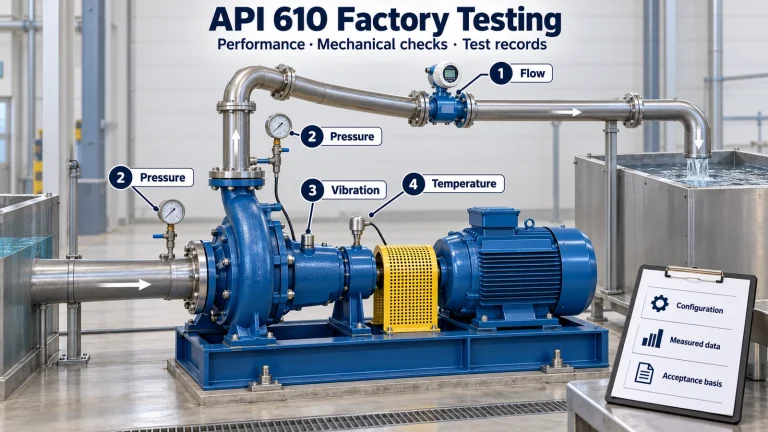
- Inspection and test scope, acceptance criteria, and documentation deliverables
- Written list of deviations from the existing pump and any site work required
For critical service, define inspection and testing requirements in the purchase documents before the order is placed. A test certificate is useful only when its test basis and acceptance criteria match the project requirement.
Replacement approval checklist
- Identify the exact pump family, size suffix, serial number, group, and scope being replaced.
- Compare installation and component interfaces using drawings and tolerances.
- Confirm the impeller, adjustment method, applicable clearance procedure, and seal compatibility.
- Review a curve and power/NPSH data for the actual liquid and operating range.
- Approve each wetted material against process conditions and required specifications.
- Record deviations, tests, documentation, and installation work before purchase approval.
Request a technical fitment review
Send the nameplate, installation drawing, operating point, fluid data, seal details, material requirements, and the scope being replaced. We will identify which interfaces and operating limits need confirmation for the proposed configuration.
Frequently asked questions
Does ASME B73.1 prove that a Durco Mark 3 equivalent will perform the same?
No. A matching standard dimension designation addresses specified installation dimensions. It does not by itself establish matching hydraulics, internal parts, seal arrangement, materials, or process suitability. Evaluate those separately.
What information is needed to cross-reference a Durco Mark 3 pump?
Start with the complete nameplate and serial number, full model and suffix, drawings, operating conditions, impeller and seal details, material requirements, and the scope being replaced. A partial size designation is not enough for a reliable engineering review.
Can a reverse-vane impeller be assumed to be interchangeable?
No. Confirm the exact pump configuration, impeller dimensions and material, adjustment arrangement, clearances, and seal limitations against the applicable documentation. An adjustment increment is not a universal clearance target.
Are CW12MW and wrought C-276 the same material?
No. CW12MW is a cast-alloy designation associated with the C-276 family, while UNS N10276 identifies wrought C-276. Confirm the specified casting or wrought product form, material standard, grade, and MTR for the component being supplied.
What should I send for a replacement review?
Send the nameplate photo, existing drawings, process and operating data, seal and auxiliary details, material requirements, and any required inspection or test specification. Submit the information for engineering review; final fit and suitability depend on the confirmed configuration and service.
Technical references
- ASME B73.1, Specification for Horizontal End Suction Centrifugal Pumps for Chemical Process
- Flowserve Durco Mark 3 ASME product brochure
- Flowserve Durco Mark 3 maintenance card
- Haynes International, Guide to the Metallurgical, Corrosion and Wear Characteristics
ANSI Pumps Pro is an independent supplier. References to third-party trademarks and model designations identify products for comparison and do not imply affiliation, authorization, or endorsement. Final interchangeability and material suitability must be confirmed for the specific pump, documentation, and service.