What a Pump Nozzle Load Actually Is
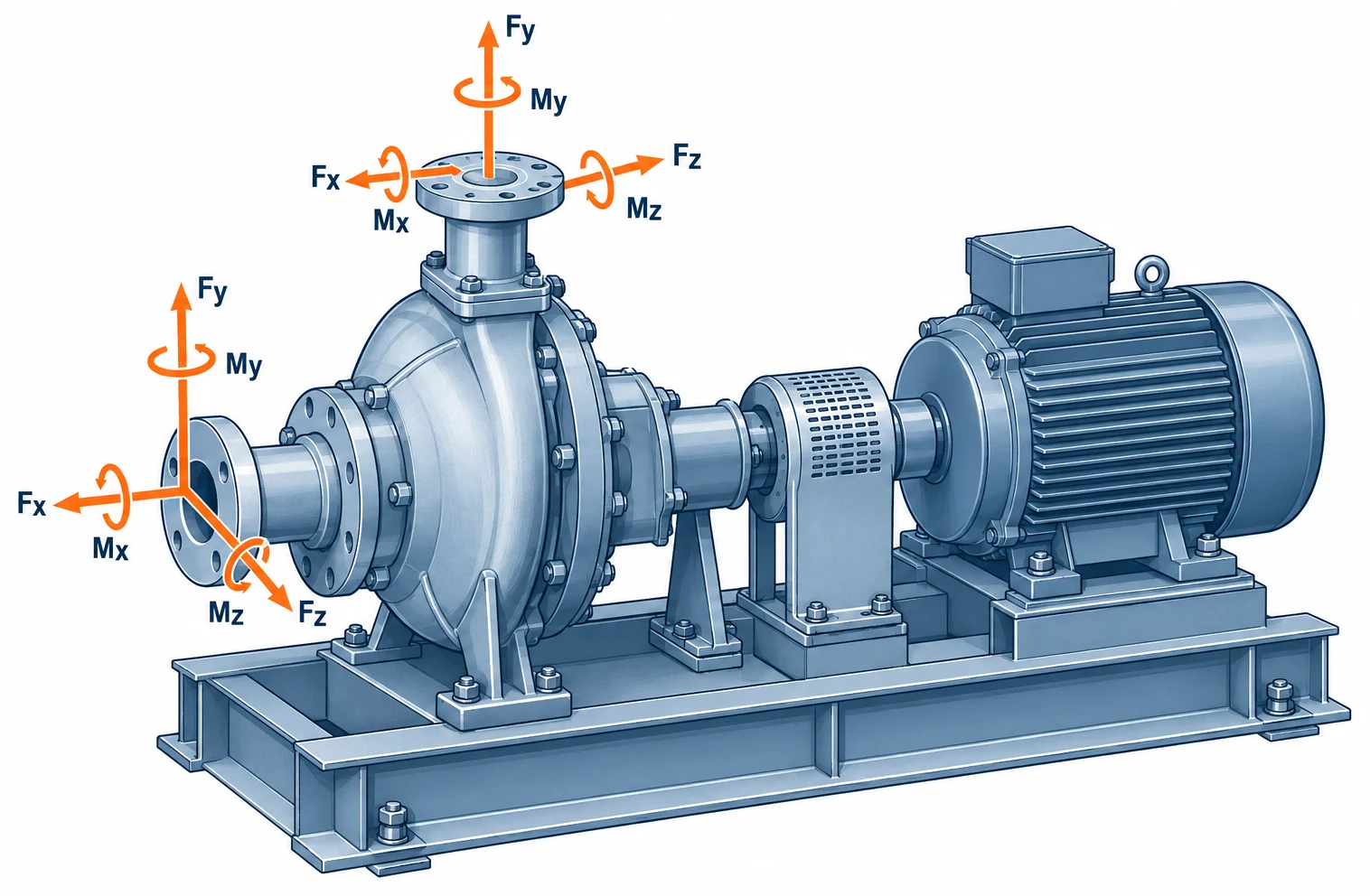
A connected pipe can push, pull and twist a pump nozzle in three directions. Those external loads travel through the nozzle neck and casing into the pump feet, baseplate, anchors and rotating assembly.
For engineering review, the loads are normally resolved into three orthogonal force components and three moment components. The exact coordinate convention must follow the applicable pump drawing, standard or OEM definition—do not assume that every vendor labels the axes identically.
Axial force
A force component along the defined X direction. Verify the actual project coordinate convention before assigning the physical direction.
Vertical force
A vertical component can come from pipe weight, support movement or thermal growth and may contribute to casing/baseplate distortion.
Lateral force
A horizontal transverse load can shift the casing relative to the driver and change the cold-to-hot alignment relationship.
Resultant Force — Vector Concept
FR — resultant force magnitude
Fx, Fy, Fz — orthogonal force components in the applicable coordinate system
Resultant Moment — Vector Concept
MR — resultant moment magnitude
Mx, My, Mz — moment components about the applicable coordinate axes
Engineering Note: These resultant equations explain the vector concept only. They are not a replacement for the applicable ANSI/HI 9.6.2 acceptance method, pump grouping, adjustment factors or OEM/project allowable-load data.
Where Nozzle Loads Come From
ANSI/HI nozzle-load assessment is not only about pipe weight. In practice, three families of load sources deserve separate review because they behave differently during installation, startup and temperature changes.
Pipe strain and fit-up
Mislocated supports, prefabricated piping that does not naturally meet the flange, pipe weight and forced bolt-up can preload the casing before the pump even starts.
Pressure reaction
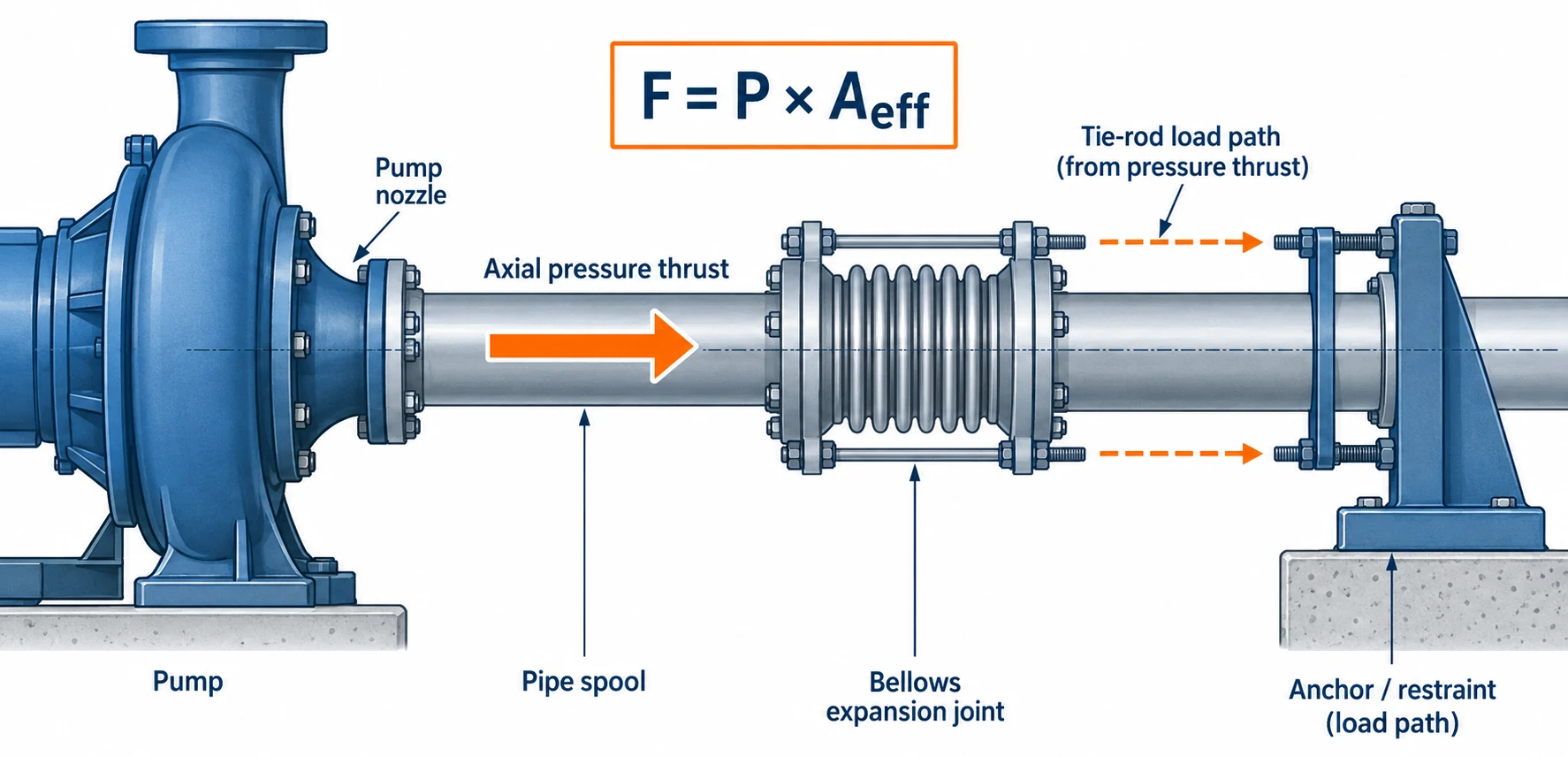
Internal pressure can create reaction forces at elbows, reducers, bellows and restraints. Expansion joints can increase the problem if pressure thrust is not properly restrained.
Growth and contraction
Hot or cold piping changes length and support reactions. A pump that aligns well cold can move once the line reaches operating temperature.
How Piping Loads Become Pump Reliability Problems
The practical problem is not the number on a stress-analysis report by itself. It is the deformation and relative movement that external loads can create across the pump, driver and foundation system.
How ANSI/HI 9.6.2 Should Be Used
ANSI/HI 9.6.2 covers applied nozzle-load assessment for several rotodynamic pump categories, including horizontal end-suction single-stage pumps in the B73 family. The standard includes nomenclature, loading criteria, material specifications, adjustment factors, maximum individual nozzle loads and example assessments.
Do collect
- Pump type / size / group used by the applicable method
- Suction and discharge force components
- Suction and discharge moment components
- Material and operating-temperature information
- Baseplate / installation condition where required
- OEM or project-specific allowable data if supplied
Do not assume
- One flange-size table applies to every ANSI pump
- All B73.1 manufacturers have identical stiffness
- A single resultant force/moment ratio replaces the standard
- B73.1 dimensional interchangeability means identical nozzle-load capacity
- API 610 allowable loads are a fixed multiple of B73.1 loads
Why there is no generic allowable-load table here: final allowable values depend on the applicable ANSI/HI 9.6.2 method and pump grouping, with adjustment factors and project/OEM details. Use the current standard and actual pump data rather than a flange-size chart copied from an unrelated source.
ASME B73.1 is principally a design/specification and dimensional-interchangeability standard for horizontal end-suction chemical-process pumps. Pumps with the same standard designation are intended to share important mounting and nozzle interfaces. That does not mean their hydraulic performance or allowable external nozzle loads are automatically identical.
API 686-Style Pipe-Strain Verification Before Startup
This field check turns a vague “the pipe may be pulling the pump” suspicion into a measurable installation check. Use the edition and project specification that governs the actual job.
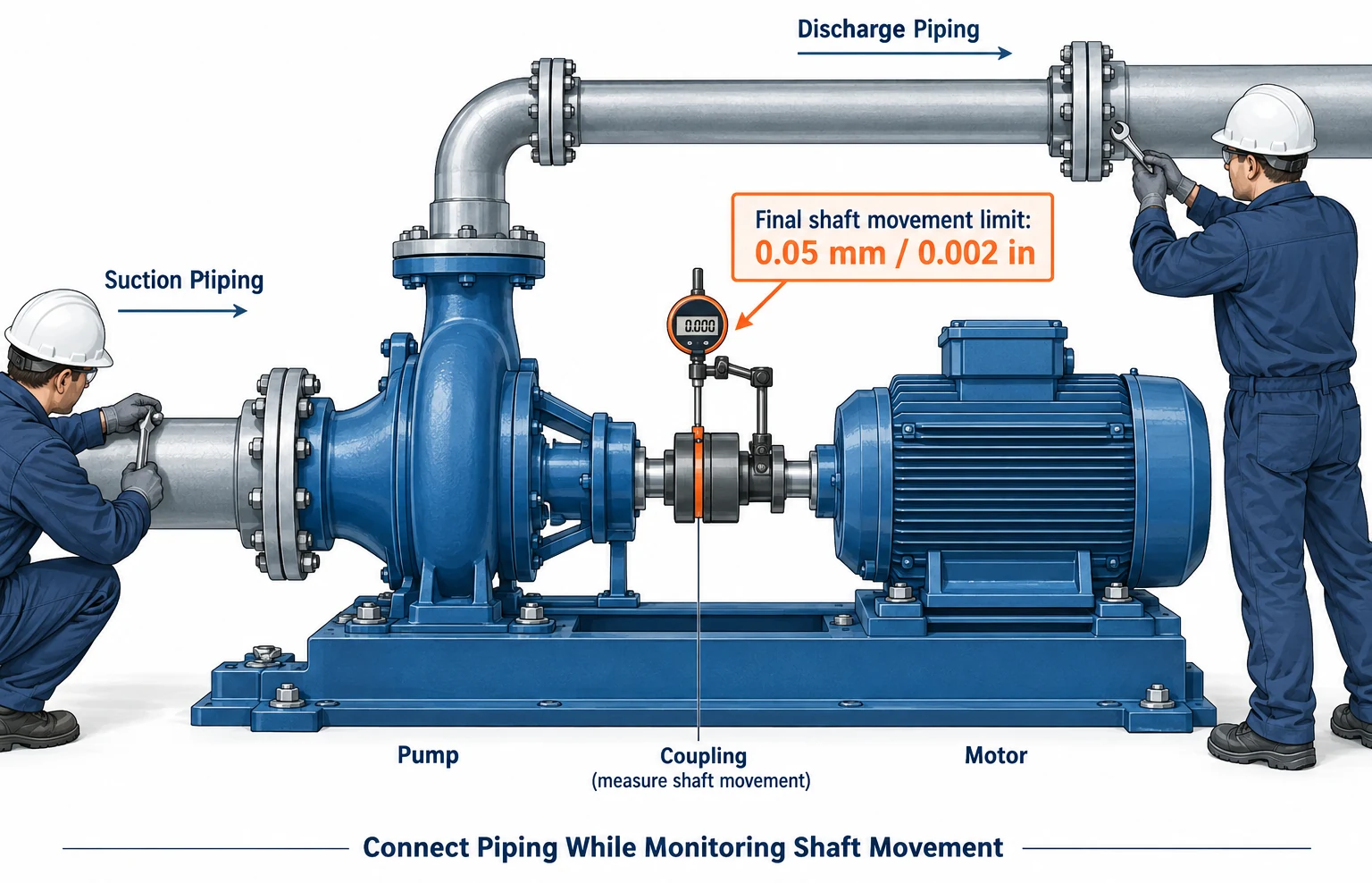
API 686 guidance uses this as the final maximum shaft movement in either vertical or horizontal direction after machinery flanges are tightened in the referenced piping-alignment procedure.
Movement can temporarily exceed 0.002 in during the tightening sequence, provided the final requirement is met. If final movement remains above the limit, correct the piping or supports and repeat the check rather than “aligning the motor around” a strained pipe.
Establish the machinery alignment baseline
Complete the applicable initial pump/driver alignment and document the starting condition before using piping bolt-up as a strain check.
Install horizontal and vertical movement monitoring
Use dial indicators or suitable laser tooling so movement can be observed in both directions while piping is connected.
Confirm natural flange fit-up
The piping should meet the pump nozzle without using flange bolts as a pulling device. Correct support location, elevation or pipe geometry where necessary.
Bolt up in the specified sequence and monitor movement
Follow the project/OEM torque procedure. Observe when movement begins; this can help identify which line, support or connection is imposing strain.
Accept or correct the piping
If the final movement exceeds the applicable criterion, loosen the piping and correct the piping/support system, then repeat the verification. Do not treat motor movement as the primary corrective action for pipe strain.
Expansion Joints Can Reduce Thermal Restraint—and Still Increase Nozzle Load
A flexible bellows is not automatically a “zero-load” connection. Internal pressure acting on the bellows effective area creates an axial pressure thrust that must be reacted by the restraint system, tie rods, anchors or other intended load path.
Pressure-Thrust Relationship
Fthrust — axial pressure thrust
P — applicable internal pressure
Aeff — expansion-joint manufacturer’s effective bellows area
Baseplate, Grout and Foundation Are Part of the Nozzle-Load System
The casing does not respond to piping loads in isolation. External load travels through the pump feet into the baseplate, grout/foundation and anchors. Baseplate stiffness, foundation condition and hold-down integrity therefore influence how much relative movement occurs at the shaft and coupling.
Nozzle→
Casing / Feet→
Baseplate→
Grout / Foundation→
Anchors
Engineering boundary: good grouting and a rigid base help control deformation, but they do not make an overloaded piping system acceptable. The correct fix for pipe strain is still the piping/support/restraint system.
Why a Pump Can Align Cold and Move at Operating Temperature
Thermal growth changes pipe length, support reactions and equipment elevations. A cold alignment report therefore cannot prove that nozzle loads remain acceptable when the process reaches operating temperature.
Cold checks can reveal
- Forced flange fit-up
- Incorrect support elevations
- Pipe weight carried by the nozzle
- Immediate bolt-up movement
Operating-condition review can reveal
- Thermal growth loads
- Support lift-off or restraint changes
- Expansion-joint thrust/reaction issues
- Hot alignment movement
For temperature-sensitive service, combine the installation check with the piping flexibility/stress analysis, support design and any hot-alignment requirement specified for the project.
Field Troubleshooting Matrix
Use symptoms to decide what to inspect first—not as proof of a single root cause. For a structured follow-up, use our pump performance troubleshooting guide.
| Observed symptom | Check first | Why it matters |
|---|---|---|
| Alignment shifts after piping bolt-up | Pipe strain / flange fit-up / supports | Direct evidence that the piping connection is moving the machinery. |
| Seal leakage appears mainly after heat-up | Thermal piping loads and hot alignment | Cold geometry may be acceptable while operating-temperature reactions distort the casing or shift alignment. |
| Vibration rises after process temperature stabilizes | Thermal growth, supports, alignment, hydraulics | ANSI/HI pump vibration limits can help frame the review, but temperature-dependent nozzle load is only one possible cause; hydraulic and rotor causes still need to be excluded. |
| Repeated coupling wear | Shaft alignment + movement after piping connection | A flexible coupling should not be used to mask continuous machinery movement. |
| Pump/base movement or loose anchors | Baseplate, grout/foundation, anchors and piping reaction | The external load path may be exceeding the stiffness or restraint available in the installed system. |
What to Send for an Engineering Review
If the issue involves chronic alignment changes, seal leakage or a pump replacement in an existing piping system, start with evidence that separates pump fitment from piping-load problems.
Replacement check: Critical pump replacement dimensions and ASME B73.1 dimensional interchangeability can simplify mounting/nozzle-interface review, but they do not prove that an existing piping-load problem disappears when the pump is replaced. Correct pipe strain and restraint problems separately.
Related engineering references: Goulds 3196 replacement configurations; Durco Mark III replacement configurations.
Pump Nozzle Load FAQ
What shaft movement is commonly checked during an API 686 pipe-strain verification?
In the referenced API 686 piping-alignment procedure, the final shaft movement after machinery flanges are tightened is limited to 0.05 mm (0.002 in.) in either vertical or horizontal direction. Use the governing project edition/specification and OEM instructions for the actual job.
Can an expansion joint increase pump nozzle load?
Yes. A bellows can reduce thermal restraint while still creating pressure thrust equal to internal pressure multiplied by the effective bellows area. If that thrust is not carried by the intended anchors, tie rods or restraint system, the pump nozzle can receive substantial axial load.
Does ASME B73.1 dimensional interchangeability mean every pump has the same allowable nozzle loads?
No. B73.1 standardizes important installation interfaces such as mounting dimensions and nozzle size/location, but allowable external nozzle loads depend on the applicable nozzle-load assessment, pump design, materials, temperature, baseplate/installation and OEM/project data.
Why can a mechanical seal leak only after the piping becomes hot?
Thermal growth can change nozzle forces and moments, moving or distorting the pump relative to the cold condition. That can change shaft alignment or seal-chamber geometry. However, hot leakage is not proof of nozzle load by itself; seal condition, hydraulics and other mechanical causes should also be checked.
Should flange bolts be used to pull the pipe into alignment with the pump?
No. The piping should naturally meet the machinery flange within the applicable installation requirements. If bolts are needed to pull the line into position, correct the piping, supports or fabrication rather than transferring that preload into the pump.
Technical Sources
- ASME B73.1 — horizontal end-suction centrifugal pumps for chemical process; design/specification and dimensional-interchangeability requirements.
- ANSI/HI 9.6.2 — Rotodynamic Pumps for Assessment of Applied Nozzle Loads; loading criteria, material/temperature adjustment factors, maximum individual loads and assessment examples.
- API Recommended Practice 686 — machinery installation and piping-alignment / pipe-strain verification procedure. Verify the edition and project specification governing the job.
- Project piping code/specification, piping stress analysis, expansion-joint manufacturer data and pump OEM allowable-load data where applicable.