
Injection, Dosing, Metering and Chemical Feed: What Do the Terms Mean?
In plant conversations, chemical injection, dosing, metering and chemical feed are often used interchangeably. The words describe the application more than they define one pump construction. The first engineering question is therefore not the label on the service—it is whether the process requires a controlled, repeatable dose or continuous transfer of process liquid.
A controlled-volume metering pump delivers a predictable displacement over repeated cycles and is commonly used where chemical addition must follow a specified rate, ratio or control signal. Other positive-displacement technologies can also be used for dosing or injection, but that does not automatically place every injection pump inside the same standard scope.
Application name does not equal governing standard
Chemical injection pump is an application description. Controlled-volume metering pump is a pump category. API 675 pump is a more specific contractual/specification category within controlled-volume reciprocating pump service.
ANSI/HI 7.1–7.5 and API 675 Do Not Cover the Same Scope
ANSI/HI 7.1–7.5 provides terminology, definitions, application and operating guidance for controlled-volume metering pumps. Its scope covers hydraulic, pneumatic or mechanical drives and liquid ends such as plunger, piston and diaphragm configurations.
API 675 is narrower. The current API 675 scope covers controlled-volume reciprocating pumps used in petroleum, chemical and gas services, including hydraulic diaphragm and packed-plunger designs. Rotary positive-displacement pumps and direct mechanically actuated diaphragm pumps should not be described as automatically falling inside the same API 675 scope.
| Question | ANSI/HI controlled-volume context | API 675 context |
|---|---|---|
| What is it? | Broad controlled-volume metering-pump guidance | Specific procurement / performance standard for applicable controlled-volume reciprocating pumps |
| Typical liquid ends | Plunger, piston, diaphragm | Hydraulic diaphragm and packed plunger within the standard scope |
| Rotary PD pump? | Separate rotary-positive-displacement technology | Not inside API 675 scope |
| Direct mechanical diaphragm? | Can be a metering-pump technology | Do not label as API 675 by default |
How a Controlled-Volume Metering Pump Produces a Measured Dose
In a reciprocating metering pump, the displacement element moves through repeated suction and discharge strokes. Inlet and discharge check valves control the direction of liquid flow. Capacity is then adjusted by changing effective displacement, stroke length, stroke frequency or drive speed, depending on the design.
Q = delivered volumetric flow;
Vs = displacement per cycle;
N = cycles per unit time;
ηv = volumetric efficiency. Use compatible volume and time units throughout.
What API 675 Performance Requirements Mean in Practice
API 675 performance language is useful because it turns “accurate dosing” into measurable requirements. For an applicable API 675 pump, the procurement specification should define rated capacity, turndown and the required performance verification rather than relying on a generic accuracy claim.
| Parameter | API 675 reference basis | Practical meaning |
|---|---|---|
| Steady-state flow accuracy | Within ±1% of rated flow | Measured delivered flow must remain inside the allowed band under specified test conditions. |
| Linearity | Within ±3% of rated flow | Capacity response across the specified adjustment range must remain acceptably linear. |
| Repeatability | Within ±3% of rated flow | Returning to the same setting should reproduce capacity within the stated tolerance. |
| Turndown | At least 10:1 | The specified controlled-capacity range must support meaningful adjustment without redefining the pump category. |
| Rated capacity | At least 110% of specified maximum capacity | Selection includes capacity margin over the purchaser’s stated maximum requirement. |
Do not rewrite ±1% as “±1% of every set point”
Keep the exact performance basis tied to the governing standard and test conditions. A shorthand marketing claim can overstate what the specification actually guarantees.
How a Chemical Injection Skid Works
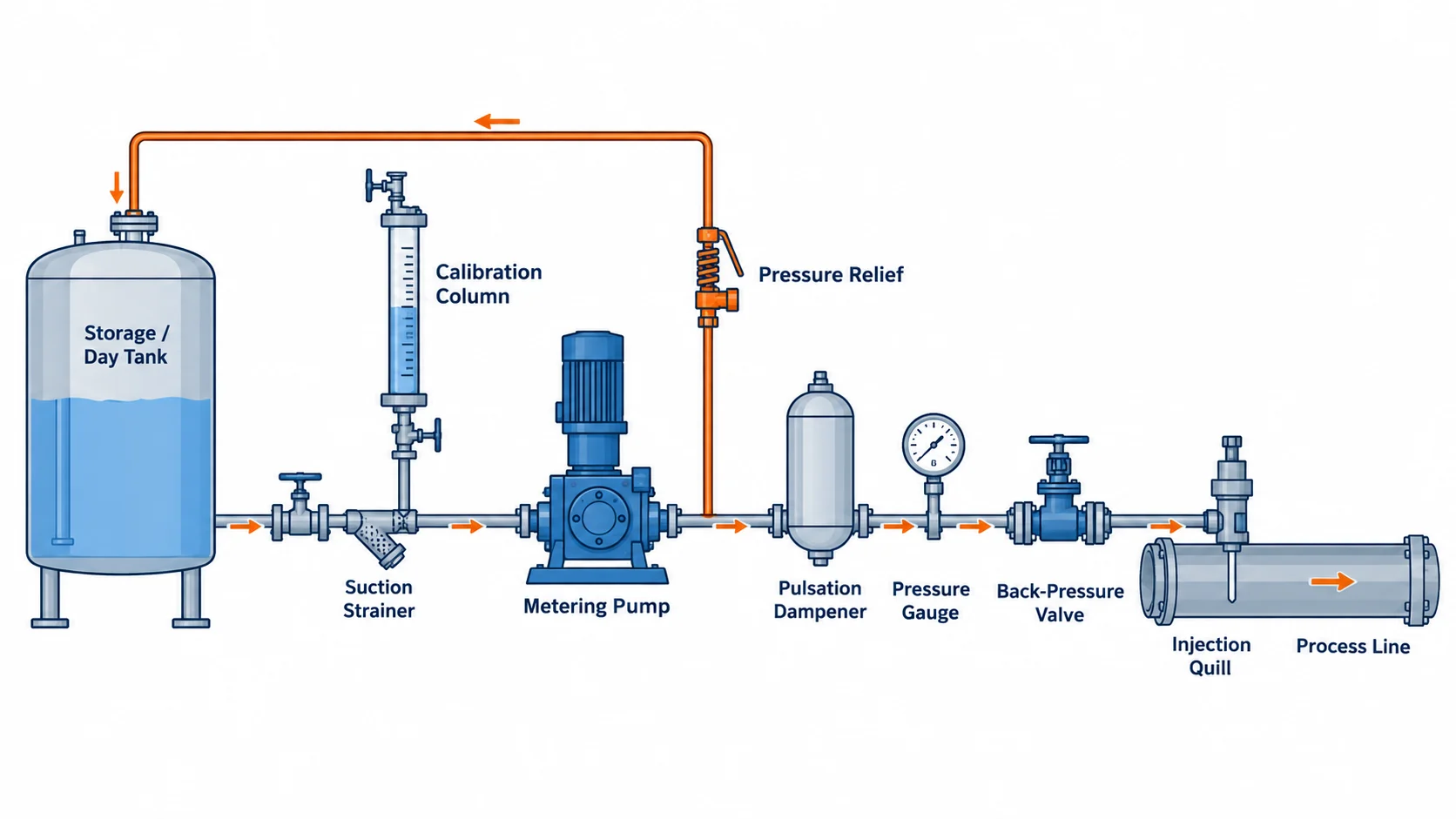
A metering pump is only one part of the injection system. Accuracy, safety and reliability depend on the surrounding suction, discharge, calibration, relief and injection components.
Chemical Injection Skid P&ID
Controlled engineering diagram: final topology, valve location and relief-return path must be checked before production use. The image is not a substitute for the project P&ID.
Which Pump Technology Fits the Injection Duty?
The most useful comparison is not a universal “maximum pressure” table. It is the pumping principle, the process-fluid behavior and whether the project standard applies.
| Technology | Best fit | API 675 scope | Key strength | Main limitation |
|---|---|---|---|---|
| Hydraulic diaphragm metering | Hazardous/corrosive precision injection; elevated pressure | Can be API 675 | Contained liquid end + controlled capacity | Check valves, pulsation and hydraulic-system complexity |
| Packed plunger metering | Clean compatible liquid; high-pressure service | Can be API 675 | Pressure capability and mechanical efficiency | Dynamic packing and leakage management |
| Mechanical diaphragm | General dosing at product-specific pressure | Do not label API 675 by default | Simple containment / no packed plunger | Pressure and accuracy envelope are design-specific |
| Peristaltic | Off-gassing, abrasive or shear-sensitive dosing | Not API 675 | No wetted check valves; hose is primary wetted path | Hose fatigue and pressure capability |
| Gear / progressive cavity | Viscous continuous feed / injection | Rotary PD; not API 675 | Smoother continuous flow | Clearance, solids, abrasion and control behavior are product-specific |
Step-by-Step Chemical Injection Pump Selection
1. Define minimum, normal and maximum injection rate
Do not select only from the normal dose. The pump and control method must cover startup, low-load operation, maximum chemical demand and any future increase. State whether the required flow is fixed, manually adjustable, flow-paced or controlled by a PLC/DCS loop.
2. Define the actual injection pressure
Injection pressure is not only the process-line static pressure. Include pressure loss through the injection quill/check valve, discharge piping, fittings and required backpressure. Confirm the maximum credible process pressure and blocked-line protection philosophy.
3. Define the complete fluid condition
Provide chemical identity, concentration, specific gravity, viscosity at operating temperature, vapor pressure, solids, gas evolution and crystallization tendency. For corrosive service, use the site’s chemical compatibility and resistance guide for preliminary screening, then verify the exact pump-head, valve, diaphragm, seal and piping materials.
For sulfuric-acid service, the separate sulfuric acid pump material selection guide shows why concentration and temperature must remain attached to any material statement.
4. Check inlet conditions using NPIPA / NPIPR—and do not ignore acceleration pressure
NPIPA = net positive inlet pressure available;
psuction,total,abs = total absolute pressure at pump suction;
pvp = liquid vapor pressure at pumping temperature. Use the same absolute-pressure unit for every term.
For a reciprocating metering pump, available static suction pressure is not the whole inlet analysis. Suction-line length, diameter, viscosity, liquid acceleration, stroke frequency and gas release can create dynamic inlet-pressure loss that does not appear in a simple tank-level check.
5. Match control method and turndown requirement
State whether the process requires fixed manual capacity, stroke adjustment, variable speed, 4–20 mA control, flow-paced dosing or closed-loop pH/ORP/concentration control. The required control range may determine the pump/drive configuration even when the maximum duty point looks straightforward.
6. Confirm materials, containment and area classification
Confirm all wetted components, leakage consequence, secondary containment, diaphragm rupture detection where applicable, motor/actuator hazardous-area requirements and the project electrical standard. ATEX, IECEx, NEC/Class/Division or Zone requirements are project-specific and should not be inferred from the chemical name alone.
Precision Injection or Bulk Chemical Transfer?
Flow rate alone does not determine the pump category. A metering pump can operate well beyond an arbitrary low-flow cutoff, while an ANSI process pump can be selected for comparatively low-flow transfer if the hydraulic duty, operating range and system objective make a centrifugal process pump appropriate.
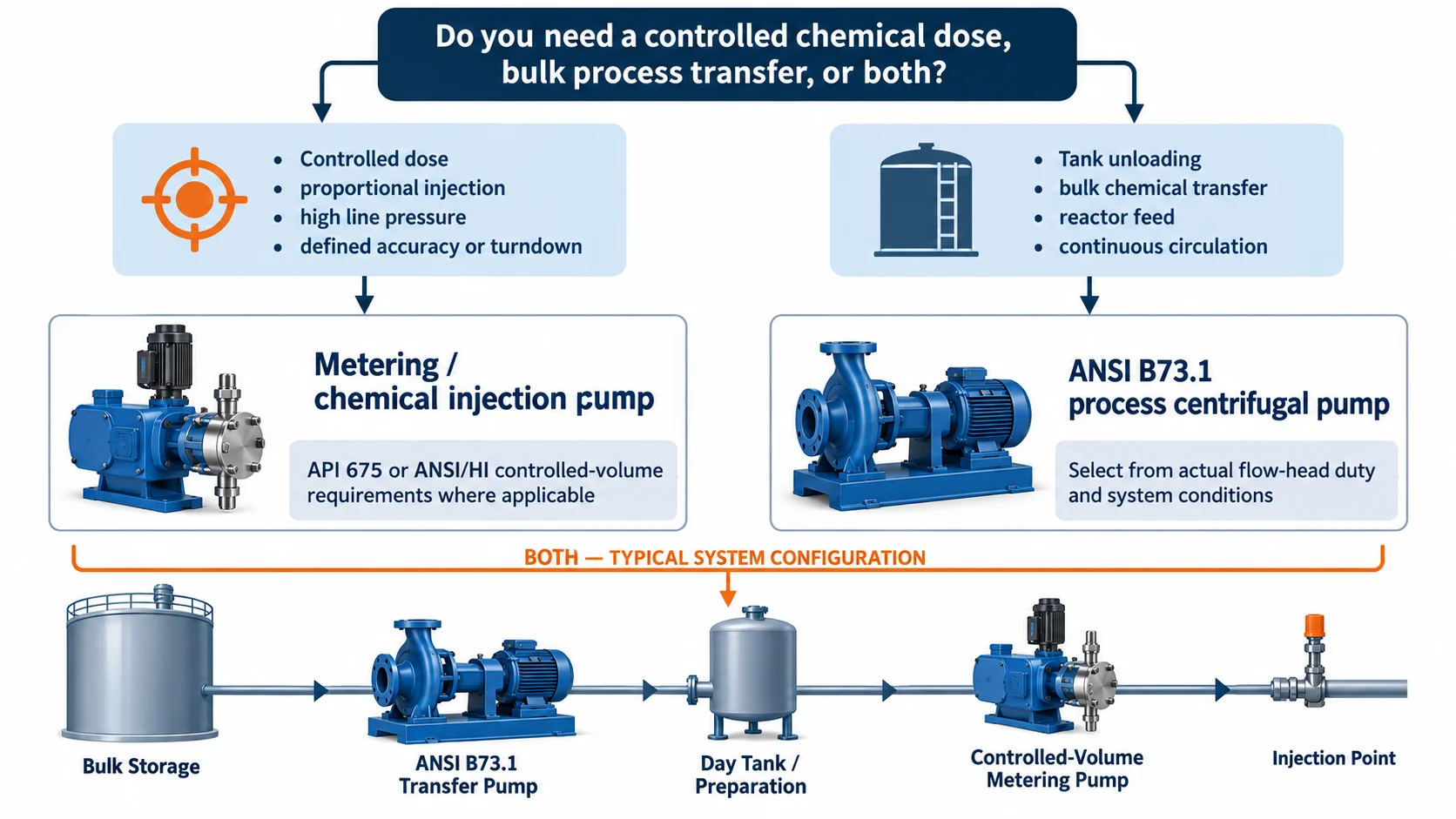
Metering Pump vs ANSI B73.1 Transfer Pump Decision
Decision logic should be based on required dosing control versus bulk process transfer—not on one universal GPM cutoff.
| Engineering question | Metering / injection pump | ANSI B73.1 process pump |
|---|---|---|
| Primary objective | Controlled dose into a process | Transfer, unload or circulate process liquid |
| Flow behavior | Controlled displacement; often reciprocating/pulsating | Rotodynamic flow governed by pump/system curve |
| Accuracy requirement | May be contractual and tied to metering performance | Hydraulic performance and operating range are the primary selection basis |
| Pressure behavior | Selected to inject against required line/back pressure | Selected from required flow/head duty |
| Typical control | Stroke, speed, electronic pacing, process signal | System resistance, throttling, VFD or process control valve |
| Typical duty | Inhibitor, biocide, catalyst, pH reagent, corrosion chemical | Tank unloading, bulk acid/caustic transfer, reactor feed, recirculation |
| Standard context | API 675 / ANSI-HI controlled-volume where applicable | ASME B73.1 horizontal chemical-process centrifugal pump |
One chemical system may use both pump categories
Bulk transfer and precision injection often occur in series rather than competing for the same duty.
Bulk storage
Truck unload / tank inventory
ANSI transfer pump
Move chemical to day tank or preparation system
Day tank / preparation
Buffer, dilution or batch preparation
Metering pump
Controlled chemical dose
Injection point
Process line / reactor / treatment train
If the duty is really low-flow centrifugal transfer rather than precision dosing, review low-flow ANSI process pump selection instead of forcing the service into a metering-pump category.
Common Chemical Injection Failure Modes and First Checks
| Symptom | Likely mechanism | First engineering check |
|---|---|---|
| Loss of prime / erratic dose | Gas binding, vapor formation, off-gassing | Vapor pressure, tank level, suction layout, degassing and fluid chemistry |
| Capacity below calibration | Insufficient inlet pressure, acceleration effects, valve leakage | NPIPA, dynamic suction loss, check-valve condition and viscosity |
| Check valve will not seat | Solids, crystallization, contamination | Fluid condition, filtration strategy and valve material/geometry |
| Excessive pipe vibration | Reciprocating pulsation / resonance | Dampener sizing/location, pipe supports and stroke frequency |
| Uncontrolled flow / siphoning | Insufficient discharge backpressure | Back-pressure / anti-siphon arrangement and elevation difference |
| High discharge pressure | Blocked valve, plugged quill or closed isolation | Relief path, set pressure and discharge-line obstruction |
When the Duty Becomes a Chemical Process Pump Selection
If the requirement is bulk transfer, unloading, continuous process feed or circulation, the next step is to define the centrifugal duty point and installed interfaces rather than trying to size an injection pump from a dosing formula. If the installed model is unknown or the duty is changing, start with the ANSI pump selection worksheet before choosing a replacement family.
For existing ANSI installations, use the ANSI pump interchangeability verification guide to separate external fitment from hydraulic, material and internal mechanical compatibility.
For model-specific replacement review, see the Goulds 3196 replacement and Durco Mark III replacement engineering routes. Broader technical references remain available in the ANSI pump technical resources hub.
What to Send for an Injection or Chemical-Transfer Review
Chemical Injection Pump FAQ
Is every chemical injection pump an API 675 pump?
No. “Chemical injection” describes the application. API 675 applies to a specific scope of controlled-volume reciprocating pumps and should not be used as a blanket label for every diaphragm, peristaltic, gear or progressive-cavity dosing pump.
What is the difference between a metering pump and an ANSI B73.1 process pump?
A metering pump is selected to deliver a controlled dose, often against significant process pressure and over a defined adjustment range. An ANSI B73.1 centrifugal process pump is selected primarily from a required flow/head duty for transfer, circulation, unloading or process feed.
Does a higher flow rate automatically mean I should use an ANSI pump?
No. There is no universal GPM category boundary. Controlled-volume metering pumps can extend into flow ranges that overlap with some process-transfer duties, while ANSI process pumps can also serve comparatively low-flow transfer applications. The correct category depends on the process objective, control requirement, pressure and hydraulic operating range.
Why are NPIPA and acceleration pressure important for a metering pump?
A reciprocating metering pump creates cyclic liquid acceleration in the suction piping. Even when the static suction pressure looks acceptable, long or undersized suction piping, high viscosity, high stroke frequency or gas release can reduce the pressure available at the pump during the suction stroke.
Why is a back-pressure valve used on many injection skids?
It can maintain the positive discharge pressure needed for stable metering behavior and help prevent uncontrolled flow or siphoning when the process line does not provide sufficient backpressure. Final sizing and placement depend on the actual system.
Technical Sources
- American Petroleum Institute — API Standard 675 publication basis (3rd Edition, November 2012; reaffirmed July 2021).
- Hydraulic Institute — ANSI/HI 7.1–7.5:2023, Controlled-Volume Metering Pumps for Nomenclature, Definitions, Application and Operation.
- Hydraulic Institute — ANSI/HI 7.8, Controlled-Volume Metering Pump Piping Guideline, for inlet/discharge piping, NPIP and acceleration-pressure effects.
- Milton Roy — published API 675 accuracy, linearity, repeatability, turndown and rated-capacity guidance.
- ProMinent — metering-system accessory guidance for back-pressure/relief valves and pulsation control.
- ASME — B73.1-2026 specification for horizontal end-suction centrifugal pumps for chemical process.
- LEWA — current metering-pump operating data demonstrating why one universal flow-rate category cutoff is not valid.