What Is Water Hammer in a Pumping System?
Water hammer is a pressure transient caused by a rapid change in liquid velocity. In a pump system, it can follow a fast valve movement, a pump start or trip, or a discharge check valve closing after flow has begun to reverse. The pressure response depends on the liquid, the pipe, the event, and the system boundaries; it cannot be predicted from pump type alone.
For ANSI process-pump users, the useful first step is to identify what changed and when. A noise or vibration report can help locate an event, but it does not by itself establish the pressure peak or prove that the pump is the source.
How Can a Pressure Transient Be Screened?
For a rapid change in flow velocity, the Joukowsky relationship gives a first-pass estimate of the pressure change in an idealized liquid-filled pipe:
Δp is the estimated pressure change; ρ is liquid density; a is pressure-wave speed in the liquid-and-pipe system; and Δv is the change in average liquid velocity in the pipe segment being assessed.
For a simple pipe run, the pressure-wave round-trip time can be represented as T = 2L/a, where L is the distance to the relevant reflection boundary and a is pressure-wave speed. Comparing this time with the effective flow-change duration can help screen whether an event is rapid in that idealized run. Actual valve flow characteristics and the wider network affect the result.
Do not treat a screening estimate as an allowable pressure
Compare assessed transient pressures with the documented limits for the actual pump, piping, valves, joints, and instruments at the applicable operating temperature. A hydrostatic test pressure is not an operating-pressure allowance.
What Causes Hydraulic Surge in ANSI Pump Systems?
Several events can produce a transient. The event sequence and the system response should be established before choosing a mitigation device.
| Observed or reported event | What to establish | What the observation does not prove |
|---|---|---|
| Pump trip or loss of power | Trip timing, pump coast-down, flow reversal, static head, and pressure history. | That a VFD ramp or a particular check-valve type will prevent the transient. |
| Discharge check-valve impact | Valve design and orientation, operating flow, closing behavior, and reverse velocity at closure. | That every swing check valve is unsuitable or every “non-slam” valve is suitable. |
| Fast control or isolation valve movement | Actual valve movement and flow response, actuator sequence, and distance to relevant boundaries. | That the actuator’s nominal stroke time alone describes the hydraulic closure. |
| Pressure oscillation, pipe movement, or noise | Time-synchronized pressure, pump status, valve status, and field observations. | The transient’s peak pressure, location, or equipment damage mechanism. |
| Possible column separation or air pocket | Pipe profile, high points, pressure history, air-management devices, and restart sequence. | That adding an air/vacuum valve without system analysis is safe or sufficient. |
How Can a Transient Affect an ANSI Process Pump?
A pressure transient can load the connected piping, supports, valves, pump nozzles, and casing. Depending on the event and equipment limits, the system may also experience flow reversal, vibration, or changes in rotor operation. The specific consequences must be determined from the system evidence and the pump’s documented configuration.
Do not infer a failed mechanical seal, shaft, bearing, or coupling from a water-hammer report alone. If a component has failed, document the failure pattern and operating conditions, then assess whether the transient is a supported cause alongside alignment, lubrication, cavitation, material, installation, and process-condition factors.
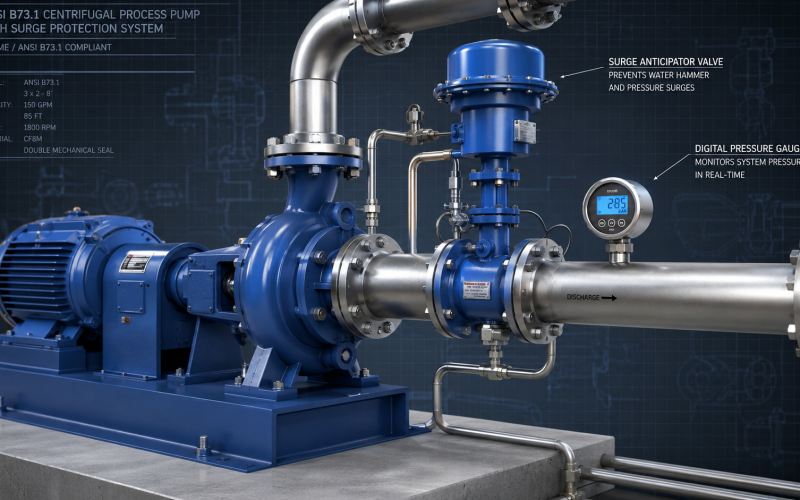
ASME B73.1 is a pump design and specification standard covering defined horizontal end-suction chemical-process pumps and dimensional interchangeability. It is useful for identifying the pump category and interfaces; it does not, by itself, determine a system’s transient pressure or prove that a replacement component will withstand a surge.
The site’s Technical Resources hub can help locate pump curves and related reference material. Those resources do not replace a system-specific transient assessment.
What Data Is Needed to Assess Surge Risk?
Collect the system information below before selecting a control measure. Record units, operating state, and the source of each value; distinguish measured data from estimates.
| Information to collect | Useful details |
|---|---|
| Pump and driver | Model, size, speed, impeller configuration, operating flow/head, driver/control method, and available pump or motor inertia data. |
| Transient event | What initiated it, event sequence, pump trip or start behavior, valve commands and feedback, and whether flow reversal was observed. |
| Liquid | Fluid composition, concentration where relevant, temperature, density or other verified properties, and any gas or solids content that affects the system. |
| Pipe system | Route and profile, lengths, inside diameters, material, wall thickness, restraints, branches, tanks, and relevant pressure boundaries. |
| Valves and protection | Valve type, size, orientation, closing/control behavior, manufacturer dynamic data, relief or surge devices, and their set points or configuration. |
| Observed response | Pressure trends with sensor location and recording rate, pump and valve status records, alarms, vibration observations, and inspection findings. |
The pump calculators can help organize selected pump-duty or pipe-loss inputs. They do not calculate a complete hydraulic transient.
Which Mitigation Measures Should Be Evaluated?
Mitigation should address the event shown by the data. Depending on the system, an engineer may evaluate controlled pump starting or stopping, valve sequence or closure behavior, check-valve dynamics, surge vessels, relief devices, air-management measures, or changes to system inertia. These are options for analysis, not universal prescriptions.
A check valve should be assessed using its dynamic behavior in the actual installation, including flow deceleration and reverse velocity at closure. Spring-assisted or nozzle-style designs can suit some services; other applications may require a different closing strategy or device. Media, solids, orientation, head loss, pump reversal, and system response all matter.
Likewise, a VFD or a slower valve command may reduce some transients but cannot be assumed to protect a system during every trip or power-loss case. Surge tanks, air/vacuum valves, relief devices, and added rotational inertia also require sizing and review against the complete operating and failure scenarios.
Choose controls from the transient analysis
Compare candidate measures against the event sequence, documented equipment limits, and expected operating cases. Avoid choosing a device solely by a generic label such as “non-slam,” or by a fixed pipe-length or closure-time rule.
When Is a Transient Analysis Needed?
Use a system-level transient analysis when a pump trip or restart produces significant reverse flow, when the line may experience sub-atmospheric pressure or column separation, when several pumps or branches interact, when check-valve response controls the event, or when the consequences of exceeding a component limit are serious. The analysis method and boundary conditions should match the system and event; a single Joukowsky calculation is not enough for every case.
Keep measured data, assumed inputs, model results, and uncertainty separate. If the available records cannot establish the event or pressure response, identify the missing measurements rather than reporting a precise but unsupported peak.
Related engineering references: pump performance troubleshooting steps; suction-system and NPSH checks; confirm the operating point on the pump curve; assemble the system head terms.
Frequently Asked Questions
Can the Joukowsky equation predict the maximum pressure in my system?
Not by itself. It is a first-pass relationship for a rapid velocity change under simplifying assumptions. Complex networks, pump trips, check-valve dynamics, reflections, and column separation can require a full transient analysis.
Does ASME B73.1 set the allowable water-hammer pressure for a pump?
ASME B73.1 defines pump design and specification requirements within its scope. The allowable pressure for an installed pump and connected system must be verified from the actual equipment and piping documentation at the applicable conditions.
Will a VFD eliminate water hammer after a power failure?
Do not assume so. A VFD can shape commanded speed changes, but a power-loss or trip event has its own pump and liquid-column response. Assess that event separately.
Is a spring-assisted or nozzle check valve always the best choice?
No. Valve response must match the system’s deceleration, reverse-flow behavior, liquid, solids, orientation, and operating cases. Compare candidate valves using relevant dynamic data or transient analysis.
What should I provide for an engineering review?
Provide the pump and driver details, operating duty, liquid and temperature, pipe route and dimensions, valve information, event sequence, available pressure records, and inspection findings. Identify which values are measured and which are estimated.
Sources
- ASME, B73.1 — Specification for Horizontal End Suction Centrifugal Pumps for Chemical Process.
- Waterhammer.com, Joukowsky Equation — equation scope and limitations.
- Waterhammer.com, Worst Case Scenario — pipeline communication time and transient screening.
- Grundfos, Water Utility Water Distribution Manual — pump stoppage, check-valve slam, and system factors.
- KSB, Transient Flow Analysis Helps Avoid Risks of Surge Pressure.
- Applied Flow Technology, Surge Transients Due to Check Valve Closure in a Municipal Water Pumping Station.