
Executive Summary: Lithium battery recycling plants present some of the most aggressive pump services in modern chemical processing: hot H₂SO₄ at 200°F + abrasive metal oxides. CD4MCuN and Alloy 20 are the proven materials. 316SS will fail.
Where ANSI Pumps Fit in Lithium Battery Recycling
Hydrometallurgical battery recycling turns black mass into recoverable metal-bearing solutions through leaching, separation and recovery. Pump selection starts with the duty at each transfer point: liquid chemistry, temperature, solids, flow, head and suction conditions.
This guide follows the wet-process duties associated with black mass preparation, acid leaching, solvent extraction and wastewater treatment. It covers material choices, mechanical seals and the operating data needed to specify an ANSI process pump.
Demanding applications: hot sulfuric acid at 150–200°F, abrasive metal particulates (Co, Ni, Mn, Li oxides), organic solvents, aggressive leaching solutions at low pH. Standard 316SS fails quickly here.
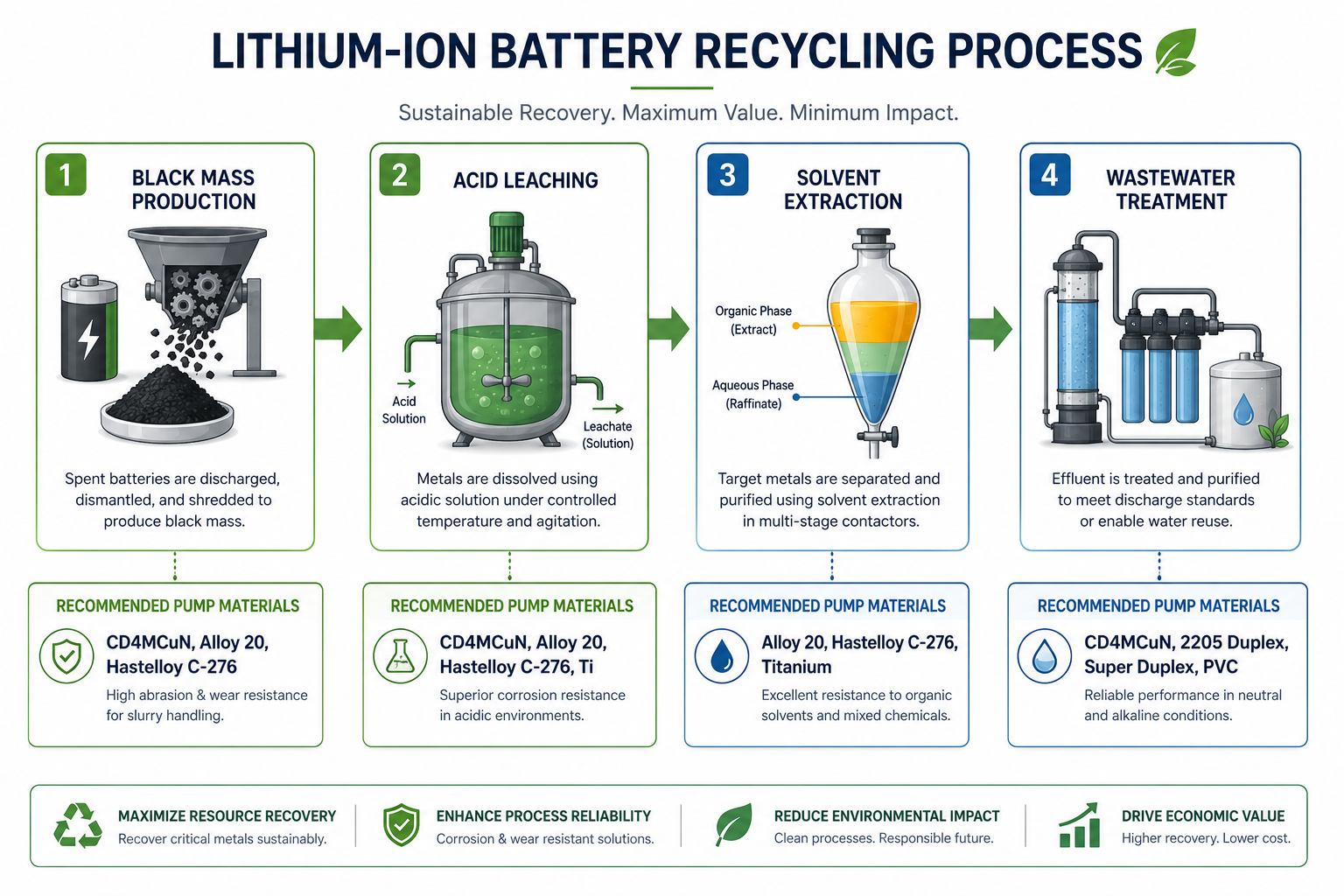
4 Process Stages — 4 Material Solutions
Separate slurry transfer, clarified-liquid transfer and chemical dosing when building the pump list. These services can have different hydraulic and sealing requirements even within the same process stage.
Stage 1: Black Mass Production — Shredding & Separation
Battery shredding and separation produce “black mass” powder containing active materials, graphite and residual metals. Composition depends on battery chemistry and upstream separation. Liquid pumping begins where the process uses wet separation or mixes the powder into a slurry.
- Pump challenge: Abrasive slurry — metal oxides erode impellers and casings. Fine particulates penetrate seal faces.
- Material: CD4MCuN (255-290 BHN). Resists abrasion 2-3× better than 316SS.
Stage 2: Acid Leaching — The Toughest Service
Black mass + 2-4M H₂SO₄ at 150–200°F + H₂O₂ as reducing agent. Dissolves metal oxides.
- Pump challenge: Hot sulfuric acid + dissolved metals + residual abrasive solids. This is the most aggressive service in the plant.
- Material: Alloy 20 (CN7M) — specifically developed for H₂SO₄ service. For most aggressive conditions: Hastelloy C-276.
Stage 3: Solvent Extraction & Metal Recovery
Metals selectively extracted, precipitated as high-purity salts.
- Pump challenge: Organic solvents attack standard elastomers. High purity demands.
- Material: Alloy 20 or 316SS + PTFE/FKM elastomers. Double mechanical seals with barrier fluid.
Stage 4: Wastewater & Acid Recovery
Neutralization produces metal-bearing precipitates, while acid recovery and concentration create separate liquid or brine duties. Record pH variation, settling behavior and crystallization risk for each stream.
- Material: CD4MCuN (neutralization slurry — abrasion + Cl). Titanium or CD4MCuN (brine concentration).
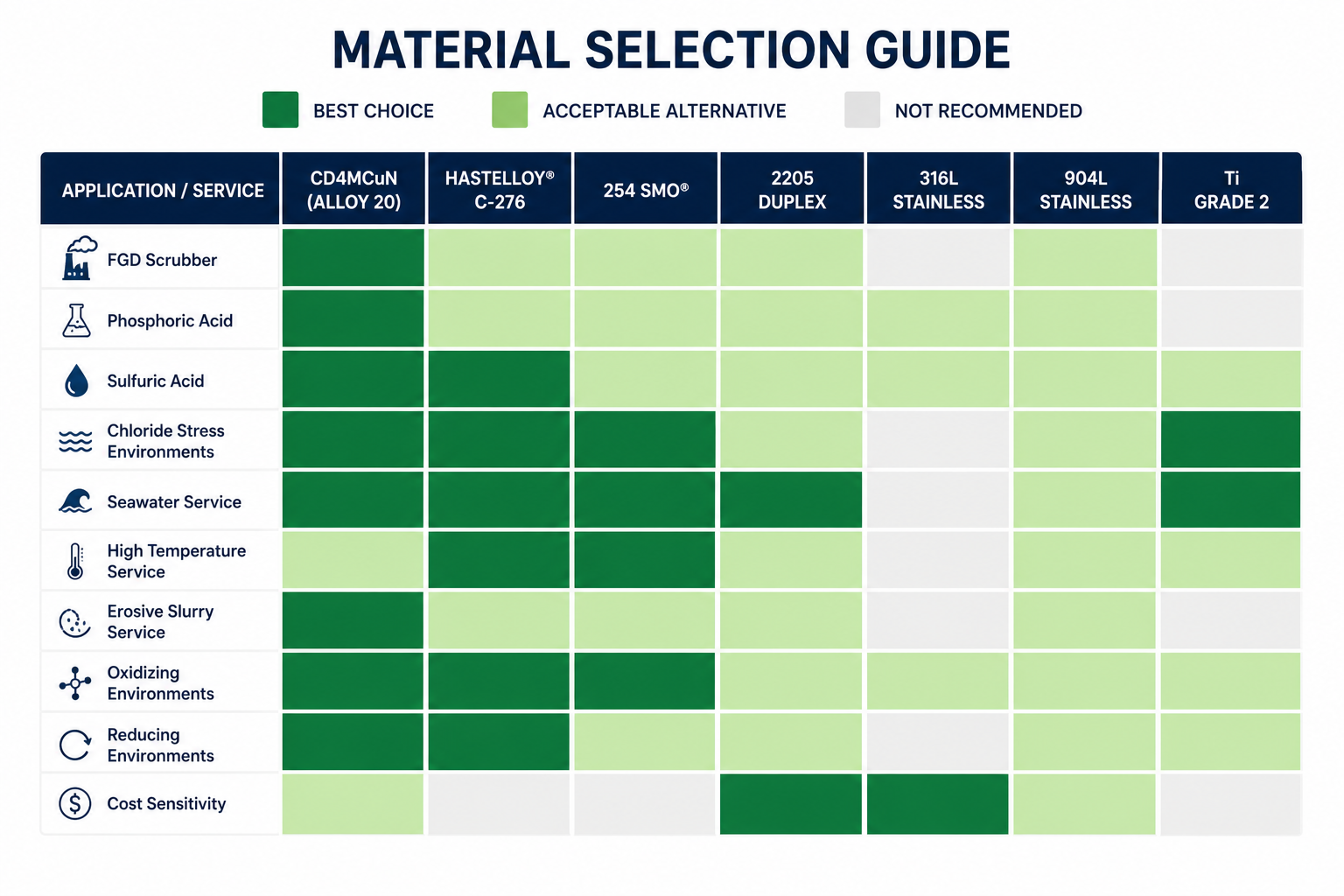
Complete Material Selection Matrix
Use the process areas below to organize the material review. Include actual acid concentration, temperature, contaminants and solids data with the pump specification. Temperature ranges are shown in °F; 150–200°F corresponds to approximately 66–93°C.
| Process Area | Fluid | Temp | Recommended | Alternative |
|---|---|---|---|---|
| Black mass slurry | Abrasive, pH 2-7 | Amb-150°F | CD4MCuN | 316SS w/ hardened rings |
| Sulfuric acid leaching | 2-4M H₂SO₄ + metals | 150-200°F | Alloy 20 | Hastelloy C-276 |
| HCl leaching (alt) | HCl + metal chlorides | 150-180°F | Hastelloy C-276 | — |
| Solvent extraction (aq) | Acidic metal sulfate | 100-140°F | Alloy 20 / 316SS | — |
| Solvent extraction (org) | Kerosene extractant | 100-140°F | 316SS + PTFE/FKM | — |
| Neutralization slurry | Lime + precipitated metals | 100-160°F | CD4MCuN | 316SS |
| Brine concentration | Concentrated salts | 180-220°F | Titanium / CD4MCuN | Super Duplex 2507 |
Match the Pump Type to the Duty
ANSI end-suction centrifugal pumps can serve liquid transfer and selected slurry circulation duties when the fluid properties and operating point fit the pump design. Compare the available hydraulic range, solids passage, impeller construction and seal arrangement with the complete process duty.
- Transfer and circulation: check normal, minimum and maximum flow against the pump curve, efficiency, power and operating region.
- Viscous or high-solids slurry: review rheology and settling behavior, and compare a purpose-designed slurry pump or positive displacement pump where appropriate.
- Filter-press feed: evaluate the changing pressure and flow across the full filtration cycle.
- Chemical addition: define dosing accuracy and turndown separately from bulk transfer capacity.
Review the available pump families and compare them against the duty sheet. ASME B73.1 addresses pump design and dimensional interchangeability; chemical compatibility and slurry performance require their own review.
Critical Design Considerations
Mechanical Seal Selection
- SiC/SiC faces — evaluate the specific face grade, process chemistry, lubrication and solids exposure with the seal supplier.
- API 682 Plan 32 — external clean flush to keep solids off seal faces. Define a compatible flush fluid, pressure above the seal chamber, required flow and a reliable supply during start-up, operation and shutdown. Confirm that the process accepts the resulting dilution or contamination.
- Double cartridge seals — review containment requirements for solvent extraction services, including the buffer or barrier system, pressure control and monitoring.
- Hard-faced wear rings — CD4MCuN + Stellite coating for extended life
Temperature Management
Leaching is exothermic. Rate the pump for maximum possible temperature, including credible process excursions and cleaning conditions. Check casing pressure limits, seal materials, elastomers and available suction margin at that temperature. Confirm bearing-housing cooling and lubricant limits with the pump manufacturer.
Solids Handling
Record particle-size distribution, maximum particle size, solids concentration by weight or volume, and settling behavior. For semi-open impellers, review passage size, running clearance and the maintenance adjustment procedure. Verify the operating point and allowable operating region using the pump supplier’s data and ANSI/HI 9.6.3.
Check NPSH available at the lowest vessel level and highest liquid temperature. Include suction-line losses, vapor pressure, entrained gas and the margin required by the application. Material selection should be accompanied by a review of the suction system.
Review seal interfaces and repair handover information before confirming the pump and seal package.
Material Certification for Battery Recycling Projects
Define the inspection package with the purchase specification: MTRs with heat-number traceability, PMI verification, dimensional reports, hydrostatic test certificates and surface-finish records as applicable to the component and order. Match the material grade, part identification, test scope and acceptance criteria to the supplied pump or replacement part.
Operating Data for a Battery Recycling Pump Specification
Prepare one duty sheet for each service. The following data allow the hydraulic selection, wet-end materials and seal support system to be reviewed together.
- Process: stage, battery chemistry or feed composition, continuous or batch operation, and duty or standby arrangement.
- Liquid: full chemical composition, acid concentration and reporting basis, pH, chlorides, fluorides and other impurities where present.
- Physical properties: normal and maximum temperature, density, viscosity or rheology, vapor pressure and entrained gas.
- Solids: concentration and its basis, particle-size distribution, maximum size, abrasiveness and settling behavior.
- Hydraulics: minimum, normal and maximum flow; differential head; suction and discharge pressure; vessel levels and NPSH available.
- Installation: electrical supply, speed control, hazardous-area classification where applicable, available utilities and space restrictions.
- Replacement duty: existing model, size, nameplate, material records, drawings and failure history.
- Inspection: required material certification, dimensional checks, pressure or performance testing and document requirements.
Use this information to compare pump configurations on the same basis and identify missing data before requesting a quotation.