
PUMP RELIABILITY GUIDE
Low-Cost Pump Condition Monitoring: A Practical Reliability Plan
A practical baseline-and-trend program for monitoring ANSI process pumps without starting with an expensive permanent sensor system.
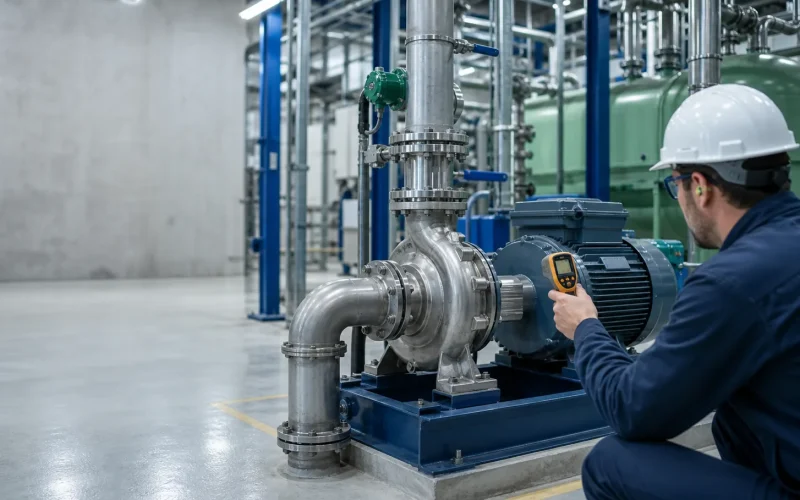
Record temperature, vibration, pressure, flow and visual condition under known duty.
Use repeatable measurement points and context instead of isolated readings.
Move from screening to diagnosis or replacement review when the evidence supports it.
Small and mid-sized plants do not need a large wireless monitoring platform to improve pump reliability. A disciplined program built around baseline readings, trend records and clear escalation rules can identify developing problems before they become unplanned shutdowns.
This guide explains a practical low-cost condition monitoring program for ANSI B73.1 process pumps, including temperature, vibration, pressure, leakage, lubrication, flow and operator observations. The objective is not to replace engineering diagnosis. It is to detect change early and decide when a deeper inspection or replacement review is justified.

Start With a Baseline, Not a Generic Alarm Limit
A single reading rarely proves that a pump is healthy or failing. First record the pump under known operating conditions: flow, discharge pressure, suction pressure, speed, liquid temperature, bearing temperature, vibration location and lubrication condition.
Repeat the readings at a consistent time and location. Note whether the pump is starting, warming up, operating at minimum flow or running near its normal duty point. This context is essential because a temperature or vibration value can change with load, alignment, ambient conditions and process state.
| Baseline item | Record | Why it matters |
|---|---|---|
| Operating condition | Flow, pressure, speed and liquid temperature | Separates equipment change from process change. |
| Temperature | Bearing housing, casing and seal area | Helps identify lubrication, loading, friction or leakage changes. |
| Vibration | Measurement point, direction, unit and instrument | Creates a repeatable trend for later comparison. |
| Visual condition | Leaks, corrosion, coupling guard and foundation | Captures evidence that sensors may miss. |
Need help reviewing pump reliability data?
Send your pump model, operating readings and photographs. We can help separate a likely wet-end, bearing, seal, alignment or application issue from a simple process change.
Temperature Monitoring
An infrared thermometer can support routine checks of bearing housings, seal chambers, motor surfaces and nearby process piping. Infrared readings are useful for trending, but they are affected by emissivity, surface finish, reflection, distance and measurement angle.
- Mark the measurement points so each reading is taken at the same location.
- Record the pump load and liquid temperature with every reading.
- Compare the same pump with its own baseline and, where appropriate, a similar pump in the same service.
- Investigate a sustained upward trend instead of reacting to one isolated value.
- Use contact measurement or a qualified instrument when surface emissivity makes infrared readings unreliable.
A rising bearing temperature may relate to lubrication, alignment, loading, cooling, bearing condition or instrumentation. It is an inspection signal, not a diagnosis by itself.
Vibration Monitoring
A handheld vibration meter can provide a low-cost screening layer for pumps that are important but do not justify permanent sensors. Measure at repeatable bearing-housing points and record the direction, unit, speed and operating condition.

An overall vibration value can show that the machine has changed, but it may not identify whether the cause is imbalance, misalignment, looseness, bearing damage, cavitation, resonance or a hydraulic problem. When a trend changes materially, confirm the reading and escalate to a more detailed measurement or inspection.
Do not copy a vibration limit from another pump. Use the current applicable Hydraulic Institute guidance, the equipment manufacturer’s limits and the actual pump installation.
Pressure, Flow and Power Trends
Existing suction and discharge gauges can provide useful condition information when the readings are recorded with flow and speed. A change in differential pressure may be caused by impeller wear, increased internal clearances, a blocked suction path, a changed system valve position, a different liquid or an instrument problem.
Where practical, trend:
- Suction and discharge pressure
- Flow rate or a reliable process proxy
- Motor current or input power
- Pump speed and VFD frequency
- Liquid temperature and density or viscosity when relevant
These trends should be interpreted together. A pressure change without a flow change means something different from a pressure and flow change accompanied by higher motor current.
Leakage and Mechanical Seal Checks
Seal leakage is an early warning for the process, the environment and the pump. Record visible leakage, spray pattern, seal-pot condition where used, flush or barrier pressure, and any change in seal temperature.
- Never treat a hazardous or corrosive leak as a normal condition.
- Check that flush, quench or barrier systems are operating as specified.
- Inspect the shaft sleeve, seal chamber and nearby piping for corrosion or deposits.
- Look for evidence of dry running, cavitation, vibration or misalignment that could shorten seal life.
Replacing a mechanical seal without correcting the underlying operating or alignment problem often repeats the failure.
Lubrication and Oil Condition
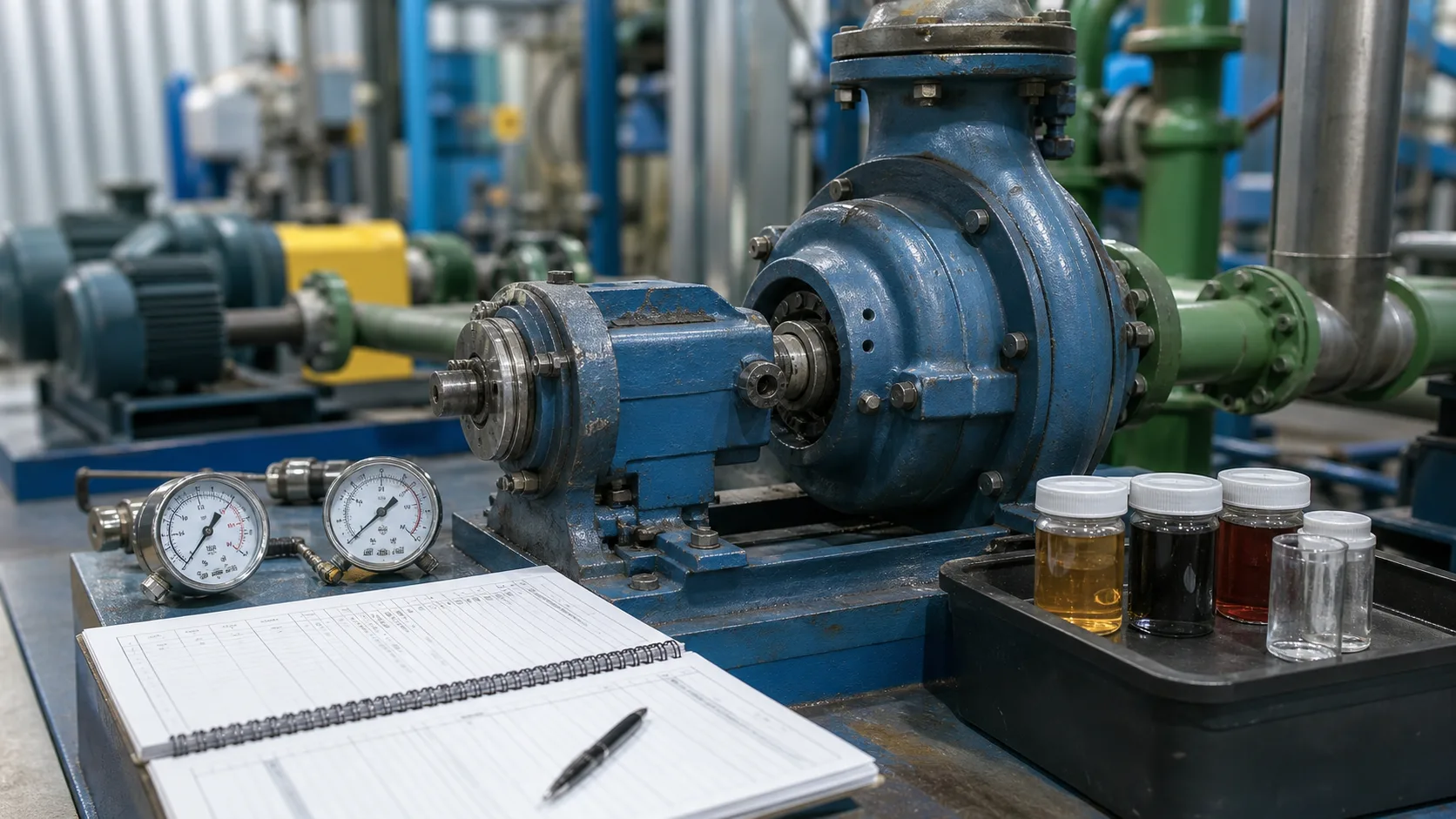
For oil-lubricated bearing frames, record lubricant type, level, color, contamination, change date and any signs of water ingress. Oil analysis can be useful when the pump’s criticality and failure cost justify laboratory testing.
Do not use a universal oil-change interval. Follow the bearing-frame manufacturer, lubricant supplier and site reliability procedure. Incorrect oil, overfilling, incompatible grease or water contamination can create a failure even when the pump appears hydraulically healthy.
Operator Observations Are Condition Data
Operators often notice changes before a scheduled inspection: a new rattling sound, a different valve position, a warmer bearing housing, unusual seal leakage, pulsation or a changed startup time. Convert these observations into structured records instead of relying on memory.
A useful shift log includes:
- What changed and when
- Pump operating state at the time
- Sound, smell, leakage or vibration description
- Any valve, speed, liquid or temperature change
- Immediate action taken
- Whether the condition repeated on the next shift
Use an Escalation Decision Tree
| Observation | First response | Escalate when |
|---|---|---|
| Temperature trend rises | Confirm measurement point, load and lubrication | Trend continues or is accompanied by noise, vibration or leakage. |
| Vibration changes | Repeat the reading and verify instrument and mounting point | Change repeats, grows or appears with process instability. |
| Pressure or flow changes | Check valves, suction conditions, speed and instruments | Hydraulic performance remains below the required duty. |
| Seal leakage increases | Check flush, barrier, alignment and process conditions | Leak is hazardous, uncontrolled or linked to damaged components. |
| Oil condition changes | Check level, lubricant, contamination and bearing temperature | Wear metals, water or repeated contamination are confirmed. |
The purpose of an escalation rule is to move from observation to diagnosis at the right time. It should not encourage an operator to continue running unsafe equipment.
When Monitoring Points to a Replacement Review
Condition monitoring does not automatically mean that the complete pump must be replaced. The data may point to lubrication, alignment, piping, controls, a seal, bearing, impeller, casing or wear-ring issue.
A replacement or parts review becomes useful when:
- The wet end no longer meets the required flow and head.
- Corrosion, erosion or wear has reduced clearances or casing integrity.
- Replacement components are difficult to source or cannot be traced.
- The existing pump repeatedly fails under the same operating conditions.
- A Goulds 3196 or Durco Mark III pump needs a documented dimensional and hydraulic compatibility review.
For an ANSI replacement, compare casing and nozzle dimensions, shaft and bearing frame, impeller diameter, seal chamber, materials, motor power, speed and the actual duty point. Dimensional interchangeability does not automatically prove hydraulic or operating compatibility.
See our guides on Goulds 3196 and Durco Mark III impeller adjustment, chemical pump corrosion failures, and ANSI process pumps in water treatment.
A Practical Low-Cost Monitoring Plan
- List pumps by safety, production and replacement criticality.
- Choose repeatable temperature, vibration, pressure and visual measurement points.
- Record a baseline under a known operating condition.
- Set a consistent inspection frequency based on criticality and failure history.
- Trend the data and investigate changes rather than isolated readings.
- Define who can stop the pump and who performs the technical diagnosis.
- Keep a parts and replacement plan for critical Goulds 3196, Durco Mark III and ANSI pump positions.
Frequently Asked Questions
What is the lowest-cost way to start pump condition monitoring?
Start with a repeatable log of operating condition, temperature, visual leakage, pressure and operator observations. Add handheld vibration measurements where the pump’s criticality justifies the instrument.
Can an infrared thermometer diagnose a pump failure?
No. It can identify a temperature change that deserves investigation. Confirm the measurement and consider lubrication, alignment, loading, bearing, seal and process causes before deciding on a repair.
How often should ANSI process pumps be monitored?
There is no universal interval. Set the frequency from pump criticality, operating severity, failure history, safety exposure and the stability of the baseline. Critical or unstable equipment needs more frequent review.
When should monitoring lead to an ANSI pump replacement review?
Consider a review when the pump repeatedly misses duty, components are worn or corroded, failures recur, or an obsolete pump position needs a documented Goulds 3196 or Durco Mark III replacement assessment.
Technical Sources
PUMP RELIABILITY SUPPORT
Need help interpreting pump condition data?
Send your readings, pump model and operating conditions for a practical reliability review.