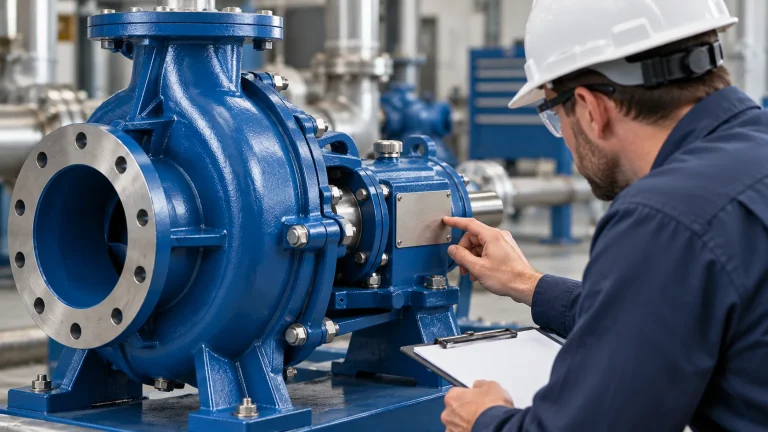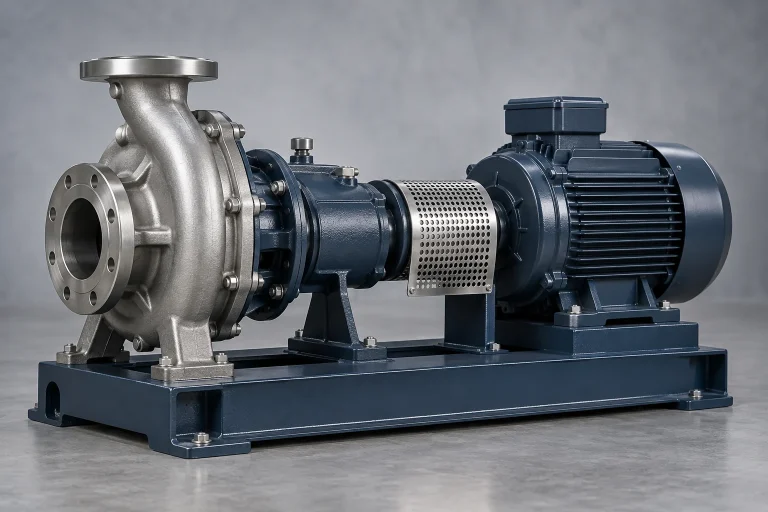
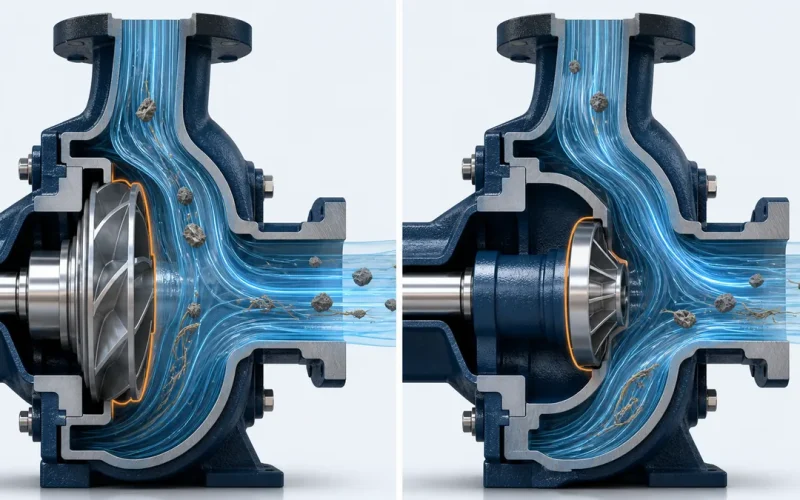
This guide is for maintenance engineers, plant buyers and repair teams comparing a conventional horizontal process pump with a recessed-impeller alternative.
What is a recessed impeller pump?
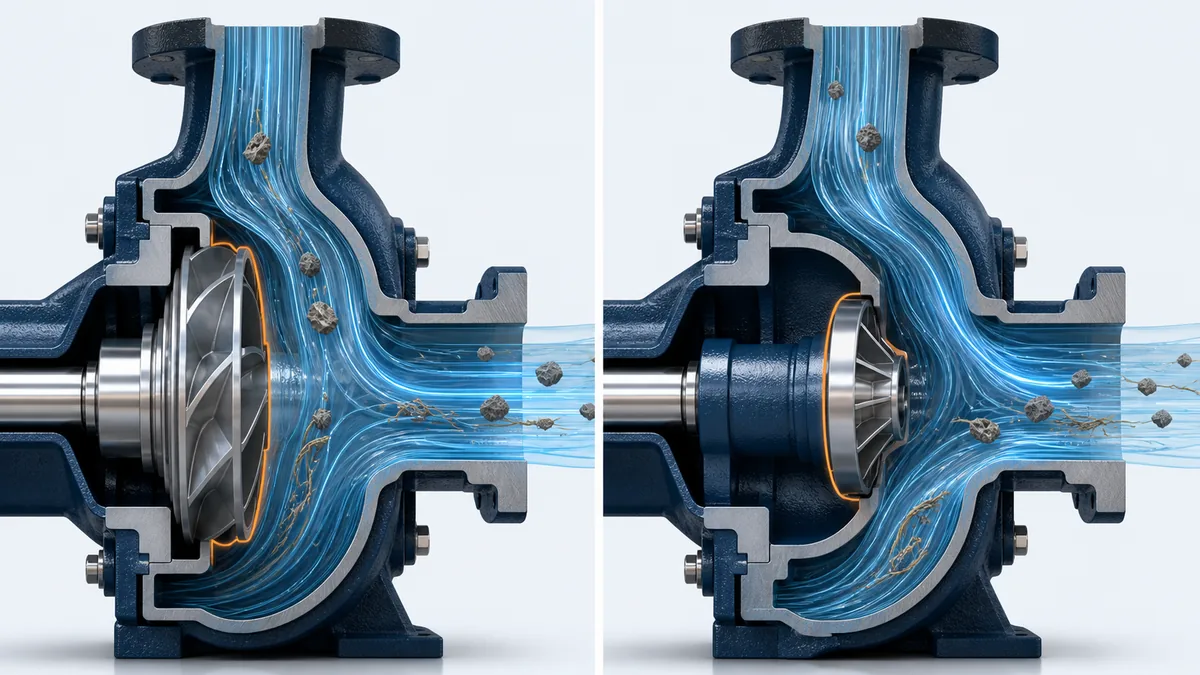
A recessed impeller pump places the impeller back from the main through-flow passage so liquid and entrained solids can move through the casing with less direct impeller contact. The rotating impeller induces a vortex that carries difficult material through the hydraulic end. This is often called a vortex pump arrangement. It can help with fibres or solids, but selection still depends on the pump curve and duty.
What the official design literature says
The Goulds CV3196 brochure describes a recessed open impeller working with a concentric vortex casing. The stated purpose is non-clog solids handling with reduced contact between the impeller and the pumped material. The literature lists services such as screen rejects, fibrous wastewater, long-fibre white water, filter slurry and liquids containing entrained air or gas.
The Goulds Pump Selection Guide classifies the standard 3196 as an ANSI chemical process pump and the CV3196 as a non-clog process pump. That is the central difference: they may share elements of a power-end platform, but they are intended to solve different hydraulic problems.
| Selection question | Conventional 3196-type duty | CV3196-type duty |
|---|---|---|
| Liquid condition | Clean or moderately contaminated process liquid | Bulky, fibrous or shear-sensitive material; entrained gas may also be present |
| Impeller relationship to flow path | Impeller operates directly in the principal casing flow path | Recessed impeller drives a vortex while remaining outside much of the through-flow path |
| Main decision driver | Efficiency and duty-point fit for the process liquid | Passage of difficult material with less direct solids contact |
| Main replacement risk | Wrong curve, material, seal or dimensional configuration | Assuming non-clog performance without checking solids, suction and operating point |
Use the installed model and duty as the starting point. Select a CV3196-type hydraulic end only when the process problem justifies a recessed-impeller design.
Start with the liquid, not the model name
Record more than “slurry” or “wastewater.” An engineering review needs:
- Required flow, head, speed and available suction conditions
- Fluid name, specific gravity and viscosity
- Solids concentration, maximum particle size and particle shape
- Fibre length and whether fibres mat, wrap or bridge
- Expected air or gas volume and whether it changes during operation
- Temperature, corrosion risk and abrasive wear history
- Existing model, size, frame, casing, impeller and seal arrangement
These inputs answer five separate questions: dimensional fit, mechanical fit, hydraulic suitability, material suitability and operating limits. Passing one check does not prove the other four.
When a Recessed Impeller Pump Is Worth Reviewing
A CV3196-type hydraulic end is worth an engineering review when an otherwise suitable process pump repeatedly plugs with stringy material, damages a shear-sensitive product, or loses stable operation as gas enters the liquid. It may also be considered where large or irregular solids must pass through the casing with limited impeller contact.
It is not automatically the best choice for fine abrasive slurry, clean liquid or a service in which energy efficiency is the dominant requirement. A recessed impeller can trade hydraulic efficiency for solids-handling behaviour. The pump curve, power demand and operating range still need confirmation.
Does “parts interchangeable with 3196” mean every part fits?
No. The OEM brochure mentions parts commonality with the 3196 platform, while the CV3196 IOM provides size- and frame-specific interchangeability drawings. Those drawings are the correct level of evidence; the family name is not.
| Component or interface | Minimum evidence for a replacement review |
|---|---|
| Complete pump | GA drawing, nozzle centreline, flange details, baseplate, coupling and confirmed duty point |
| Casing | Pump size, casting/part number, flange and casing-joint dimensions, material |
| Impeller | Size, part number, bore, outside diameter/trim, vane geometry and material |
| Shaft or sleeve | Frame, shaft diameter, fits, keyway/thread details, seal interface and material |
| Seal chamber or adapter | Frame group, pilot and bolt dimensions, seal type and mating component drawing |
Illustrative engineering review example
The following is a decision example, not a customer case or performance claim.
A mill reports that an installed process pump blocks when long fibres enter the sump. A photograph suggests a 3196-family power end, but there is no sectional drawing. The correct review does not begin by quoting a CV3196 casing. It first confirms the nameplate and frame, records fibre length and concentration, checks the required flow and suction conditions, and compares the existing GA with the proposed complete pump. If only the wet end is being considered, the casing, adapter, seal chamber and impeller interfaces are checked individually against controlled drawings.
The result may be a complete recessed-impeller pump, a different solids-handling selection, or no change at all if the blockage is caused by the suction arrangement rather than the pump hydraulic end.
What the quotation should state
A useful quotation identifies the exact model and size basis, confirmed duty point, proposed wetted material, seal arrangement and dimensional interfaces reviewed. For an individual part, it should identify the drawing, OEM part number or measured sample used for verification. Any unresolved item should remain an engineering hold point rather than being hidden inside a blanket “interchangeable” statement.
Related engineering resources
For a complete-pump decision, compare Goulds 3196 and Durco Mark III configurations, review ANSI B73.1 compatibility limits, and use the OEM part-number cross-reference for component identification.
FAQ
Is a recessed impeller always better for solids?
No. It can suit bulky, fibrous or shear-sensitive material, but solids characteristics, suction conditions, efficiency and the operating point must be reviewed.
Can a CV3196 impeller be quoted by model name alone?
No. Provide the pump size, frame, part number or measured dimensions, material and service information.
Are all CV3196 parts interchangeable with 3196 parts?
No. Commonality is component-, size- and configuration-specific and should be confirmed from controlled drawings or part data.
Sources and review method
This guide was reviewed against the official Goulds CV3196 brochure, CV3196 IOM and Goulds Pump Selection Guide listed above. OEM descriptions are used for identification and technical comparison only; they are not Yingsiman performance guarantees. Available replacement scope depends on the specific size, hydraulic selection, material and verified manufacturing data.
Review the CV3196 recessed impeller process pump and the Goulds 3196 equivalent pump. For parts, include the OEM part number and material in your technical fitment request.
Editorial and trademark note
Prepared by the ANSI Pumps Pro editorial team from official OEM literature and the replacement-review workflow used by ANSI Pumps Pro / Yingsiman. Last source review: August 9, 2026. Final fit, material and performance remain subject to engineering verification. ITT Goulds and referenced model designations are trademarks or product identifiers of their respective owners and are used only for identification and replacement-reference purposes. ANSI Pumps Pro / Yingsiman is not affiliated with, sponsored by or endorsed by ITT Goulds.
A suitable choice depends on the actual fluid, fibres or solids, entrained gas, duty point and retained installation interfaces. Compare Flow Paths
For a 3196 replacement scope, see the Goulds 3196 replacement solution and begin identification with the OEM Part Number Cross-Reference.