
Pump reliability improvement projects should be prioritized with evidence, not selected by motor size or the latest failure alone. When a plant has dozens or hundreds of pumps, prescreening helps engineers identify the positions most likely to justify a detailed reliability or efficiency assessment.
Prescreening does not prove that a pump is inefficient or failing. It creates a defensible shortlist for maintenance teams, reliability engineers and procurement managers. The shortlist should then be validated with measurements, pump curves, system information and a project-specific business case.
What Makes a Pump Worth Prescreening?
Prioritize pumps where several risk or opportunity signals occur together. Common signals include:
- High production or safety criticality.
- Long annual operating hours.
- Throttled discharge or bypass flow control.
- Repeated seal, bearing, coupling or wet-end failures.
- Known operation far from the required duty point.
- High energy use or rising motor current.
- Corrosion, erosion, cavitation or difficult-to-source parts.
- Uncertain pump, system or maintenance records.
No single signal is enough to authorize a pump replacement. A large motor may be lightly loaded, while a smaller pump may create the highest production risk. Combine energy, reliability, process and safety context.
Build a Simple Pump Population Register
| Data group | Useful fields | Why it matters |
|---|---|---|
| Equipment identity | Tag, manufacturer, model, size, speed and service. | Prevents mixed data and supports later fitment review. |
| Process duty | Flow, head, liquid, temperature and operating range. | Shows whether the pump is selected for the actual process. |
| Control | VFD, throttling, bypass, on/off or control-valve position. | Identifies potential hydraulic and control losses. |
| Reliability | Seal, bearing, coupling and impeller work orders. | Reveals recurring failure patterns. |
| Business impact | Downtime cost, spare availability and safety exposure. | Connects technical findings with project priority. |
| Evidence quality | Data source, collection date, measured or estimated status, and known gaps. | Makes the shortlist traceable and highlights what must be verified. |
Begin with CMMS records, motor lists, drawings, operator logs and energy data. Mark unknown fields instead of filling them with assumed values. Record the date and source for important readings so teams can distinguish current measurements from old or estimated information.
Filter 1: Energy and Operating Hours
Energy is one useful screening factor, but motor horsepower alone is not energy consumption. Estimate or measure actual load, speed, operating hours, electricity rate and control method. A pump running many hours at partial load can deserve attention, while a large standby pump may not.
Look for evidence such as:
- Motor current or power that differs from the expected duty.
- Long operation against a throttled valve.
- Bypass or minimum-flow recirculation that runs continuously.
- VFD speed setpoints that have not been reviewed.
- Large changes in flow, pressure or power after process modifications.
Use measured data before claiming savings. Prescreening identifies candidates; it does not establish a guaranteed percentage reduction. For system-level assessment guidance, see ISO/ASME 14414:2019 and the U.S. Department of Energy MEASUR tools.
Filter 2: Control Method and System Resistance
A discharge valve or bypass line may be necessary for process control, startup or minimum-flow protection. It can also indicate that the pump and system are mismatched. Review the actual control objective before recommending a VFD, impeller trim, pump change or piping modification.
For each candidate, record normal and minimum flow, valve position, bypass flow and destination, VFD frequency, minimum-flow requirements and available suction pressure. A control change must preserve stable operation, motor limits, seal conditions and the required process range.
Filter 3: Maintenance and Condition History

Review work orders and operator reports for repeated events rather than relying on one repair. Group failures by component and operating condition:
- Mechanical-seal leakage or short seal life.
- Bearing temperature or vibration changes.
- Coupling or alignment problems.
- Impeller, wear-ring or casing damage.
- Cavitation, low-flow or dry-running events.
- Corrosion or material incompatibility.
Repeated failure may be caused by the pump, installation, piping, control logic, liquid chemistry or maintenance practice. The screening result should define the next measurement, not automatically blame the pump. For a measured baseline and engineering action plan, continue to the pump system assessment guide.
Filter 4: Duty Point and BEP Review
Compare the actual operating range with the manufacturer curve and the pump preferred operating region. Avoid universal rules such as a fixed percentage of BEP for every pump. The acceptable range depends on pump design, service, speed, NPSH, vibration, recirculation and the project specification. Consult ANSI/HI 9.6.3-2024 operating regions guidance and the manufacturer data for the specific pump.
Escalate a pump for review when measured flow and head do not match the expected duty, the pump spends long periods at low flow or near runout, vibration or temperature changes with flow, throttling compensates for an oversized pump, or the process duty changed after the original selection.
Use the actual pump curve, system curve and field measurements where available. A motor-current reading by itself cannot prove that the pump is operating correctly. For more detail, see how operating range affects ANSI pump efficiency and reliability and how to read a centrifugal pump curve.
Use a Transparent Priority Score
A simple scorecard helps different teams reach the same shortlist. Use low, medium and high ratings, then record evidence and confidence. These labels are a local screening aid, not a validated universal risk or savings formula.
| Factor | Low priority | Medium priority | High priority |
|---|---|---|---|
| Production impact | Standby or non-critical service. | Reduced output if unavailable. | Safety, compliance or major production impact. |
| Energy opportunity | Low hours or measured low load. | Uncertain or variable load. | Long hours with throttling, bypass or verified excess power. |
| Failure pattern | Stable history. | Occasional repeat work. | Recurring seal, bearing, wet-end or coupling failures. |
| Duty uncertainty | Recent curve and field data. | Partial records. | Changed process or no reliable duty data. |
| Replacement risk | Parts and drawings available. | Some supply uncertainty. | Obsolete, corroded or difficult-to-source equipment. |
For each rating, record evidence and source, collection date, whether information is measured or estimated, confidence, next action and responsible role. Safety, environmental, regulatory and major production risks should trigger the site risk process independently; do not let an average score downgrade an urgent risk. Do not publish savings claims from the score alone. Use the score to select the next action: measure, inspect, model the system, correct the installation, repair the pump or request a replacement quotation.

What the Follow-Up Assessment Should Include
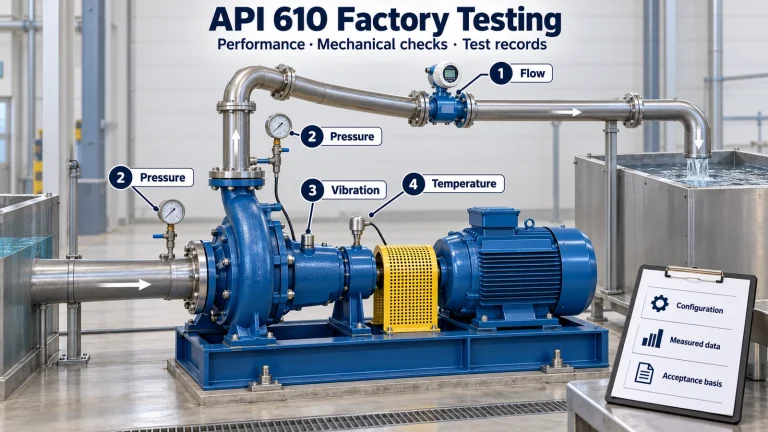
- Actual flow, suction pressure and discharge pressure.
- Speed, motor current or input power.
- Liquid composition, temperature, density and viscosity.
- Vibration and bearing temperature at repeatable locations.
- Seal, lubrication and leakage condition.
- Current impeller diameter, clearances and material.
- System curve, control-valve position and bypass flow.
- Maintenance records and available drawings.
For hazardous or corrosive services, use the site’s approved safety and measurement procedures. Do not ask operators to collect data from unsafe equipment. A system assessment should document its boundary, baseline, assumptions and recommended actions; it does not automatically establish guaranteed savings.
When the shortlist is ready, use the pump system assessment and measured-baseline guide to plan the next engineering step.
After validating the opportunity, review practical pump system optimization measures before selecting an intervention.
When Prescreening Leads to an ANSI Pump Replacement Review
Optimization may involve controls, piping, impeller trim, alignment, lubrication, seal selection or a complete pump replacement. For a Goulds 3196 or Durco Mark III replacement, compare dimensional, mechanical, hydraulic, material and operating compatibility separately.
- Casing and nozzle dimensions.
- Shaft, bearing frame and mounting.
- Impeller diameter and duty point.
- Seal chamber and mechanical seal.
- Wetted material and corrosion conditions.
- Motor power, speed and coupling.
- NPSH, temperature, viscosity and solids.
Dimensional interchangeability can reduce installation work, but it does not automatically prove equal hydraulic performance or suitability for a changed process. Use drawings, measurements and operating data before ordering. For the detailed compatibility evidence list, see the ANSI pump interchangeability guide.
Practical Prescreening Workflow
- Build the pump register and mark unknown data.
- Rank pumps by criticality, operating hours and maintenance history.
- Identify throttling, bypass and uncertain duty points.
- Use baseline measurements to validate the shortlist.
- Estimate the business case using measured data.
- Choose the least-complex corrective action that solves the verified problem.
- Document the result and update the pump register.
Need help screening a pump population?
Send a pump list, model information, operating data or maintenance history. ANSI Pumps Pro can help identify which ANSI pump positions need a deeper fitment, material or reliability review.
Frequently Asked Questions
What is pump prescreening?
Pump prescreening is a structured way to rank a group of pumps before detailed testing or engineering. It uses criticality, operating data, control method, maintenance history and duty uncertainty to select the best candidates for follow-up.
Is a large motor automatically a high-priority optimization candidate?
No. Motor size is only one screening factor. Operating hours, actual load, control method, process criticality and maintenance history should also be considered.
Does throttling always mean a pump should be replaced?
No. Throttling may be required for process control or protection. Confirm the operating range, minimum-flow requirement, system curve and control objective before changing the pump or control method.
When should a prescreened pump receive a replacement quotation?
Request a replacement review when measurements show a persistent duty or reliability problem, existing components are worn or unavailable, or a Goulds 3196 or Durco Mark III position needs documented fitment and material confirmation.
Technical Sources
- ISO/ASME 14414:2019, Pump system energy assessment. Use this as a system-assessment reference, not as a savings guarantee.
- ANSI/HI 9.6.3-2024, Rotodynamic Pumps — Guideline for Operating Regions. Consult applicable pump data and manufacturer recommendations.
- Hydraulic Institute: Pump optimization and energy-efficiency assessment
- Hydraulic Institute: ANSI/HI 9.6.5 condition monitoring