Start With the Acid, Not the Pump Type
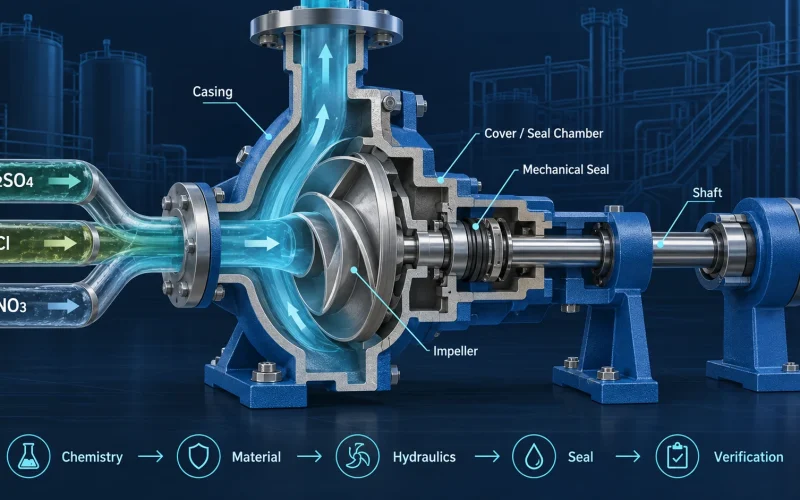
An acid transfer pump is selected from the chemistry and operating envelope, not from a generic “acid pump” label. Start with the exact acid or mixture, concentration range, normal and maximum temperature, impurities or contaminants, oxidizing or reducing condition, chlorides or fluorides where relevant, solids, specific gravity, viscosity, vapor pressure, aeration or gas release, and startup, shutdown, cleaning and upset conditions.
Define normal, minimum and maximum flow, TDH or pressure, suction condition and NPSHa as well. Dilution, batch changes and temperature excursions can change the material, seal and hydraulic review. A chemical name by itself is not a material specification.
Which Acid Transfer Pump Type Fits the Duty?
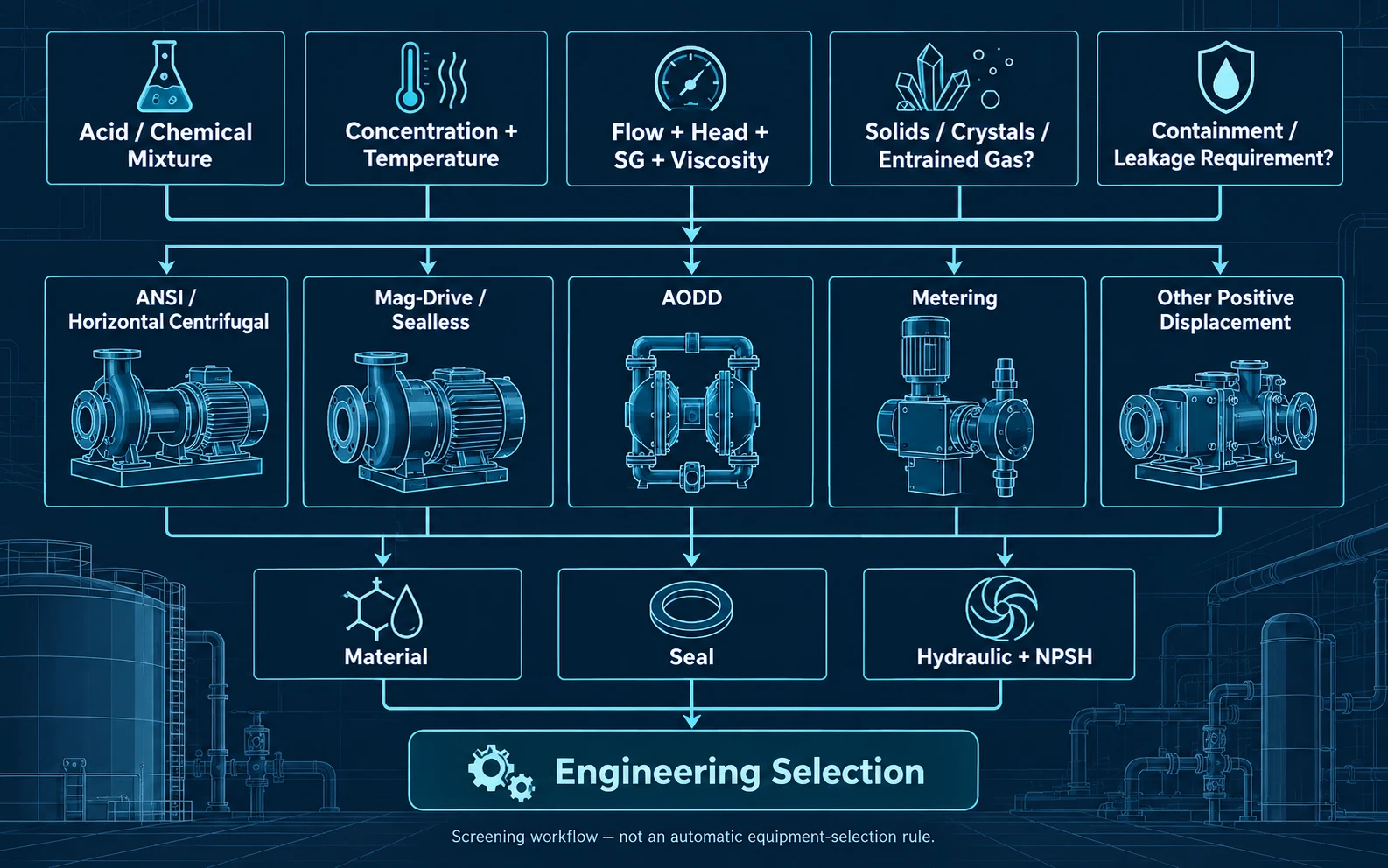
Different technologies can be reasonable starting points for different duties. The comparison below is a screening aid, not a universal ranking of safety or suitability.
| Pump type | Common reason to evaluate | Main verification points |
|---|---|---|
| ANSI / horizontal centrifugal process pump | Continuous process transfer, established hydraulic duty, metallic construction | Curve, NPSH, material, seal, pressure boundary and full operating range |
| Mag-drive / sealless | Eliminate a dynamic shaft seal where containment is a priority | Dry-run limits, solids, containment shell, heat generation and material limits |
| AODD pump | Intermittent transfer, self-priming needs or certain solids and utility duties | Diaphragm material, air quality, pulsation, efficiency and hazardous-area requirements |
| Metering pump | Controlled low-flow injection or dosing | Pressure, turndown, pulsation, check valves and diaphragm or plunger materials |
| Other positive-displacement pump | Viscosity or application-specific reasons | Lubricity, relief protection, clearances, materials and leakage containment |
Acid and Material Screening
Material screening should identify the variables that control corrosion and mechanical integrity without turning a general trend into a blanket approval. Alloy family, product form, welds, castings, velocity, contaminants and the rest of the wetted system all matter.
| Acid service | Critical variables | Material families commonly evaluated | Main caution | Final verification |
|---|---|---|---|---|
| Sulfuric acid (H2SO4) | Concentration, temperature, velocity, aeration and contaminants | Alloy 20 / CN7M, selected nickel alloys, selected stainless grades at limited conditions and fluoropolymer systems | Corrosion behavior changes sharply with concentration and temperature | Exact condition, corrosion data and casting grade |
| Hydrochloric acid (HCl) | Concentration, temperature and oxidizing contamination | Selected nickel alloys such as C-family grades, fluoropolymer systems and application-specific materials | Austenitic stainless resistance can deteriorate severely; contamination changes behavior | Exact concentration and temperature plus corrosion-rate/source data |
| Nitric acid (HNO3) | Concentration, temperature and oxidizing strength | Selected stainless grades, titanium in applicable conditions and fluoropolymer systems | Reducing-acid assumptions cannot be transferred directly to nitric acid | Exact chemistry, grade and source data |
| Phosphoric acid | Purity, temperature, fluoride/chloride content and solids | Alloy 20, selected stainless or nickel alloys and non-metallic systems | Wet-process acid may contain impurities or solids that change behavior | Impurity analysis and exact condition |
| HF / special mixed-acid service | Concentration, temperature, water content and impurities | Application-specific metallurgy or fluoropolymer system after engineering review | High consequence of incorrect generic material selection | Manufacturer or material-vendor-specific review |
Screening only — not a corrosion guarantee. Final metallurgy must be confirmed against the exact acid composition, concentration, maximum temperature, contaminants, velocity, material grade/form and the complete wetted system.
For a deeper sulfuric-acid discussion, see impeller material selection for sulfuric acid service. That dedicated article should be used for its source-backed examples rather than copied into this guide.
Specific Gravity and Motor Power
For a controlled U.S. customary comparison, the simplified brake-horsepower relationship is:
Q is flow in US gpm; H is total dynamic head in ft; SG is liquid specific gravity relative to water; and ηpump is pump efficiency as a decimal. NIOSH lists SG = 1.84 for sulfuric acid at 96–98% concentration; this is a reference value, not a substitute for the supplier’s property data at the actual concentration and temperature. At the same Q, H and assumed efficiency, shaft power scales with SG.
Use the selected pump curve and verified fluid-property data for driver sizing. Do not transfer this reference SG to another concentration or temperature.
If Q, H and pump efficiency are held constant, the shaft-power term scales approximately with SG. Actual selection must still account for the pump curve, efficiency, viscosity effects, operating range, startup conditions and driver requirements. Do not reuse the example SG for another concentration or temperature without verified property data. For the underlying calculation context, see how specific gravity affects centrifugal pump power.
Mechanical Seal and Leakage Containment
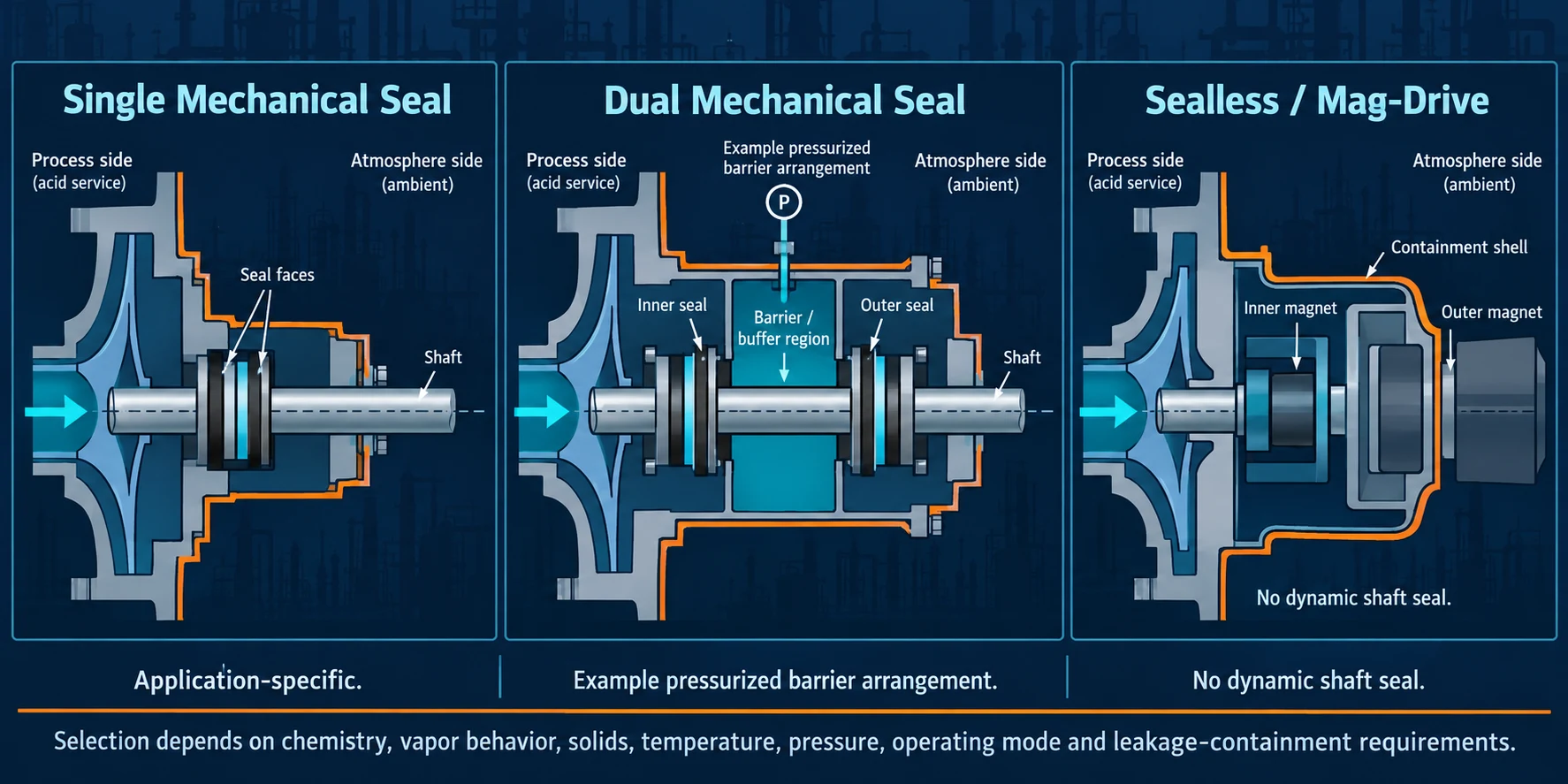
Single mechanical seal
A single seal may be appropriate when process compatibility, leakage policy, pressure, temperature, seal chamber geometry and seal materials support that arrangement. It is an application decision, not the default answer for every acid.
Dual mechanical seal
A dual arrangement may be evaluated when containment objectives or process conditions lead the project and seal engineer to specify it. The barrier or buffer system, monitoring, pressure relationship and support equipment must be reviewed as a complete system.
Sealless / mag-drive
Sealless designs can eliminate a dynamic shaft seal, but dry-running, solids, temperature, containment-shell heat generation and design limits still require verification.
Where API Seal Support Plans Enter the Review
Plan 11 is a discharge-to-seal-chamber flush arrangement using process fluid. It must be evaluated for process cleanliness, vapor-pressure margin and the selected seal system. Plan 53A is a pressurized external reservoir or barrier-fluid system for a pressurized dual-seal arrangement. Plan selection depends on fluid properties, solids, vapor behavior, seal arrangement, pressure, temperature, containment objectives and seal-vendor or project requirements.
These descriptions are conditional examples, not default prescriptions for a chemistry or pump. Seal faces, elastomers and secondary seals remain application-specific, and the complete support system must be reviewed with the seal vendor and project requirements.
NPSH, Suction and Installation Review
Review vapor pressure at the actual temperature, NPSHa, suction losses, tank level or static head, suction-line restrictions, entrained gas or gas release, startup and shutdown, dilution or batch changes, drainage, containment, flushing, ventilation, isolation, alignment and maintenance access.
Do not publish or rely on a universal required NPSH-margin number without a defined standard, pump or vendor criterion and project basis. Follow the approved SDS, PHA, site procedure and chemical-handling controls. Pump selection does not replace process-safety review.
When an ANSI B73.1 Process Pump Fits Acid Service
ASME B73.1 is relevant when the duty is compatible with a horizontal, end-suction, single-stage chemical-process pump and the selected pump meets the required hydraulic, NPSH, material, seal, pressure-boundary and installation conditions.
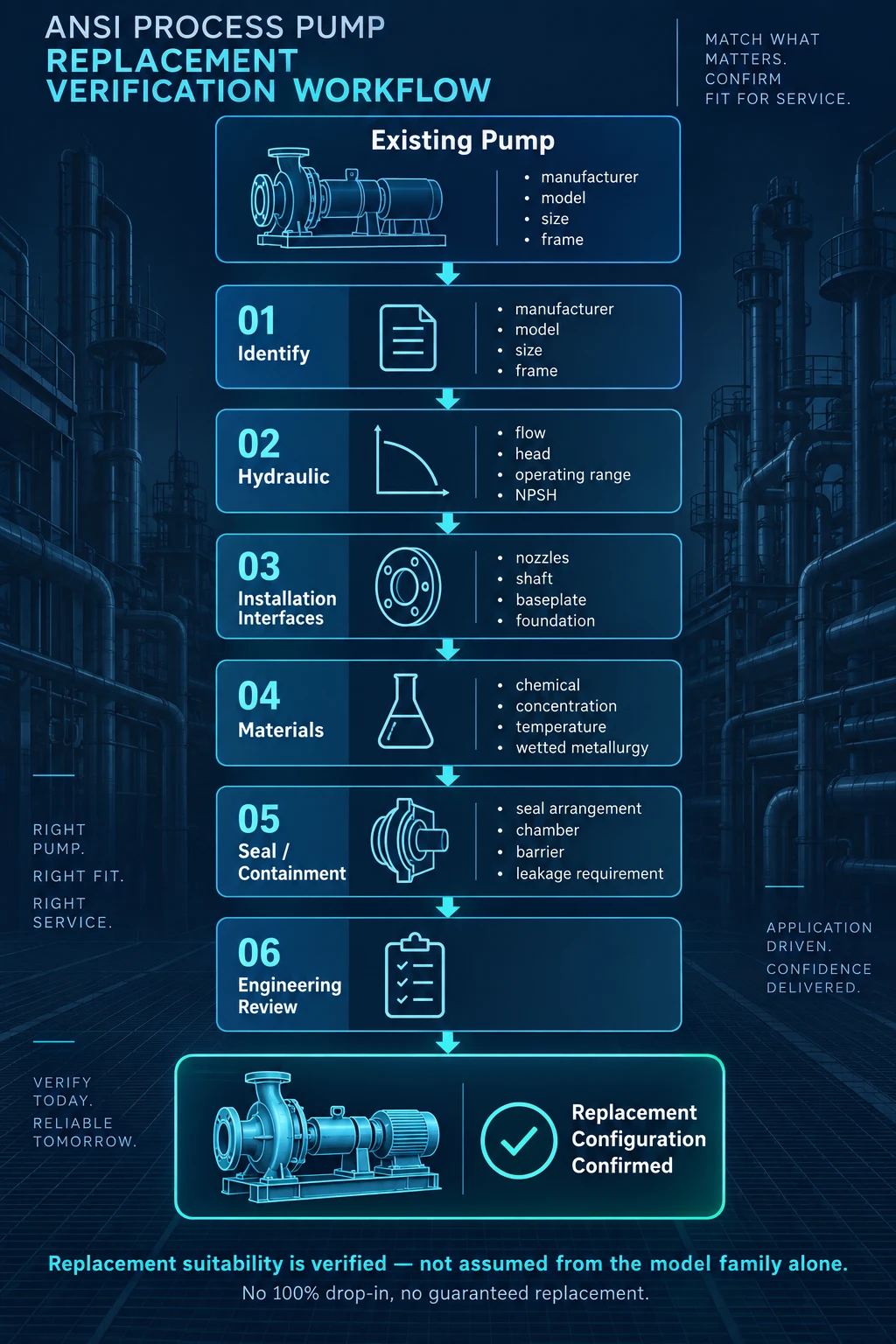
B73.1 includes dimensional interchangeability requirements for pumps sharing the same standard dimension designation. Relevant dimensions include mounting dimensions, suction and discharge nozzle size or location, input shaft, baseplate and foundation bolt holes. B73.1 conformity by itself does not prove that different OEM internal parts, seal systems or hydraulic curves are universally interchangeable.
Replacing an Installed ANSI Process Pump
Do not approve a replacement from the model family alone. Use this verification chain: existing model → frame / size → duty → installation interfaces → metallurgy → seal arrangement → replacement verification.
An installed Goulds 3196 or Durco Mark III can be reviewed for a replacement configuration, but the actual frame, size, interfaces, duty, materials and seal arrangement must be checked before quotation and release. Start with the existing Goulds 3196 replacement pump or Durco Mark III replacement pump page when those model families are in scope.
Acid Transfer Pump Selection Checklist
Fluid
- Chemical or mixture and concentration
- Normal and maximum temperature
- Contaminants, solids, SG, viscosity and vapor pressure
Hydraulic
- Normal, minimum and maximum flow
- TDH or pressure and suction condition
- NPSHa and speed if known
Pump and mechanical
- Pump type, wetted material and pressure boundary
- Seal or containment requirement
- Motor, hazardous-area and installation/interface requirements
Existing equipment and documentation
- Manufacturer/model, size/frame, nameplate and GA drawing
- Current material, seal arrangement and failure evidence
- Material certification, inspection/test requirements and project specification
Related engineering references: review viscosity correction limits; compare Alloy 20 and Hastelloy for chemical service; calculate the system total dynamic head.