
Why Sulfuric Acid Is Not a Single Corrosion Environment
“Sulfuric acid” is not enough information to approve a pump material. The same alloy can behave differently as H₂SO₄ concentration, temperature, impurities and flow conditions change.
For a first engineering screen, separate the chemical environment from the mechanical environment. Use the chemical compatibility and resistance guide as a screening reference, then verify the actual service condition. Concentration and temperature establish the basic corrosion condition; chlorides, fluorides, oxidizing/reducing contaminants and aeration can change the mechanism again. Velocity, solids, cavitation and recirculation then add erosion or erosion-corrosion to the problem.
Define the Complete Process Envelope Before Comparing Materials
Dilution and upset cases matter. A system that normally handles concentrated acid may pass through a more corrosive intermediate concentration during water addition, flushing or startup. Review the full operating path, not only the steady-state product specification.
Alloy 20 / CN7M: Where It Enters the Shortlist
Alloy 20 (UNS N08020) was developed for aggressive acid service and is well known for sulfuric-acid resistance. Carpenter Technology describes its 20Cb-3® Alloy 20 as having excellent resistance to hot sulfuric acid and notes strong resistance to stress-corrosion cracking in boiling 20–40% sulfuric acid.
That does not create a universal approval envelope for a pump. Actual corrosion behavior still depends on concentration, temperature, impurities, aeration, velocity, deposits and fabrication condition. For cast pump components, a related casting grade such as CN7M may enter the discussion, but the wrought alloy name and cast grade must not be treated as interchangeable purchasing descriptions. For a deeper alloy-to-alloy comparison, see the Alloy 20 vs Hastelloy C-276 material selection guide.
C-276 Family: Use Published Corrosion Data, Not the Alloy Name Alone
Wrought C-276 (UNS N10276) is frequently shortlisted for aggressive mixed or contaminated acid service because of its broad corrosion resistance. But “C-276” should not be converted into a single safe concentration or temperature limit.
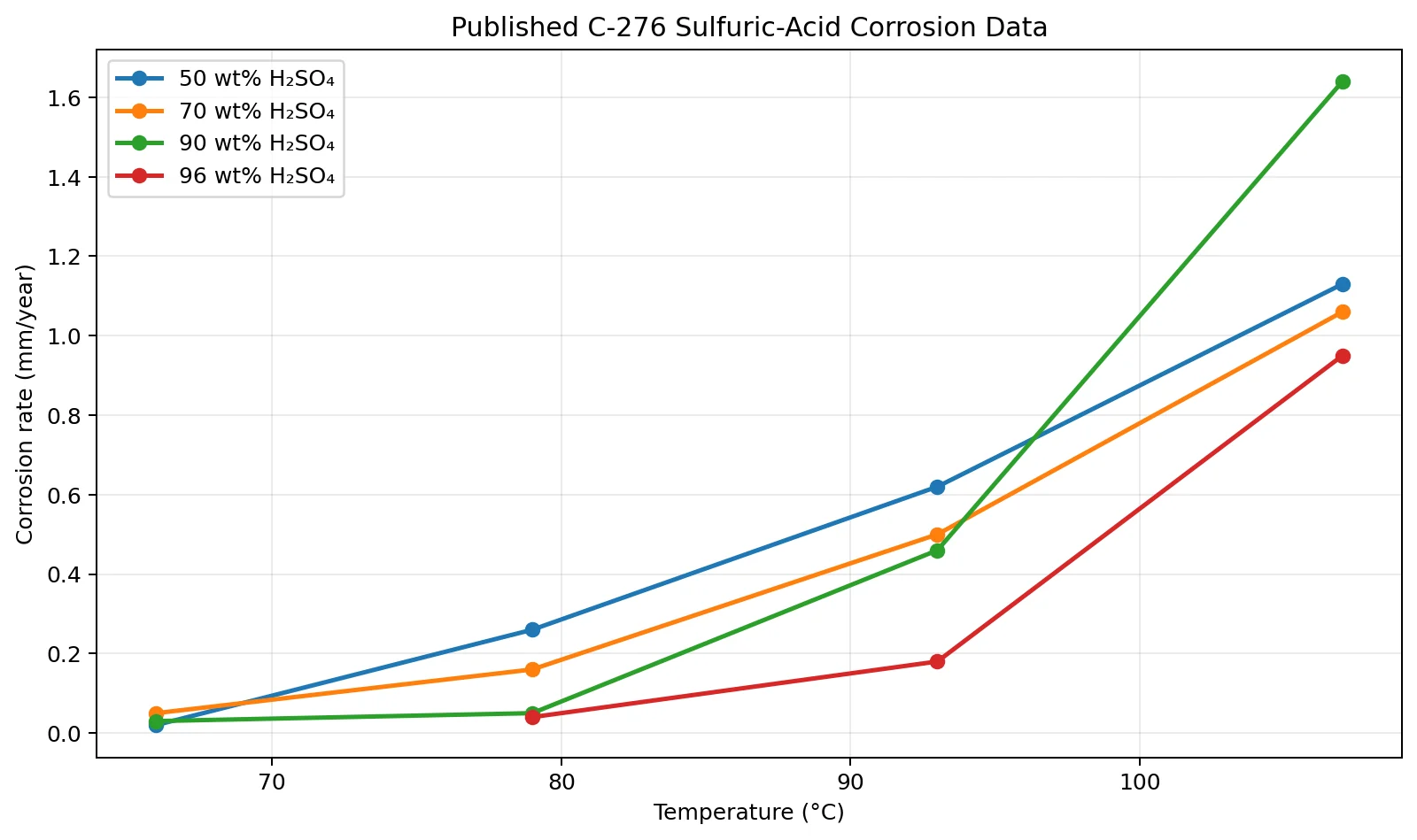
The table below uses selected HASTELLOY® C-276 laboratory data published by Haynes International for reagent-grade sulfuric acid. Every corrosion rate remains tied to a specific concentration and temperature.
| H₂SO₄ | 66°C / 150°F | 79°C / 175°F | 93°C / 200°F | 107°C / 225°F |
|---|---|---|---|---|
| 50 wt% | 0.02 mm/y | 0.26 mm/y | 0.62 mm/y | 1.13 mm/y |
| 70 wt% | 0.05 mm/y | 0.16 mm/y | 0.50 mm/y | 1.06 mm/y |
| 90 wt% | 0.03 mm/y | 0.05 mm/y | 0.46 mm/y | 1.64 mm/y |
| 96 wt% | — | 0.04 mm/y | 0.18 mm/y | 0.95 mm/y |
Source: Haynes International. Tests were performed in reagent-grade acids under laboratory conditions; Haynes encourages field testing before industrial use. “—” means no value shown for that condition in the cited table.
PVDF: Excellent Chemistry Can Still Have Mechanical Limits
PVDF is resistant to many inorganic acids, and manufacturer data show that sulfuric-acid concentration capability changes with temperature. AGRU’s published PVDF guidance includes a concentration-versus-temperature curve and explicitly identifies fuming sulfuric acid as unsuitable for PVDF.
That is a reminder that “chemical compatibility” is only one part of pump selection. A PVDF pipe, liner or molded pump casing has a different mechanical design basis from a metallic ANSI B73.1 process pump. Pressure-temperature rating, creep, nozzle loads, joint design, thermal cycling and actual product construction must be checked separately.
Chemistry
Use the resin/product manufacturer’s chemical-resistance data at the actual H₂SO₄ concentration and temperature.
Pressure–temperature
Confirm the rated product, geometry and service duration. Do not transfer a pipe rating directly to a pump casing.
Mechanical construction
PVDF pump architecture is not automatically dimensionally or mechanically equivalent to a metallic ANSI B73.1 wet end.
Do Not Treat Wrought Alloy Names and Cast Pump Grades as Automatic Equivalents
UNS N08020 → cast grade must be specified
Wrought Alloy 20 / UNS N08020 is not a complete casting specification. CN7M is a cast grade associated with sulfuric-acid pump and valve service, but the exact ASTM purchasing specification and component requirement must be stated.
UNS N10276 → do not infer one cast grade
C-276 identifies a wrought composition. Cast grades such as CW2M or CW12MW have their own UNS chemistry and should not be presented as automatic one-to-one equivalents without the project/casting specification.
Material Screening Matrix
This matrix deliberately avoids universal temperature or concentration limits. It shows what evidence should control the screening decision.
| Decision factor | Alloy 20 / CN7M family | C-alloy family | PVDF |
|---|---|---|---|
| Material form | Metallic; distinguish wrought vs cast | Metallic; exact wrought/cast chemistry matters | Polymer / lined / nonmetallic construction |
| Sulfuric-acid evidence | Use condition-specific corrosion data for exact grade/form | Use condition-specific corrosion data; do not rely on family name | Use chemical chart + product P/T data |
| Contaminants | Review chlorides, fluorides, oxidizers/reducers and aeration | Often shortlisted for severe mixed chemistry, but still condition-specific | Review chemical resistance and stress-cracking risks |
| Velocity / erosion | Check erosion-corrosion in high-velocity/solid-bearing zones | Check corrosion + erosion together | Mechanical erosion and solids can control life |
| Pressure / temperature | Pump/component design + material properties | Pump/component design + material properties | Strongly product- and temperature-dependent |
| ANSI replacement fit | Can be engineered in metallic ANSI wet ends where documented | Can be engineered in metallic ANSI wet ends where documented | Usually a different construction; do not assume drop-in fit |
| Final approval | Exact grade + evidence + full wetted assembly | Exact grade + evidence + full wetted assembly | Exact resin/product + chemical chart + P/T rating + mechanical design |
Velocity, Solids and Erosion-Corrosion Can Change the Result
A static corrosion coupon does not reproduce the local velocities and turbulence inside a centrifugal pump. The impeller eye, vane passages, cutwater region and recirculation zones can experience different hydraulic severity from straight piping or stationary immersion tests.
Nickel Institute literature on CN7M notes that some failures historically described as intergranular corrosion were actually erosion-corrosion. A material that looks acceptable on a chemistry-only chart can still lose life rapidly if high velocity, entrained solids or cavitation repeatedly remove the protective surface condition.
Mechanical Seal and Secondary Materials Are a Separate Selection Decision
The casing alloy does not automatically determine the seal plan. Sulfuric-acid concentration, leakage consequence, cleanliness, solids, crystallization risk, vapor conditions, seal-chamber pressure, utilities and containment philosophy all affect the seal arrangement.
FFKM may be a candidate in severe acid exposure, but the exact compound matters. A generic elastomer family name is not enough to approve a seal for concentrated sulfuric acid at elevated temperature.
How Material Choice Changes an ANSI B73.1 Wet End
Do not stop at the casing. The material decision should cover every process-exposed component and every interface whose failure can release the liquid or change fitment.
For this site’s current parts scope, commercial links should focus on casing, cover, impeller, shaft and selected metallic mechanical-seal components rather than implying every seal consumable or every polymer wet end is supplied.
Material Selection Still Has to Fit the Installed Pump
An alloy that is chemically suitable is not automatically a valid replacement. For an installed ANSI pump, confirm the existing model/size, nozzle and mounting interfaces, impeller geometry, seal-chamber arrangement, shaft/power-end interfaces, hydraulic duty and material specification.
Goulds 3196 replacement
Use the dedicated 3196 route when the installed configuration must be cross-checked for complete pump, wet-end or supported component fitment.
Durco Mark III replacement
Use the Mark III route where group, impeller configuration, rear cover, seal chamber and power-end relationships must be verified.
Exotic-alloy ANSI process pumps
Use the high-alloy product route as a commercial entry point, but keep final metallurgy tied to actual process evidence rather than a universal alloy ranking.
What to Send for a Sulfuric-Acid Material Review
Sulfuric Acid Pump Material FAQ
Is Alloy 20 always the best material for sulfuric-acid pumps?
No. It can be an important candidate for selected services, but concentration, temperature, contaminants, velocity, exact material form and the full wetted assembly must be reviewed.
Is CN7M the same as wrought Alloy 20 / UNS N08020?
No. They are related corrosion-resistant material choices, but wrought Alloy 20 and a cast grade such as CN7M are different product forms/specifications.
Is C-276 automatically better than Alloy 20?
No. C-276 has broad corrosion resistance, but published data still change with concentration and temperature. Cost, casting route, contaminants and actual component design also matter.
Can PVDF be selected from a chemical-resistance chart alone?
No. Chemical compatibility must be combined with the exact product’s pressure-temperature capability, geometry, load path, thermal cycling and mechanical construction.
Do MTR and PMI prove suitability for sulfuric acid?
No. They verify identity and traceability. Suitability still depends on the process environment, corrosion evidence, product form and complete wetted-system design.
Technical Sources
- Haynes International — HASTELLOY® C-276 sulfuric-acid corrosion data.
- Carpenter Technology — 20Cb-3® / Alloy 20 (UNS N08020) sulfuric-acid information.
- Nickel Institute — alloy selection and CN7M guidance for sulphuric-acid service.
- AGRU — PVDF chemical-resistance guidance including sulfuric-acid concentration vs temperature and fuming-acid limitations.
- ASME B73.1 — horizontal end-suction chemical-process pump design/dimensional framework.
- Seal supplier/API-plan documentation — verify against the selected seal arrangement and project specification.
Have a Sulfuric-Acid Pump Material Question?
Send the acid concentration range, normal and upset temperature, contaminants, current pump model/material and any failure evidence. We can identify which material, wet-end and replacement interfaces should be verified before quotation.