
Unusual Pump Noise Is a Symptom, Not a Diagnosis
A new crackle, rumble, squeal or rhythmic pulse can come from the pump, driver, piping or a changed operating condition. The sound can help narrow the investigation, but it cannot prove cavitation, bearing damage or the need for replacement by itself. Record when the noise occurs and compare it with pressure, flow, temperature, speed, vibration and maintenance history before choosing an intervention.
For an older ANSI process pump, the decision is whether the equipment can return to stable service after a system correction or defined repair, or whether a verified component or complete-pump replacement should be reviewed. This guide provides an initial triage path; it does not replace site procedures, the pump IOM or a condition-monitoring assessment.
Useful first question: What changed at the same time as the noise — liquid level, temperature, flow, valve position, speed, piping, maintenance or another pump in parallel?
Make a Repeatable Observation Before Inspecting
Follow plant operating and process-safety procedures. Do not approach an exposed coupling, remove a guard, open a pressurized casing or loosen a live pipe connection to investigate sound. Intrusive inspection requires the applicable isolation, depressurization, draining, lockout/tagout and hazardous-fluid controls.
From a safe observation point, record the sound description in consistent terms, its location, whether it is continuous or intermittent, and the operating state when it starts or changes. Note recent work or process changes. If readings are taken, record the instrument, units, measurement location and whether conditions were stable.
On narrow screens, scroll each table horizontally to read all columns without compressing the inspection details.
| Record | Why it matters | Useful context |
|---|---|---|
| Sound and location | Provides a repeatable symptom description and helps compare pump, bearing housing, driver and connected piping. | Start time, load state, continuous or intermittent, and whether the noise is stronger at one location. |
| Hydraulic condition | Connects the symptom with the pump’s actual operating point and suction conditions. | Flow, suction and discharge pressure, tank level, liquid temperature, valve position and strainer condition. |
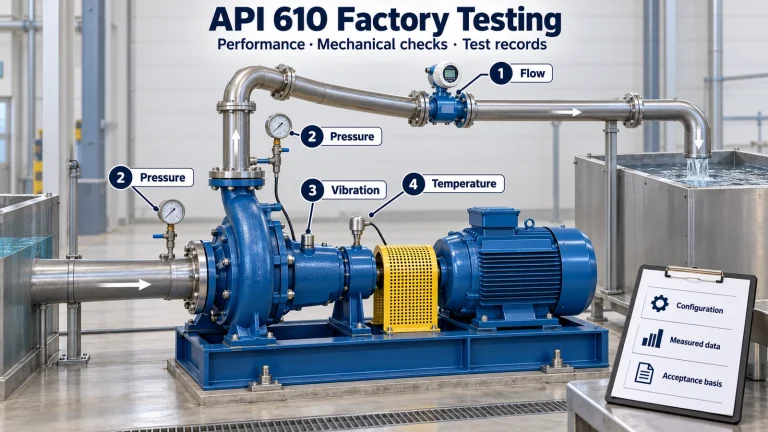
| Mechanical condition | Shows whether the sound coincides with changes in the rotating equipment or support. | Speed, motor current if safely available, repeatable vibration readings, bearing-temperature trend and coupling/base history. |
| Recent changes | Often identifies a changed input that preceded the symptom. | Maintenance, alignment, piping or valve changes, VFD settings, process composition and parallel-pump operation. |
Compare readings only when the equipment is at a comparable operating condition. A temperature or vibration number without its location, operating state, measurement method and equipment baseline may be difficult to interpret.
Compare the Sound With Other Evidence
The patterns below are investigation prompts, not one-to-one diagnoses. Similar sounds can arise from different faults, and hydraulic and mechanical issues can occur together.
| What is heard | Other evidence to compare | Next diagnostic direction |
|---|---|---|
| Crackling or gravel-like noise | Does it change with flow, liquid level, temperature or suction pressure? Is performance unstable or reduced? | Review suction restrictions, air ingress, liquid vapor-pressure conditions and the applicable pump curve. See the cavitation diagnosis guide and NPSH and operating-regions guide. |
| Steady rumble or growl | Is vibration or temperature trending upward at a repeatable bearing-housing location? Does the indication follow speed or operating load? | Review lubrication, bearing condition, alignment, looseness, foundation and hydraulic loading. Use the pump vibration troubleshooting guide for measurement and analysis. |
| High-pitched squeal or rubbing sound | Did it follow maintenance, a change in seal support, dry running, a temperature change or evidence of contact? | Have qualified personnel assess seal, bearing and rotating/stationary clearances under the correct isolation procedure. Use the exact pump and seal documentation. |
| Rhythmic pulse, thump or fluctuating sound | Does it coincide with pressure or flow fluctuation, a valve/control change, a repeated mechanical event or a piping/support change? | Check for hydraulic instability, recirculation, driver or structural response, and piping effects. Compare actual operation with the pump-specific approved curve and operating region. |
Do not diagnose by a fixed sound frequency or temperature threshold. Bearing characteristic frequencies depend on the installed bearing geometry and speed. Temperature limits depend on the bearing, lubricant, load, measurement location and application. Use the equipment baseline, manufacturer instructions and the site’s approved monitoring limits.
Follow the Evidence to the Next Check
Use this sequence to decide which technical review is needed. It is a triage aid, not an instruction to adjust a running system or dismantle equipment.
Describe the sound, location, start time and operating condition. Capture comparable readings where safe.
Check whether the symptom changes with flow, suction conditions, liquid temperature, speed, load or a recent system change.
Hydraulic clues → suction, NPSH and operating-region review. Bearing or rotating clues → repeatable condition-monitoring measurements. Installation clues → piping, support and alignment review.
Use the applicable curve, IOM, seal documentation, measurement baseline and site procedure before planning an adjustment or inspection.
ANSI/HI 9.6.4 addresses vibration measurement and allowable values for defined pump and test conditions; it is not a universal alarm setting or a root-cause chart. For monitoring methods, see ANSI/HI 9.6.5-2022 and the site’s ANSI/HI 9.6.4-2022 overview. For the pump’s preferred and allowable operating region, use the current ANSI/HI 9.6.3 guidance together with manufacturer data.
Decide Whether to Repair or Review a Replacement
Noise alone is not a reason to replace a pump. A defined repair may be appropriate when the pump and base remain serviceable, the required duty is still valid, and inspection identifies a correctable defect. A replacement review may be warranted when damage is extensive, the duty has changed, repeated repairs have not restored reliable operation, or the required parts and documentation are no longer available.
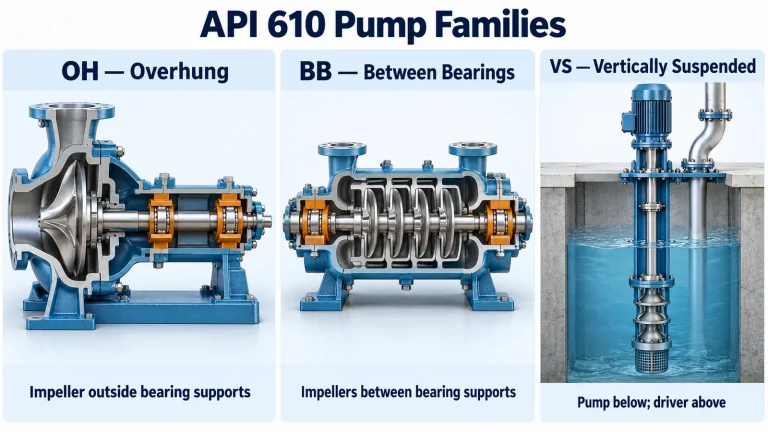
Before selecting a replacement assembly, compare more than external dimensions. Confirm the installed model, size and group; shaft and bearing arrangement; seal chamber; impeller and trim; rotation; materials; driver; connections; operating point and applicable performance curve. ASME B73.1 dimensions alone do not prove that every internal component or hydraulic characteristic is interchangeable; see our guide to dimensional interchangeability versus real compatibility.
| Review area | Evidence to confirm |
|---|---|
| Dimensional | Flanges, centerline, mounting, shaft and coupling interfaces against the installed configuration. |
| Mechanical | Bearing frame, shaft arrangement, seal chamber, rotation, coupling and driver fit. |
| Hydraulic | Required flow and head, speed, impeller trim, power, operating range and NPSH basis at the actual duty. |
| Materials | Fluid composition, temperature, concentration, solids and corrosion conditions. |
| Documentation | Approved drawings, inspection and material records, test scope and applicable manufacturer instructions. |
For model-specific clearance procedures, see Goulds 3196 vs. Durco Mark III impeller adjustment. If the evidence supports a replacement review, continue to the relevant Goulds 3196 or Durco Mark III replacement route and verify the exact scope.
Frequently Asked Questions
Does a gravel-like sound prove that a pump is cavitating?
No. It can be a clue, but air ingress, recirculation, debris and other hydraulic or mechanical conditions can create similar noise. Compare the sound with suction conditions, liquid temperature, flow, pressure and performance data before drawing a conclusion.
How can I distinguish bearing noise from cavitation?
Do not rely on the sound alone. Compare repeatable measurements at appropriate pump and driver locations with the operating point, suction data, temperature trend, speed and equipment history. If vibration analysis is needed, use the correct bearing and pump information and a qualified diagnostic process.
Should I change a valve position to see whether the noise stops?
Do not use an improvised valve change as a universal diagnostic test. Any operating change must be approved for the process and equipment and follow site procedures. Record the original condition first, and have operations or engineering staff determine whether a controlled change is appropriate.
Does unusual noise mean an old pump should be replaced?
No. First identify whether the cause is in the system, operating condition, driver or pump. Repair or replacement should follow inspection findings, the required duty, pump condition, parts availability and the verified fit of any proposed replacement.
What information should I collect for an engineering review?
Provide the nameplate and model/size, fluid and temperature, flow, suction and discharge readings, speed, sound description and location, repeatable vibration or temperature records, recent changes, maintenance history, drawings or photographs, and the specific repair or replacement scope under consideration.
Technical Sources
- Hydraulic Institute, ANSI/HI 9.6.4-2022 — Rotodynamic Pumps for Vibration Measurements and Allowable Values; consult the 2024 erratum where applicable.
- Hydraulic Institute, ANSI/HI 9.6.5-2022 — Rotodynamic Pumps Guideline for Condition Monitoring.
- Hydraulic Institute, ANSI/HI 9.6.3 — Rotodynamic Pumps Guideline for Operating Regions.
- Hydraulic Institute, ANSI/HI 9.6.1-2024 — NPSH margin guidance overview.
- Hydraulic Institute Pump FAQs — background on NPSH3 and pump measurements.
Standards and manufacturer instructions apply within their defined scope. Use the current IOM and site-approved procedures for the installed pump and service; this article is an initial decision aid, not a substitute for engineering review.